Category: Community Garden

Community Garden in London SW16 run by Transition Town Tooting. Come down and get your hands dirty!

  • ACE 2019 – A celebration of Transition in Tooting and looking forward…

    On Saturday 2nd March, we held our Annual Celebratory Extravaganza! at Mushkil Aasaan on Tooting High Street. 75 people came from diverse backgrounds, some close to Transition Town Tooting, some coming for the first time, some young, some not so young, all very welcome!

    75 people joined us to celebrate! And look forward together

    It was fun looking back at our activity and seeing how we have worked.

    7 themes of our endeavours emerged:

    Local Food Growing and Cooking

    Outdoor Learning

    Urban Nature and Biodiversity

    Good Change Locally

    Creativity and Imagination

    Low Carbon Living

    Wellbeing and Community Inclusion

    Do you Jellybrella?

    Mushkil Aasaan was decorated in true TTT style with a  displays highlighting specific projects and partners: folks sitting on the Talk / Not Talk bench made by CARAS and TTT; the Community Garden and a partnership project with Gatton School; the Foodival annual community food festival; the buzzing presence of crocheted honeybees illustrated the community & CARAS getting together. We shared the extraordinary Jellybrella – happening now and during the Wandsworth Arts Fringe.

     Looking back

    We celebrated over 20 projects ranging across local food, urban outdoors, outdoor learning, creativity and imagination, wellbeing and community inclusion, good change locally, low carbon living and how all that sits within wider networks. 17 people spoke of these projects, painting a vivid picture of what Transition Town Tooting does, and does in partnership with such a rich array of organisations, just some examples of project partners are the London Beekeepers’ Association, Ravenstone Primary School, CARAS, Wandsworth Oasis, Work and Play Scrapstore, J4Y Scouts and  Furzedown Low Carbon Zone.

    This idea of network and collaboration has grown deeper in recent years and gives context to our work locally as part of a wider movement for change, touched on at the Annual Celebration when Lucy gave us the background on Extinction Rebellion, a growing number of Councils declaring a climate emergency and school children striking for climate. Coupled with that are events such as the CTRLshift Emergency Summit for Change, happening 8th to 10th of May in Stoke, that looks to provide a platform for connection and collaboration across all actors working towards a more sustainable and regenerative future.

    After listening for AGES, we looked forward together…

    Looking forward…

    Richard, Sharon and Chuck,
    TTT’s Acting Secretary
    and Co-Chairs
    The business of the AGM took place, with Richard Couldrey being sworn in as TTT Acting Secretary and Sharon Gray and Chuck Whitehead as Acting Co-Chairs. David Thorne volunteered to continue as TTT’s Treasurer. 
    Why “Acting”, well, we’re changing the way we do things and moving from the Co-Chair model of governance to a “Governance Circle”, including more people, sharing the workload and, hopefully, making it more accessible for YOU to join in!

    How we design together…

    Chuck led us through a simple and fun activity to look forward, as a group, involving pairing up with someone you didn’t know very well and answering 2 questions: What could Transition Town Tooting do in 2019? + What could Foodival look like in 2019?

    Feedback from ACE diverse participants about activities in 2019.

    Even as raw feedback, it’s very interesting and valuable what dozens of people care about and wanted to say at short notice – the activity only lasted 15 minutes or so. It was noticeable that ‘social sustainability’ is very strongly represented. It was also noticeable that the responders were culturally diverse: reflecting Tooting. Read the ideas here.

    Time to enjoy some cake before pack away and look forward to great projects together in 2019…

    Many thanks to Sharon, Chuck, Richard, Eleanor and Hilary for photos!
    The “Talk, not talk” bench makes its way home…
    Turning heads as it goes! 
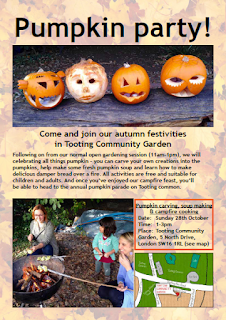
  • Pumpkin Party Sunday October 28th

    Come and join our autumn festivities in Tooting Community Garden!

    Pumpkin Party Poster 2018
    click for pdf poster

    Following on from our normal open gardening session (11am-1pm) this Sunday, we will be celebrating all things pumpkin – you can carve your own creations into the pumpkins, help make some fresh pumpkin soup and learn how to make delicious damper bread over a fire. All activities are free and suitable for children and adults. And once you’ve enjoyed our campfire feast, you’ll be able to head to the annual pumpkin parade on Tooting common!

    We look forward to seeing you!
    Sunday 28th October, 1-3pm 
    Tooting Community Garden, 5 North Drive, London SW16 1RL

  • Tooting Speaks! The big dilemmas of local food

    30 passionate Tooting folk came to The Selkirk (thanks so much Ben and the team!) on Wednesday night to join our 4 fantastic speakers, Kemi Akinola, Robert Biel, Robyn Knight and Sue Sheehan, in wrestling with the big dilemmas of sustainable food systems and what we can do locally. Our title was “Local Food is an Expensive Luxury” and the discussion was hosted by TTT’s co-founder Lucy Neal. If you’re interested in these gatherings, they’re part of our monthly Green Drinks at The Selkirk on the third Wednesday of every month, details HERE.
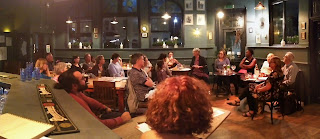
    Local Food is an Expensive Luxury

    But what was it that contextualised food as “local”? Our first speaker, Sue Sheehan (Incredible Edible Lambeth) opened the account with the hyper local – food grown by you as being an active form of protest – claiming the land and building personal resilience for healthy, home grown, cheap veg and against the power of advertising and convenience, after all, gardening is the most “therapeutic and defiant act as you can do” according to the ultimate Guerrilla Gardener, Ron Finley, watch THIS and “plant some shit”. Switch to our second speaker, Dr Robert Biel, Senior lecturer at University College London and author of Sustainable Food Systems – the role of the city and we learn as recently as 1985, with population at 56 million, the UK produced 95% of its food from within its shores… a poignant and powerful statistic, particularly given the risk of a no deal Brexit and the threat that presents of us not being able to feed ourselves, which you can read more about in a recent article by Jay Rayner HERE.

    Read on for LOADS more…

    Zooming up a level, local food systems were championed as methods for plugging the leaky bucket of global finance – keep money circulating more locally through fresh fruit and veg and prepare food, cooked with love and shared in local eateries. Our third speaker, Robyn Knight joined us from Sutton Community Farm who supply 250 vegboxes to customers spread from Kingston to Greenwich. The Farm emphasises the social and environmental benefits of growing by engaging 1500 volunteers who benefit from exercise and socialising for increased wellbeing.

    which brings us to our first major dilemma… MEASUREMENT AND  NARRATIVE.

    Measuring impact in terms of monetary value alone compromises our ability to paint a more accurate picture of the role food plays in the beautiful complexity of life. And yet we’re required to do that to “make ends meet”, to be a “sustainable” business, to apply for and report back on funds. But how do we report back on the surrounding benefits, the positive impact on the wider community or even relieving pressure on the NHS through healthier, more active communities? Thinking beyond money, the language and metaphors become important, they can either “deliver us hope or foreclose possibility“, according to Robert Macfarlane, I’d much rather be opening the doors of possibility when ti comes to the future of food. The expense we talk about in the title of the debate could refer to the perceived prohibitively expensive farmers market produce, or could be juxtaposed next to the abundance of a well run allotment, garden, community garden or balcony, all requiring very little financial input, but a huge amount of time and love.
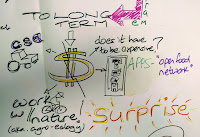
    Back to the debate and Robert Biel went on to talk about luxury as short, sweet, quick hits designed to make us want more. Can luxury be re-framed as being long term and slow, with richer, deeper rewards going beyond $£$money as the only factor in our food choices? Can Community Supported Agriculture schemes and online services such as  Open Food Network transform our food growing systems (maybe a truly long and slow project)? Can we learn to embrace “surprise” gardening – working with natural systems, in all their mess and chaos (from a human point of view) to produce abundance? Agro-forestry, permaculture and agro-ecology come to mind. Plenty to connect with in terms of your practice of growing food and which systems you may want to invest in for the weekly shop.

    This is all very well, but I was hugely grateful for the grounded view given by our fourth Speaker Kemi Akinola, founder of Be-Enriched and local Councillor (although she made clear the views she expressed were for the benefit of debate, the Devil’s Advocate had entered the room) and Co-Chair of both Lambeth food Partnership and Wandsworth food Partnership… Kemi gave a massive high five to Supermarkets, the way perhaps most of us shop for our food, for supplying consistently cheap, accessible food of huge variety and, in terms of the pressure on space in the urban landscape, super efficient. One shop does the lot. You can read more about the global food system HERE.

    Which brought us to our second major dilemma – LAND.


    For more on Land, check out Shared Assets


    In London particularly, land is seen as a driver for the housing crisis, and housing dominates conversation about land use in Town Halls across the Capital. Compare the use of land for food production against the use of land for a high density housing and you can see how challenging it is to fight for community gardens or inner city farms, in the context of the current capitalist regime. You only need to look across the Atlantic to see the effect of plummeting land value on opening up the possibilities for space use, let alone addressing urban food deserts which affect 26.5 million Americans, a staggering stat. Places like Chicago and Detroit, Michigan being recent examples of urban community farms re-valuing space for community benefit, addressing urban inequality and giving access to healthy food, community connection and exercise.

    Back to London and the definition of local that ran throughout the conversation. Scale became important, thinking about the productivity of local growing and the value of peri-urban agriculture. Imagine if it was the norm that we knew exactly where the food we bought was grown and that place was just down the road? However, its not just about local food being grown close to us. Knowing more about the food we eat is key in our decision making as food consumers. Ethical and sustainable choices are hard to make and often are a challengeable viewpoint at best. Would you support small local businesses over a globalised meat-free diet? How would you decide between packaging free and high provenance food choices? The Supermarkets may work to a globalised, season-less standard, but at least most food products are fully labelled as to where the food originates, empowering the consumer to make an informed choice. Audience member Jenny Teasdale even cited that lamb from New Zealand had a smaller carbon footprint than lamb raised in the UK, there’s an interesting article HERE outlining some of the research supporting this argument, I’d heard the same about apples (ah yes, the year round crop… fresh breaburns in January anyone?).

    Back to Tooting…  and we have just organised our 11th Annual Foodival, a celebration of what we can grow, cook and eat locally. David Thorne, one of the team of 5 who co-organise the event this year, reflected that this fundamental message behind Foodival was difficult to make stick with many of the 600 folks who attend. That’s not to belittle this fantastic event that brings all the communities of Tooting together in a spirit of celebration and food. Maybe some are just after a cheap plate of nosh.

    Which brings us to our third dilemma… CHEAP AND ACCESSIBLE VS “LOCAL” AND “SUSTAINABLE”

    This maybe a red herring and certainly harks back to Kemi’s point about Supermarkets. It wasn’t that long ago that Lidl and Aldi came over, offering substantially cheaper brands that we didn’t recognise and wonderfully random offers down at Lidl-de-Aldi-Lidl-Aldi-Lidl-de-Aldi dee. The reality of a lot of people’s lives right now is that the shopping needs to be quick, accessible, cheap. There are bellies to feed, demanding jobs to work and, some might say, equality to reach.

    But does local and sustainable need to be expensive and inaccessible?

    Our biggest dilemma of the night had entered the room… HOW DO YOU (S)MASH THE SYSTEM?

    We’d talked a lot about being active, one of NEF’s 5 ways of wellbeing, and most of the room had in

    some way taught or shared the joy of growing food with others. We’d talked about the multitude of benefits community gardening and local growing gives and the idea of communicating that, when measurement is challenging. And we’d shared another Foodival story of family food culture being expressed in a Top Tooting Cook entry using locally grown ingredients to make an award winning Indian dish – a true Tooting cultural mash-up. You could feel this sense of wanting to smash the silos and create a systemic shift towards true value beyond monetary cost, critically based in reality and meaningful for all.

    Finally, lets unpack that word “value”. Perhaps this word pushes against the “luxury” of our title, encouraging us to think more in the longer term using regenerative, circular practices rather than linear, wasteful ones. Value as regenerative refers to the social, economic and environmental – we heard about the value of social interaction at Sutton Community Farm, mirrored at Community Farms and gardens across the Capital and beyond. We heard about the value of exercise and connection to nature, so powerful some Doctors prescribe it for to aid Patient recovery. We heard about the value of organic food practices for the Earth, re-building soil layers so depleted by intensive, industrial scale agriculture (we are literally running out of soil, some would argue). Finally, we heard about the value of local food and the systems that support it – farms, shops and customers – meaning that money becomes a bit more sticky to neighbourhoods, providing more opportunity to stabilise local economies.
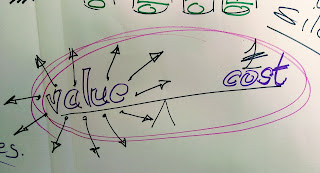
    And perhaps that’s the challenge at the heart of the debate, for us all to enact change based on the wider value of food for us, our Communities, and our future food systems. Kemi, Sue, Robyn and Robert were asked for their call to action and here’s what they said…

    Take responsibility in your choices, be informed and be active.
    Simply eat more vegetables than you do now.
    How are you spending your money? Spend it a bit more on food and bit less on stuff.
    Where are the growing spaces? Get involved in creating and supporting more.
    Work on the beautiful complexity by linking up social and environmental practice through projects.
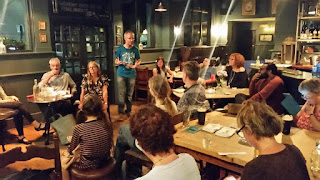
    Thanks for coming, folks!

    And finally… here’s some additional resources passed on from Robyn and Kemi:

    The Landworkers Alliance
    Community Food Growers Network
    Capital Growth
    Greenwich Community Development Agency

    Kemi can be found on Twitter here @BeeKemiA
    Sue can be found on Twitter here @GreenCChampion

    “I’d never seen a ready meal until I came from Austria to live in England in 2000”

  • The fabulous OaKomotion! Carnival promenading in Furzedown: re-imagining, movement & change

    Ten days ago the fabulous OaKomotion! travelling Carnival promenaded all round Furzedown.

    The whole amazing sunny event was based on the sucess of the Furzedown Oak Community Project. 
    In the Project community artists and host groups adopted sections of the large American Oak felled locally. Then they created sculptures to give the oak a rich and longer life. Read all about the Project here!


    Oakomotion! started at 10:30 on Sunday 24th June outside Sprout Community Arts. As Fio Adamson says: 
    “As soon as Vince and the Never Wilbies started playing outside Sprout at 10.30 on Sunday morning I realised that music in the streets is all we need to complete the Furzedown dream.”
    Read about the whole carnival day in Fio’s report – read or download here.

    Tooting Community Garden hosted the last part of the day. Fio writes:
    “A secluded dream-place with bees buzzing, veggies growing and flowers greeting the sunshine.  The Bean Dragon made by myself and 80 others still lives and should live there for many years to come. Remember the Big Day Out 2016, Dahomey Road street party and the Foodival the same year? – yes,  you too probably chipped away then at the big piece of Oak and helped it on its way.”

    Here’s the oak Bean Dragon – part bench, all magic:

    Below there’s the new Community Garden table made with young refugees and asylum-seekers from the Tooting charity CARAS.
    It’s inscribed in many languages with messages of welcome, and all were invited to add more. When there was no more room on top it was the turn of the table legs to be decorated. Come and see the Dragon and the table any Sunday from 11-1 when the Garden is open to all.

    Really the whole day was about re-imagining, movement and change,
    from a felled tree to some beautiful living sculptures; 
    from all corners of Furzedown to our hidden but accessible oasis. 
    Thanks to Fio and all the OaKomotion! team.
    Here’s the dancing finale in the garden:

  • November update on our ‘Gardens of Refuge’ refugee & asylum project partnership with CARAS

    This time last year we were in the middle of the voting period for the Aviva Community Fund, where the Gardens of Refuge joint project with the Tooting charity CARAS won £10,000 – thanks to the votes of many friends near and far. 

    This time last year…the voting was hot!

    We’re nearing the end of 2017’s diverse activities with refugee and asylum-seeker beneficiaries. TTT has co-facilitated over 20 workshops in 2017 with the project…there’s two more to go before Xmas.

    Here’s an update of activities since the summer – and a view forwards as we plan for 2018. We’ve included notes about each of these: 

    1. Family Group
    2. Youth Club for unaccompanied young people
    3. Adults Group
    4. Stay With Love exhibition
    5. 2018 plans
    6. Would you like to contribute?

    1 Family Group
    With the CARAS team we co-facilitated a Family Activity Day over October half term in the Hall at All Saints, Tooting. 50 people joined in to meet and reconnect, do some fun creative activities for all ages and enjoy lunch cooked by members of the group.


    The big activity was carving pumpkins – and before that of course you have to get hands-on to scoop out the seeds. Any reluctance to get sticky hands was very quickly lost…in fact this stage became an activity of its own as hollowing-out took over and the children shared their new skills (none had ever done this before). Then: sketching and designing, cutting and admiring, collecting candles to take home: adults and children made short work of 20 pumpkins.

    We created more Signs of Welcome:
     

    These narrow strips of timber – some of them are the slats from discarded bed frames – are a design challenge where the artist develops what they want to say as a message, works out the fit, and paints directly or uses stencils. 

    The arttist can also tidy up an earlier sign…so it’s a collective project too.
    Thanks Jeni, Nikki, Chuck, Hannah, Isabel and more.
    We’re going to continue creating ‘Signs’ in other workshops with adults and children. The Signs evolved as a combination of our Community Garden crop markers and the welcoming words in many languages that decorate the four pallet-benches made by the Youth Club in July.


    2 Youth Club
    A rainy October afternoon saw us preparing outdoors at the Community Garden with members of the Youth Club who wanted to come along to an extra session. Some of us prepped the barbecue, some got the volcano kettle going, and some sawed down the selected plum trees we’d agreed early in the year needed thinning out. 
    The style was ‘everyone contributes to making the day work’. 


    Flying pumpkins

    After doing those jobs we shared out lots of pumpkins and got down to carving, which was hilarious, with great results – and the first time for almost all of us. 
    We lit candles and admired the collection while we ate our grilled sweet corn and baked sweet potatoes.

    We only left the garden well after dark at 6:30 pm: it was a day of surpises all round where the rain was simply ignored. 
    Thanks loads to Fiona, Jeni, Chuck, Hannah and Egle.

    3 Adults group
    Adults take part in ESOL classes at CARAS, and we’ve begun to explore how best to work together.
    As an experiment we ran an hour’s screenprinting session after the Monday ESOL class – thanks to Fiona and Chuck.

    We’re developing the idea of a series of short sessions like that – perhaps aimed at helping individuals make their own living spaces feel more like homes, or at making gifts…and more.
     

    4 ‘Stay With Love’ Exhibition finale
    We covered the exhibition & opening night in blog posts here and here.

    We offered an extra meeting and discussion time on the last weekend of the show at The Sound Lounge, inviting anyone to join us to look at the 2018 strategy for the partnership between CARAS and TTT. It was very fruitful to talk, and we helped the chat along with some board game-style pieces representing purpose, partners, activities. 

    We took everything down with the help of the Adult ESOL class – and for a little while the large Family Group mural painting was balanced outdoors in the sun on the main road. Many people stopped to ask about it. Maybe there’s another project there…?

    5 Planning for 2018’s partnership with CARAS
    Since September we’ve been exploring potential activities, facilitation roles, beneficiary groups, local relationships and of course the overall purpose of TTT and CARAS working together in 2018. 
    The overall purpose is to strengthen local social sustainability including the existing Tooting community and the refugee and asylum-seeker community.
    In outline the intention in 2018 is to focus on: 

    • beneficiary wellbeing 
    • making deeper links with other partners in Tooting by participating together on varied activities
    • self expression – including sharing the stories of CARAS refugees and asylum-seekers

    There are planned 2018 events to contribute to, alongside whatever schedule of workshops that we devise – for example there’s Refugee Week, Wandsworth Arts Fringe, BATCA Community Day…and of course the 2018 Tooting Foodival.
    There’s also the balance of need to assess across CARAS beneficiaries – for example we have done a lot with the Youth Club, and there are also many other partners who engage with them. However the CARAS Adult group has less provision…so we may shift the focus towards them. 
    We’re exploring funding – what do we need it for; what are likely sources?
    We’ll share more on the 2018 strategy soon.

    “What is your dream?”

    6 Would you like to contribute?
    Do get in contact by email or on Facebook if you would like to contribute to this partnership project either as an individual or a local partner group. 
    Over 35 people from TTT have done so, and we find it valuable, creative, challenging and fascinating. We’ve learned a lot.
    CARAS offers us a two-part volunteer training induction on understanding the current reality for refugees and asylum-seekers in the UK and on safeguarding.

  • All welcome to the Pollinator Paths Wandsworth Project Celebration, Sat 11th November

    We’re very pleased to invite everyone who loves urban gardening with insects and other wildlife in mind to our free Pollinator Paths Wandsworth Project Harvest Celebration. This is a celebration sharing ideas, experience, fun, citizen science and community.

    Here’s the basic info about the project which has been running all year, linking together dozens of local gardeners and four community gardens in the borough and led by the London Sustainability Exchange.

    We’ll be thanking participants, sharing experience, enjoying workshops and other fun activities, networking and celebrating.

    We’re also welcoming anyone – gardener, community garden or other group – who might like to join a future project aimed at enhancing London’s green spaces and biodiversity.

    Project methods will always be accessible, encouraging people to grow pollinator-friendly plants in gardens, planters or balconies.

    Plenty for families, friends and neighbours of all ages to do:

    • Enjoy the ‘Your Local Insects Need Your Love’ workshop 
    • Marvel at ‘Worm Composting For Salads and Herbs Indoors’
    • Design and build Plastic Bottle Ladybird Houses to take home
    • Play ‘Match the Pollinators to their Plants’
    • Design and make Insect Badges to wear with pride
    • Gasp at the Pollinator Paths project map

    Date: Saturday 11th November 2017
    Venue: The Penfold Centre, 1 Neville Gill Close, SW18 4TJ. The venue is right in the middle of the borough, on the west side of Southside Shopping Centre facing King George’s Park.
    Timing: 1:00pm to 4:00pm

    Delicious snacks and drinks provided

    Download the Harvest Celebration invitation and venue map here 

    Free entry: please register online here

    For more info: contact us by email here

    All welcome!

  • “Shazifim yerakim, gojeh sabz, jarareng, erik, janarek….” Tooting Community Garden’s plums

    Did you try the sour plums at the Foodival?

    ‘These sour plums are known as shazifim yerakim in Israel, gojeh sabz in Iran, jarareng in Lebanon, erik in Turkey, and janarek in Jordan.’

    These plums were saved after pruning the Greengage trees that grow in the tooting community garden as part of a pruning workshop. They were not ripe for eating but nothing goes to waste so Charles experimented with pickling the plums. They were certainly delightful at the Foodival. Something Unique.

    The pruning workshop was delivered by Ryan O’Kane from The Orchard Project and we were joined by people from other gardens that could benefit from advice on pruning fruit trees.

    Once we knew which trees were remaining then we needed to prune them  to provide space for air and better light to help them be healthy trees. Ideally this would be a vase shape but our particular trees are grown from ‘suckers’ – that is a  self propagating system connected to the main tree.

    While we all wanted to get going with the variety of exciting tools they had brought along it was important that first we decided what the aims of the pruning were. The trees have been allowed to grow a bit wild which makes them great as a habitat but the pruning would help to promote tree health and improved crop. The aims are not complementary and that made it difficult in the beginning to decide on a strategy.

    This is often something that we can struggle with any of our gardening aims. Balancing the needs of nature and the needs of humans are not always compatible and these decisions are hard. Particularly as a group who may have divergent views, or feel they do not know enough to choose a course of action. In the end we were able to agree a compromise with half reserved for habitat with some pruning for health and the other half would be cut back quite dramatically to get to a spacing that would promote fewer but stronger and more productive trees.

    There was also time to look at the Victoria plum and identify branches that we could prune to promote healthy and strong growth for the tree.

    While there were many people helping the plums are close together and it wasn’t practical to prune more than two trees in the area at a time. So there is still more work to do but we now have a strategy that should be maintainable in the future.

    It was a fantastic learning experience and if you have fruit trees in your own garden then check out https://www.theorchardproject.org.uk/about-us/ for more advice and opportunities for you to learn about caring for your fruit trees.

    Maybe you’re inspired to start a new orchard? This year our friend Martin Cobley has helped establish the first Community Orchard in Wandsworth Borough. Congratulations! If you want to visit, contact him at wendelsworthra@gmail.com

  • Foodival Menu

    For the 10th Foodival on September 16th we need lovely local growers to help us deliver this free menu to the streets of Tooting:

    Starter: Pakoras : Onions, cauliflower, courgette, spinach 

    Main Course: Vegetable Stew : Onions, carrots, potatoes, turnips, peas and any other veg including tomatoes, garlic, herbs etc.

    Dessert: Fruit Crumble : Any soft fruit – apples, pears, plums, berries 

    Are you growing any of these? Can you help?

    Some home grown donations from 2015

    For details on the Foodival and how to get involved growing, cooking, eating or celebrating please visit THE FOODIVAL BLOG

  • Gardens of Refuge project: updating you on 4 fascinating strands at the end of May

    We’re sharing our monthly update about Gardens of Refuge.
    Gardens of Refuge is our 2017 partnership project with CARAS and The Grange to provide therapeutic and positive experiences for people of refugee and asylum-seeking backgrounds who live in South-West London.
    There are four interrelated project strands to share:
    > Carpentry project with the Youth Club  
    > Family Activity Days
    > Vertical gardening with the Youth Club  

    > A 4-day trip to The Grange in Norfolk 

    1. Carpentry project with the Youth Club 
    We’ve developed a relationship with a nearby primary school who need planters for their own outdoor space.

    Led by Dermot, last weekend we began a series of 3 sessions to build and decorate these planters. The young people took on the design brief and modified the build based on other planters we have made together. In this case we’re making beds that are low enough for young children to use, and also tough enough to stand up to inevitable playground clambering.

    The session ran to twice its expected length because there was so much energy!
    Later on we have access to laser-cutting equipment or 3D printing to make plaques to fix to the beds.

    2. Family Activity Days
    This half term we have helped facilitate the fourth Family Day of 2017 – partly social, partly to do an interesting activity, partly to join together for a meal (allowing for Ramadan).


    Led by Jeni, we continued our mural project – the delightful idea of a ceiling decoration, based in images of water, for the underneath of the 4.5 metre-long rainwater catchment roof at the Tooting Community Garden.
    We started with impromptu storytelling in groups of 3 people of all ages, based on graphics done in April’s session.

    Stories have a beginning, a middle and an end, and each person supplied one of those – whatever their age.
    For example, using a painting of a snowflake, one story ran: ‘Once upon a time a beautiful snowflake was gently falling…..then the sun came out….and the snowflake turned to water and went plop on my head’. Hearing 9 or 10 of these imaginative stories was fantastic!

    Tuned up to be creative, we turned to painting details of our water images – either swirls and waves or drops (or petals…) – on the fascinating range of recycled scrap materials – metal, plastic, wood, CDs, buttons. (All from our friends at the Work and Play Scrapstore). Later we’ll arrange all these on the rainwater collector ceiling when we offer two Family sessions at the garden itself.

    3. Vertical gardening with the Youth Club
    In March and April Youth Club members made a pair of planters out of scrap pallets.  Since then we’ve been involving young people who want to work in depth with plants and keep all the planting looking good – all led by Rose, our team gardener.

    Each pallet has 3 very narrow beds, and we fixed them to the outside of the railings at the CARAS office at Blakenham Road. Both pallet-beds are planted with young plants grown in Tooting at Share Garden.
    Go and have a look – the beds symbolise the young people’s wish to look outwards, to interact with the wider community, to make something attractive for all to appreciate – and to enjoy the process.

    4. A 4-day trip to The Grange in Norfolk
    Earlier in May a group of 8 of us went to The Grange near Norwich – a respite centre combined with gardening and much more that CARAS has been to several times over the past 2 years. We were 4 young people from 3 countries, plus 4 adults from 3 countries, all helped by the two Grange hosts.

    We lived in the comfortable old house within ten acres of farmland, walked in the woods, looked at moths and grass snakes, cooked our meals, made bread and pots, made plant prints, played a lot of instruments and games, played with our mobiles.  On the middle day a larger group of 15 local people, including other refugees, joined for the weekly work day when a big list of jobs was tackled.

    The purpose is to have a positive, enjoyable, safe time together in a setting that is totally different from Tooting.
    It was a big privilege to join and help facilitate!

    Remember our Gardens of Refuge funding campaign and success?
    A proportion of the funds helps CARAS attend The Grange.
    More trips are planned for 2017.

    Thank you for reading about these diverse activities. We believe they add up to experiences which are valuable for all of us involved: we’re all beneficiaries.

    If you are interested to contribute either your time or other resources to help these projects – at a distance or hands-on – we’d love to talk about that. Please contact Charles by email.

  • Pollinator Paths workshops and the Community Garden’s 6th Birthday: Sunday 21st May 12 – 4pm

    On Sunday the Tooting participants in the Pollinator Paths Wandsworth project are collecting their plants to grow on during 2017. 
    Come to the Community Garden at 5 North Road, SW16 1RN between 12:00 midday and 4:00 pm.

    Some of the beautiful plants that project participants can grow on at home

    We’ll advise you on how to plant and look after them, and you can enjoy them all year as well as looking out for the beneficial insects that should be attracted to your balcony, patio or garden. For more info, click here – and everyone can follow progress and join in on facebook.

    We’ve had our first card!

    Plus, on the same afternoon everyone is welcome to the Tooting Community Garden’s 6th Birthday!
    We’ll start celebrating at 3:00 with the caterpillar race (find your food plant!) and
    we’ll cut the birthday cake at 3:30.

    Caterpillar costumes – choose your style
    Food plants our caterpillars race for

    Some caterpillars are very camouflaged, and some are very conspicuous – which kind will you be?

    All welcome on Sunday!