Tag: Carbon

  • Carbon Conversations – The Final Meeting

    The final session discussed how we communicate with others about Climate Change. We were asked to consider examples of bad and good conversations we had experienced. We considered some of the reasons that make it so difficult to engage in conversation: busy-ness, it’s all about the future rather than the here and now, it demands self-sacrifice with no benefit for me.

    We went on to consider our own initial reservations about approaching the topic: fears about upsetting those closest to us, our sense of ignorance, never knowing enough to present a persuasive argument. We then shared what gave us positive support. Some found that being part of a group provided a network of resources. Others talked of the cost-saving arguments for low carbon energy use. What is most helpful is to frame the problem in terms of things that can be done now.

    We followed up with a listening exercise in pairs where people were encouraged to listen to the other without interrupting them or listening selectively in order to ask questions. We recognised the importance of speaking from our own experience , “telling our story”,rather than using ideas alone as a means of engaging with people.

    Finally, we reflected on what we had found useful about our six weeks together. We shared how we had become empowered to make changes in our lives and how sharing our feelings about the process was so important. We celebrated with a meal that members brought to share and planned how we will keep in touch and meet up again in the future. Thanks, once again, to everyone for their contribution. Great to have your presence in the final session, Charles, as one of the founding figures. Thanks especially to Ben, for providing his home as an intimate space in which we could all share and reflect in an atmosphere of trust.

  • Carbon Conversations Week 5

    General consumption and waste

     In this session we focused on our consumption. We learned how it is a big proportion of our carbon footprint and how it tends to increase in line with our total household income (the more money we have the more we spend!). There is a relationship between what we buy, why we buy it and our identity.

     Our first exercise was to relate a purchase we were pleased with: Kew membership, solar PV, a battery to go with PV, second hand clothing, bikes, evening courses. And those we regretted: books, home improvements that go wrong, bad phone contract, speed dating nights, shoes and interestingly, bikes.

    Then we discussed why we buy using the exercise on p29. Thoughts that occurred to us included: purchases for comfort or enrichment, is being green denying ourselves pleasure?, purchases leading to hoarding, friends who buy to cope, purchases to celebrate traditions (Christmas, carnival), days out with children, substituting ‘experiences’ for actual gifts especially when celebrating children’s birthdays.

     Our next exercise was to design a poster exploring the differences between personal needs and wants. One group drew three concentric circles with basic needs in the centre (food, warmth, housing, ?Wifi), then a middle ring for things like special food, entertainment, enrichment, studying etc and an outer area for purchases that we felt were extravagant and not needed like weekend breaks by air (some said these were a necessity to some people), art collections, extravagant jewelry, watches etc, private heated swimming pools and so on. The other group’s poster was a collection of drawings: community giving companionship and friendship which didn’t require expenditure, a mastercard advert for a festival, choices and thoughts when making purchases, children’s expectations.

     Our penultimate exercise was to think about five ‘ways to well-being’ published by the New Economics Foundation which explored the ideas of give, connect, keep learning, be active and take notice. We all thought about whether we do these in our lives and could we make more time in our lives to do them. Generally we thought these were good principles but sometimes it can be hard to keep a balance. One particular example is how family responsibilities can take up the time we might spend on learning, being with our friends, volunteering and so on. Another is how education can give us a double bonus of spending time with others of different age groups and life experiences. And also our busy-ness can mean that we miss what is going on around us especially in the natural world. 

    Finally we thought about the things we didn’t get a chance to say during the evening – being too busy in our lives, remembering to be compassionate to ourselves, working towards the NEF Five ways, paying attention, new ideas for home improvements, the carbon significance of un-deleted emails (server space and carbon footprint!), unsubscribing to unread emails.

     Thank you to Ben for hosting our group and to Peter for the wonderful cake!

  • Carbon Conversations Week 4

    We had a lively and informed discussion about food. We started by discussing some memorable meals that we’d had and interestingly a lot of people described the context much more than the food itself. We then did an activity in pairs where we discussed the meaning of food, such as what and who influences our food choices. Topics ranged from how there’s more choice now than a few decades ago, veganism, organic vs. local, rituals and habits, noticing seasonality and availability to compassion for our own-grown vegetables. We then did an ‘anxiety spectrum’ where we got up and stood at one end of the room or the other according to how strongly we felt about certain issues, such as the treatment of small farmers in the UK and further afield, which some people in the group had not thought about much previously and took away as one of the main things they will consider after the session. In the break we enjoyed some lovely Brazilian snacks – cheese balls and corn cake and peanut sweets.

    For the majority of the session we played a food footprints game looking at the main sections of the chapter in the book: production, processing, packaging and transport. It was really useful as it’s difficult to differentiate between a lot of products which seem similar, such as the production of different fruits and vegetables, so it really gets you thinking. It seems easy to hold one piece of information in your head – say the worst or best thing about a product such as there being minimal packaging or it being flown over from New Zealand – but to think of all four factors with each product is more of a challenge. I generally find it easy to not buy a fresh product where it’s obvious that’s it’s been flown from far away, but more difficult to take into account where the ingredients of products with multiple ingredients have come from. So in some ways it’s easier to just avoid these products, or at least see them as a treat.

    We also discussed our food diaries briefly, which was interesting as even for people who already think about these things quite a lot, such as vegans, there is still often a gap between your own perception of what you eat and what you actually eat. I realised that I don’t think of myself as someone with a sweet tooth but I in fact eat more sweet things regularly than I had thought. And I also eat more dairy than I think of myself as doing.

    My main lesson was to eat less dairy (I’m already vegetarian and used to be vegan for five years), because in terms of carbon it’s actually worse than some meats. So I’m going to treat dairy as more of a treat than an everyday part of my diet. I was really encouraged by other people in the group who said they’d had loads of support to be vegan and it made me remember that my family and friends were really supportive when I was vegan a few years ago.

  • Carbon Conversations Week 3

    ‘Travel and Transport’ was the theme of the evening’s discussion this third week of Carbon Conversations.  Stories of favourite and nightmare journeys were shared – from wonderful night time cycling through Hyde Park to the extreme frustration of delays, queues and missed connections while under pressure to meet a deadline elsewhere.  We talked about what travel represents to each of us , especially within a culture where it has become so accessible and so enjoyed.  Aspirations to travel the world are encouraged almost as a rite of passage and, subsequently, many thousands of conversations coalesce around those experiences.  We looked at our reasons for making journeys and there was a recognition of the challenge that would be felt were the visiting of family and friends abroad to be restricted.
    We talked about the advantages and deficiencies of cycling and the current public transport system – who it works for, or not, – and some of the steps that could be taken to make it more accessible for all and why the obstacles to this happening are so significant.  There was a recognition that solutions in potentially wonderful technologies may be still in their infancy! This theme of taking difficult carbon-reducing decisions was continued in the group game we played: we experienced how lifestyle changing decisions could be made at the individual family level (good, though sometimes not to our liking, inconvenient and expensive) alongside having the opportunity to make strategic policy decisions at a government level (also good, potentially having a great impact but likely to incur huge resistance from many quarters).

    We spent some time reflecting on the dilemma of what feels acceptable behaviour and how we can take responsibility for our carbon footprint .  Our final activity was deciding on a manageable action that we want to take and then looking at the driving and restraining forces that we could see coming into play, and then focusing on reducing the effect of the restraining forces.  Plenty to think about during the week!
  • Carbon Conversations Week 2

    In the second session of Carbon conversations, we predominantly discussed domestic energy and how we could reduce our carbon footprint from energy usage.

    The discussion started with how much temperature rise could happen in the future and within what time and would we able to cope with it? People had thoughts from 2° C rise to 10 °C and some of them felt we are doomed, while a few who are still aware would not want to think of it negatively and see what action they could do.

    We did an exercise of what a comfortable home looks like. While most of us did prefer fresh light and air some preferred a garden. We touched upon minimalism, as to how it could contribute to a comfortable home. We discussed energy, EPCs and how we could reduce our carbon footprint as owners or tenants.

    The group was divided into two (role as owners and tenants) and played a game of reducing 6 tonnes of carbon footprint through energy savings. It included a combination of changes to the house along with behavioral changes.

    We spoke about challenges that we could face in reducing our carbon footprint through energy. The changes being expensive was a dominant factor, while for some being in a position of the tenant could hinder progress. Understanding of the technical aspects could be a challenge, while the efforts and time for research and taking informed decisions could prove to be a big task.

    At the end we all spoke about specific actions that we could take to reduce carbon footprint and any challenges that we could face. All in all, it was a fantastic session with a lot of learning on different aspects of energy as a facet of reducing our carbon footprint and how we could start off with even the simplest and free measures to reduce our carbon.

  • Carbon Conversations – First Session April 26

    In our first session we discussed some general issues around climate change such as responsibility for the problem and what a low-carbon future would look like.

    On the issue of responsibility we thought about individual vs structural change. We agreed that individuals do hold significant power through their consumer choices. However we also recognised that people can only take actions within certain frameworks of possibility (eg they can only use public transport if these services are provided; they can only use community-generated energy if the political system supports and encourages such endeavours). So of course there are limits to individual action.

    We also brainstormed what a low-carbon future might look like. We wondered what legal frameworks might be developed to ensure that our carbon footprints were lowered. In the absence of such frameworks, would people’s individual morals be enough to keep all of our footprints down? This is a thorny issue which governments are reluctant to touch, because it would involve imposing carbon quotas upon people, which could be unpopular.

    We also thought about whether we would have such a strong sense of seasonal change in the future, given our changing weather and how the availability of produce all-year round makes us more immune to the seasons. We also wondered whether, if people have smaller families, this would lead to more people living communally, in order to find a sense of community which they wouldn’t get from having a big family. Finally, we had a mind-bending discussion about self-drive vehicles, which felt like science fiction, but apparently is a fast-creeping reality!

  • It’s International Compost Awareness Week! Here’s lots of ways to get involved for 52 weeks & more

    Over seventy years ago the 
    organic agriculture pioneer 
    Sir Albert Howard stated :
     “The health of soil, plant, 

    animal and man 
    is one and indivisible”

    Taking care of the soil where we grow our food, making compost, reducing waste, healthy eating, exploring the ‘circular economy’ of growing plants, beginning to understand the web of beneficial organisms that exists below and above ground:  

    our gardens, kitchens, eating and shopping preferences are the forums for all of these.
    We can all learn more and make our own contributions even more valuable, right here in Tooting.


    Wandsworth Borough Council has published a post in its website about food waste and composting, and we’re copying some of the links here because they are accessible and practical ways being offered this spring and summer to learn more and share experience.

    • Firstly, there’s the Wandsworth Composting Project – all the details are here in this flier. TTT and other partners are contributing too.
    • Secondly there’s a practical workshop on composting skills on June 4th at Bramford Community Garden – here’s the flier.
    • Thirdly, there’s the Grow Your Own at Home! gardening classes sponsored by Be Enriched, taking place near Tooting Broadway and starting on June 10th. Here’s the flier.

    In June and early July there are further public compost advice sessions planned – when the dates are fixed we’ll share them.

    Home composting may look like a dark art: 
    these events will share the skills to demistify it for local residents.

    The Wildlife Gardening Forum has a website that’s a treasure house of experience, including a good web page on soil and fertility: click here to read it.

    Home composters provide a community service as well as benefiting our own gardens by returning organic material to the soil. We remove kilos of kitchen waste per household every week from the borough’s waste transport and processing. That borough service has a carbon cost as well as a financial cost – we can reduce both costs by working with our waste to recognise it as a valuable resource.


    Wandsworth Food Partnership  is complementary to these topics. It’s been developing over the past year as a network of people and organisations interested in food in Wandsworth. That means community groups, enterprises, charities, churches, gardens, schools, the health sector…

    Taking part is not restricted and maybe in time there will be thousands of members including families and individuals: all contributing to developing the local food culture in diverse ways.
    There’s a WFP facebook page, please get in contact for more detail.

      You’ll see our priorities on the WFP shopping bag:
      > Working together
      > Reducing food waste
      > Sustainability
      > Cultural aspects of food
      > Healthy eating
      > Physical activity

      Over the next twelve months the partnership is going to act as a hub: inspiring, celebrating, sharing, linking and reaching out to as many local groups and people as possible in each of these priority areas.

      These food priorities can all interrelate locally to inspire a positive food culture in Wandsworth. 
      In a similar way, soil organisms combine to create good compost in our gardens….

    • People’s March for Climate – This Sunday 29th November!

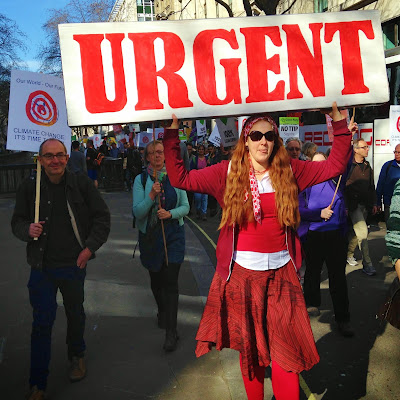
      TTT will be joining the Transition Bloc at the march, join us :
      11am at the entrance to Tooting Bec Underground Station on Sunday 29th November.

      More information from organisers, including a route map is on the Campaign against Climate Change page here

      This weekend marks the beginning of the 2 week International Climate Conference in Paris called COP21. As we all think about recent events in Paris and wish for peaceful resolution to conflicts the world over, the City hosts the World’s major leaders with hope to gain Global agreement to cut carbon emissions and prevent run away climate change.

      Our very own Jeni Walker at a similar march earlier this year

      This is the largest scale of negotiation on Climate Change mitigation and, if successful, has the highest possible positive impact for the future of us humans on this Planet we call home. However, politics is a tricky business with competing motivations and historical contexts, not to mention very well funded lobbying from those businesses that don’t want limits on carbon emissions.

      We must let those politicians know that we, the people, care. 
      Care that they go to the table with open minds, care they think about the long term, not the few years to the next General Election, care that they listen to the scientific evidence alongside the human suffering that comes from ever more frequent extreme weather events.

      You can read about our experience at the march earlier this year here

      And think about the reasons why you might want to march here

      Hope to see you there, Richard and TTT gang.

    • Carbon Conversations – free workshops to reduce your carbon footprint

      Do you want to make some changes to reduce your carbon footprint and save money, but not sure how or where to start?

      Join a group of local residents in a free series of 6 sessions to explore how small changes can make a big difference. You’ll assess your own footprint, then together we’ll look at home energy, transport and travel, food, consumption and waste to help you make changes that fit your situation.
      To read personal blog posts by participants in our 2014 series of meetings, click here and scroll down the six posts (they are in reverse order..).

      Sessions will take place every Monday, 7pm-9pm, from 22nd June – 27th July 2015, at 43 Woodfield Ave, SW16 1LE (near Tooting Bec Common).

      Trained facilitators from Transition Town Tooting will run each session. Please email Jane at transitiontowntooting@gmail.com to join, express an interest, or ask any questions. 

      The workshops are free.  We ask for a voluntary contribution of £14.00 per participant to cover the direct cost of “In Time for Tomorrow?” – the excellent Carbon Conversations handbook.

      For more information, download our flyer.

      All welcome – you do not have to be an expert!

    • Green living & games: a second theme for our St George’s Open Day Stand

      A theme we’ll be looking at with our stand in the hospital at St George’s all day on Nov 15th is green living, with games and activities to explore home and personal sustainability. Living green is a practical response at family and community level to global climate change.

      Professor Chris Rapley’s play / lecture called 2071 ‘explores the future of life on earth and climate change’ this week at the Royal Court Theatre. Some of us from TTT saw the play today, and one of the conclusions is simple and powerful:

      1. Global population will probably stabilise – say at c9.5 billion
      2. That population will need energy
      3. That energy must be carbon-free for us to have a successful future

      Blunt words.
      Getting rid of ‘carbon’ in energy and production is not the only key to being sustainable and happy…but it’s a core step. TTT have found the practical focus on everyday carbon reduction has been successful in the series of Carbon Conversations meetings we’ve offered locally since 2011. To see a recent run through of our 2014 series in six blog posts, click here – and we will be happy to talk about the meetings with visitors on Saturday.

      What about games?

      We know playing games is a simple (and sophisticated) way of understanding a new subject or rehearsing larger-scale challenges.


      In Carbon Conversations, there are a lot of games – for example on our choices in managing home energy, and on travel options, and on ‘where is the carbon in the food we use?’

      Come along on Saturday and we guarantee you will enjoy our games for all ages: Giant Green Living Jenga, Food Mapping, Food Footprints, and making a Drinks Carton Wallet.

      We’ve been making these wallets in Tooting since 2010 (last seen at the 2014 Foodival, where dozens were hidden around Tooting, each with a local chilli pepper and an invitation inside…).

      Like to see a step-by step guide to make 
      them at home?
      1 First squash your carton, with a concertina fold in each side:
      2 Fold into three and then….
        …well, come along on Saturday and find out! 


      Here are some finished wallets:


      We look forward to seeing you all day on Saturday 15th at St George’s, and all ages are welcome to come and play.