Tag: Citizen Science

  • 99% Scientific Consensus on Global Warming

    Just as a marker for the next time you encounter anyone who doubts or denies Anthropogenic Global Warming (AGW) aka warming of the planet caused by the actions of humans, an article in the Guardian this week explains that the scientific consensus on this is now over 99%. I guess most readers of this blog don’t really need persuading but … if like me you still know a few people who think it’s all a big lie, this page could be worth linking to at some point.

    https://skepticalscience.com

    The impact of global warming denial cannot be underestimated, with plenty of vested interests, for example those corporations that benefit from the continued burning of fossil fuels or cutting down of forests (and there quite a lot of them), keen to invest in putting a dissenting point of view out there. With media coverage often seeking to put both sides of a story, a vocal minority with no scientific backing can get their views amplified.  The skeptical science blog for example, referenced in the Guardian article, shows that in 2018 despite near total scientific consensus, the public perception that there actually is a scientific consensus for AGW was only around 50%!!!

    There are plenty of reliable sources that support this view. The NASA website lists loads mainly in America, but they are apparently under pressure from vested interests to remove this information.

    The Intergovernmental Panel on Climate Change has been clear for some time on the subject: 
    “Human influence on the climate system is clear, and recent anthropogenic emissions of greenhouse gases are the highest in history. Recent climate changes have had widespread impacts on human and natural systems.”
    (From Summary for Policy Makers 2014

    If you know any other reliable reviews of the subject or good debunking of denial, or even some persuasive denial (ha ha!) please do send TTT a link and we’ll be happy to quote it. DT

  • Moth Night on Friday 13th October – all welcome!

    This Friday 13th October as a part of Pollinator Paths Wandsworth project, all invited to a Moth Recording Walk at Putney Heath
    This is a fun mix of citizen science and being outdoors in the city. If you have never seen live moths close up, it’s a great opportunity.
    Poplar Hawk moth in summer
    Timing? Meet 6:30 pm 
    Start Location? Boyd Court, 101 Carslake Road, Putney SW15 3DD
    Activity? We’ll set live moth traps, go for a short evening walk and then return to the traps to see what moths hve been attracted to them. 
    Then, those that wish to can return to the Green Man Pub nearby to continue the discussion.
    Clothing? We’ll be working and walking on the Heath at dusk, so wear appropriate shoes. You could bring a torch.
    Who is this for? Anyone interested, including children of course. Have they seen live moths close up?
    Organisers & info? Contact m.redmond@lsx.org.uk or info@putneycommunitygardens.org
    We’ll be guided by David Howden from London Natural History Society and hosted by Putney Community Garden representatives.
    Moth Night is the annual national celebration of moth recording organised by Atropos and Butterfly Conservation, with local events aimed at raising awareness of moths among the general public.
    Come and enjoy getting close to moths – and many of us are not aware that moths are significant pollinators. Time to change that!
    Let’s learn more and help promote those great pollinators together.
    More info about the the Pollinator Paths Wandsworth project – click here.
  • Pollinator Paths Wandsworth – Design Workshops Friday 10th & Saturday 11th March

    Are you looking forward to gardening for wildlife in 2017?
    We recently announced the exciting new Pollinator Paths Wandsworth project, and we’ve been posting updates on Facebook and tweeting.

    The next step is to run the two free Design Workshops this week  One this Friday, one on Saturday. This is where the discussion will take place about what insects the project will aim to benefit, and therefore what plants to recommend to encourage them. And more about plant habitats and microclimates.


    The workshops are not identical – there will be a flow over the two days, and they will also work as stand-alone events. All welcome!

    Once ‘beneficiary bugs’ (actually, probably moths and a bee species) and forage plants are agreed, then the later process of enlisting local people to grow them on and observe can start. Plant distribution will be May 21st in the Tooting Community Garden (and at other local gardens on other weekends). We hope that lots of novice and expert gardeners will to be involved over the summer! 


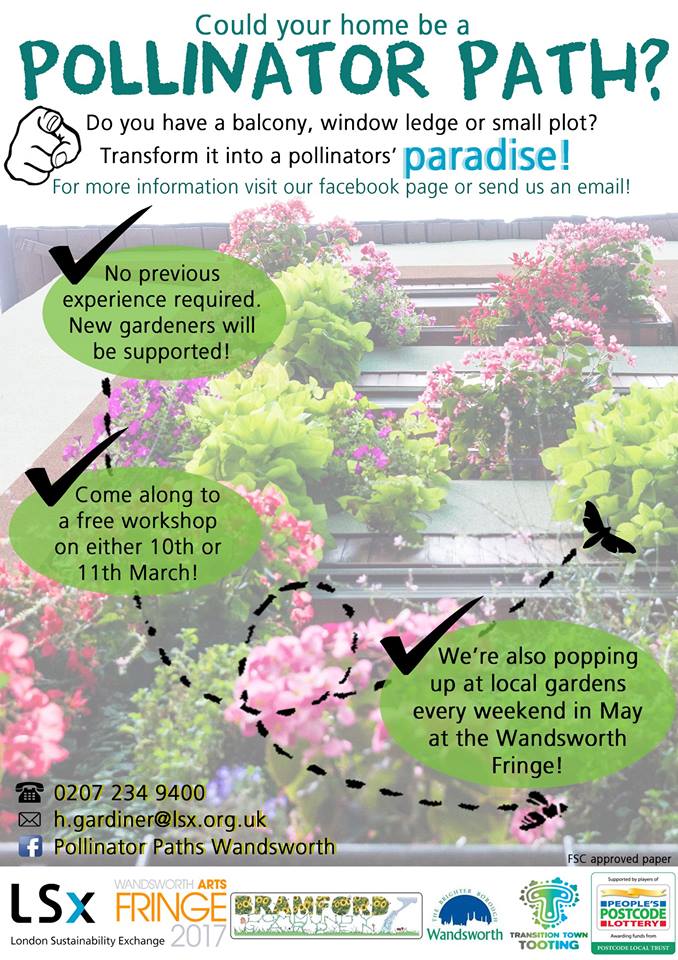
    Here’s the flyer including info with the Design Workshops at the top:

    Tooting Workshop timings and location:
    2:00 – 5:00 pm on Friday 10th March at Mushkil Aasaan, 222 Upper Tooting Road SW17 7EW

    Wandsworth Workshop timings and location:
    2:00 – 5:00 on Saturday 11th March at Penfold Centre, Neville Gill Close, Wandsworth SW18 4TJ

    And the poster for the whole project:

    We look forward to seeing you at the design workshops – let us know if you are coming by signing up here.  

    All welcome!

  • Pollinator Paths Wandsworth – a new project for 2017 linking gardeners across the borough to experiment with planting that benefits insects

    This is a new and imaginative project that is being launched now and will run throughout 2017.

    Pollinator Paths Wandsworth is all about encouraging local gardeners to establish small patches as wildlife havens. Several community gardens are involved, so there will be plenty of support. It’s going to be a good project to strengthen growing links across the borough.

    We’ll encourage many gardeners to grow selected varieties of plants which in turn are good forage for insects.
    Spinach moth image by Roy Leverton, Butterfly Conservation.

    We’re mixing growing with citizen science: we’ll research the ‘microclimates’ of London plots, balconies and windowboxes both for growing and for insects, we’ll share the results and we’ll take part in a fascinating and fun practical experiment together.

    Individuals, families, schools can get involved – anyone with a plot even if it’s small – and beginners are welcome as we’ll share all the how-tos.

    Why benefit insects? Maybe it sounds backwards to plant for the benefit of insects, but suitable habitat and forage are both reducing across London. Click here for the flyer.

    The project programme:

    • The first phase is research into city microclimates, what insects to support and what to grow. 
    • That will happen in 2 free public workshops on Friday March 10th and Saturday March 11th – all welcome to join one of the events on whichever date suits. More info to come; the Friday 10th workshop will be in Tooting and the Saturday 11th workshop in Wandsworth Town, both running from 2:00 to 5:00.
    • Then we’ll resource the plants that we select to grow.
    • The young plants will be shared out in May to those who are taking part. You’ll get support from several community growing spaces in Wandsworth. Tooting Community Garden’s plant-sharing day is Sunday May 21st
    • In summer we’ll all be growing the selected plants at our different sites: noting what does well, what crops we get, what insects find the plots and sharing information on facebook

    How to get involved?

    • You can sign up that you are interested via this online form – no commitment.
    • You can email us at TTT or talk to us at the Tooting Community Garden or another TTT event

    Plus: There’s an extra ingredient of creativity being stirred into the pot. The plant-sharing in May will be part of the Wandsworth Arts Festival Fringe, and as part of the Fringe there will be free family arts events linked to Pollinator Paths at each of the gardens.

    The project has been put together by London Sustainability Exchange working in depth with the various gardens. TTT is thrilled to be in this partnership.

     
    We hope that you will be interested to take part in this fascinating 
    growing and biodiversity project this year – all welcome.