Tag: Climate

  • Call for Climate Emergency Hustings in Tooting

    We are calling for Climate Emergency Hustings for Tooting on Tuesday 10 December in a joint effort between TTT & Extinction Rebellion Wandsworth, supported by our colleagues at the Wandsworth Cycling Campaign, and Wandsworth Living Streets. The date is not yet agreed with all candidates but we hope to host it at Mushkil Aasaan, just 2 days before the polls.

    On 1 May the UK Parliament declared a Climate Emergency. By the end of the next Parliament we will be halfway through the 12 year time period that the IPCC declared to be critical if we are serious about preventing the worst outcomes of climate change. 

    A recent Opinium poll showed that almost two thirds of the population say that the ecological and climate emergency is the biggest issue facing humankind, and 54% of all voters now say that climate change would affect how they would vote, rising to 74% for under-25s. Tooting voters need to know what our elected representatives would do in government to tackle the climate emergency which we believe to be by far the most important issue in next month’s election. Brexit will be long forgotten squabble in the future, the climate will not.

    Just for an interesting reality check, this map, taken from Climate Central’s report Flooded Future (October 2019) shows Wandsworth’s likely vulnerability to climate-related sea level rise by 2050. The red areas show the land projected to be below the annual flood level by that date.

  • Climate Emergency Hustings

    For those of us in North Tooting (aka Battersea) there are Climate Emergency Hustings tomorrow hosted by journalist Michael Crick. It would be great to do something similar in Tooting constituency.

  • Film Showing of Tomorrow, Today

    This afternoon’s film showing of Tomorrow (Demain) provides a comprehensive look at ways in which activists, organisers and everyday citizens are trying to make the world a better, greener, more sustainable place.

    All welcome for 2.30 pm at All Saints Church Tooting, Brudenell Rd SW17 8DQ.

  • Tomorrow – the movie – comes to Tooting!

    We face a climate emergency – but all over the globe, solutions already exist! 

    Join Transition Town Tooting for TOMORROW, our first Film for Action 

    with All Saints Church Tooting, Brudenell Rd SW17 8DQ
    2.30 pm on 16th November 2019


    Tomorrow (Demain) provides a comprehensive look at ways in which activists, organisers and everyday citizens are trying to make the world a better, greener, more sustainable place.

    Check out the trailer for the film!

    The overriding message? It takes a community to make change.’
    New York Times

  • Extinction Rebellion

    We are in the middle of an Anthropocene Mass Extinction so Rebellion feels one of the only solutions we have left. 

    David took a tour of Extinction Rebellion on the streets of London on Thursday and offers a short story of personal encounters. Thank you to TTT for the space.

    Arriving at Marble Arch to a solar powered music stage, a tent city, some fabulous posters and signs, it was great to see the street reclaimed. The freshness of the air was palpable, devoid as it was of the usual fossil-fuelled exhaust fumes. I took a leaflet from Jill who told me she joined an affinity group of organisers because she felt she needed to do something. At the induction centre Sam explained to me how to get involved, what activities could be arrestable or non-arrestable. She knows TTT’s Richard.

    Walking down the middle of a car-free Oxford Street, I meet a slightly sunburnt policeman being berated by a Middle Eastern woman, demanding to know when he was going to clear up the protest. Her route to a hospital appointment was affected. The policeman calmly suggested she try the tube.  An aggressive bald white man joined in to have a go. This was affecting his van business – what was the officer going to do?  Our rosy-faced PC said “I’m just doing my job, maybe you would if your boss asked you?”  I tried to assist, to mediate, but both passers-by were too angry, too lost in themselves to engage. Avoiding eye contact they stormed off as the PC and I chatted on.
    At Oxford Circus a magnificent pink boat dominated the intersection with brave activists aboard, variously attached within, beneath, around. I met Sarah, who was volunteering. She has been doing bird surveys in Oxfordshire over the last 10 years and is alarmed by the significant reduction is species sighted. 
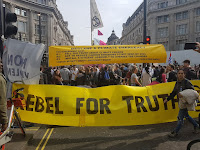
    I overhear a policeman explaining the powers of Section 14 to a man in a priest’s habit. Broadly it gives police powers to ask people to move from certain designated spaces and arrest them if they refuse. I ask him what he thinks about the protest. He smiles but concedes he is not at liberty to give his own opinion. The stand off between police and protesters is tense but calm, a older lady vicar is marched past to the waiting vans.  Because Extinction Rebellion is non-violent, no alcohol, no drugs, it is harder to police I would say.
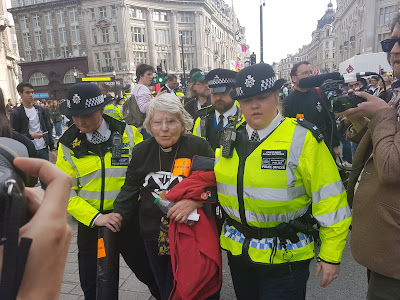
    A Vicar Arrested

    Sitting down by the well-being tent I meet Beth who asks me to write a message of hope to those attached to the pink boat. I make a little card with some inspring words, then lurk in the crowd to watch the delight of the activist who reads it and passes it on. Oh … my small act had meaning. While lending my pen to an Italian man so he too could write a note, a woman offers to wash my feet. I spare her the dubious pleasure.
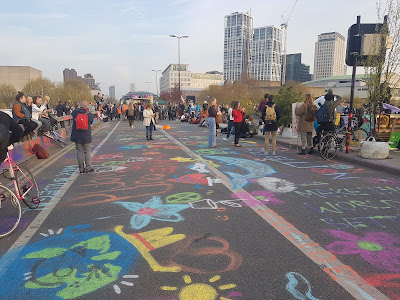
    The Colours of Waterloo
    Rob the Plastics Man

    I haul my wife out of her office and we go down via a closed off Piccadilly to Parliament Square, again successfully blockaded by small groups of dedicated activists in tents. We look up at someone slung in the tree high above, attached to a coffin, behind the Gandhi statue, and chat with West Indian Christian Laurence, who laughingly shares a nihilistic attitude to the climate chaos. In the middle of the road by Parliament, Rob is selling dump-on-Trump loo paper with the Donald’s face thereon, from a trolley, to raise money for his mental health charity. Another Rob stands adorned with signs urging action on plastics. He’s been coming from Redbridge every day for 8 weeks. Environment minister Claire Perry has hugged him and told him he is doing a good job. It is a pity the political system fails to allow Claire to do much to tackle the climate emergency, … to stop extinction.

    Briefing on the Bridge

    Finally on, as the sun sets, to a colourfully chalked Waterloo Bridge, a veritable forest of trees, plants, a music stage, talks and singers, the smell of healthy food cooking, and meditating souls on the front line ready to be picked off one by one by the police. My last chat is with Judy from Edgware as we watch a Great Gusto-like singing group “climatise” the words to “Those Were The Days”. Judy is concerned about Palm Oil and is trying really hard to exclude it from the things she buys and uses. I make a mental note to do this if I can.

    Brave Bodies on the Frontline

    Jill, Sam, PC1, Sarah, PC2, Beth, the Italian, Laurence, Rob, Rob, Claire, Judy: they are all doing something. We can all do something to rebel against extinction. I highly recommend you visit Extinction Rebellion before it finishes. 

    I personally felt invigorated, inspired to do something myself and cycled back to Extinction Rebellion after my work on Friday, loving the clear less polluted streets, wanting to be part of something I believe in. Collecting a big bundle of flyers, I handed them out to members of the public, along the length of Oxford Street, while following a Carnival-like drumming procession.  I can’t wait for others to act, I have to do something myself.  After all …
    IF NOT ME WHO? IF NOT NOW WHEN?

  • Carbon Conversations Week 3

    ‘Travel and Transport’ was the theme of the evening’s discussion this third week of Carbon Conversations.  Stories of favourite and nightmare journeys were shared – from wonderful night time cycling through Hyde Park to the extreme frustration of delays, queues and missed connections while under pressure to meet a deadline elsewhere.  We talked about what travel represents to each of us , especially within a culture where it has become so accessible and so enjoyed.  Aspirations to travel the world are encouraged almost as a rite of passage and, subsequently, many thousands of conversations coalesce around those experiences.  We looked at our reasons for making journeys and there was a recognition of the challenge that would be felt were the visiting of family and friends abroad to be restricted.
    We talked about the advantages and deficiencies of cycling and the current public transport system – who it works for, or not, – and some of the steps that could be taken to make it more accessible for all and why the obstacles to this happening are so significant.  There was a recognition that solutions in potentially wonderful technologies may be still in their infancy! This theme of taking difficult carbon-reducing decisions was continued in the group game we played: we experienced how lifestyle changing decisions could be made at the individual family level (good, though sometimes not to our liking, inconvenient and expensive) alongside having the opportunity to make strategic policy decisions at a government level (also good, potentially having a great impact but likely to incur huge resistance from many quarters).

    We spent some time reflecting on the dilemma of what feels acceptable behaviour and how we can take responsibility for our carbon footprint .  Our final activity was deciding on a manageable action that we want to take and then looking at the driving and restraining forces that we could see coming into play, and then focusing on reducing the effect of the restraining forces.  Plenty to think about during the week!
  • Carbon Conversations Week 2

    In the second session of Carbon conversations, we predominantly discussed domestic energy and how we could reduce our carbon footprint from energy usage.

    The discussion started with how much temperature rise could happen in the future and within what time and would we able to cope with it? People had thoughts from 2° C rise to 10 °C and some of them felt we are doomed, while a few who are still aware would not want to think of it negatively and see what action they could do.

    We did an exercise of what a comfortable home looks like. While most of us did prefer fresh light and air some preferred a garden. We touched upon minimalism, as to how it could contribute to a comfortable home. We discussed energy, EPCs and how we could reduce our carbon footprint as owners or tenants.

    The group was divided into two (role as owners and tenants) and played a game of reducing 6 tonnes of carbon footprint through energy savings. It included a combination of changes to the house along with behavioral changes.

    We spoke about challenges that we could face in reducing our carbon footprint through energy. The changes being expensive was a dominant factor, while for some being in a position of the tenant could hinder progress. Understanding of the technical aspects could be a challenge, while the efforts and time for research and taking informed decisions could prove to be a big task.

    At the end we all spoke about specific actions that we could take to reduce carbon footprint and any challenges that we could face. All in all, it was a fantastic session with a lot of learning on different aspects of energy as a facet of reducing our carbon footprint and how we could start off with even the simplest and free measures to reduce our carbon.

  • Urban Heat Research Report Published

    Today the Policy Studies Institute publish their research report Urban Heat: Developing the role of community groups in local climate resilience. It’s a readable, accessible and expert report.

    TTT are proud to have been able to contribute to this valuable piece of work, hosting and facilitating community conversations, mainly in 2015, about the increasing risks posed by localised heat in cities – including neighbourhoods like Tooting – in our warming climate.

    Cold weather challenges are much better recognised by most of us, including health and social care professionals, in terms of individuals’ vulnerability. So it was useful to be part of research showing that urban overheating is a significant risk, and we can take action to reduce its impact.

    We commenced the project in a cold spell in winter two years ago, when the priorities seemed very different. It was hard to visualise that later the same summer we would hold a workshop near Tooting Broadway on the hottest day of 2015. Very appropriate!

    Funded by the Joseph Rowntree Foundation, the Urban Heat project examined the potential role of the local voluntary and community sector (VCS) in the development of local climate resilience.

    In Tooting the research engaged with over a dozen relevant community organisations with diverse services and areas of focus: health care, social care, low-carbon living, community development. A number of local individuals were interviewed as well. Finally, a group of Wandsworth local authority and statutory organisations also explored the impact of Urban Heat.

    To read our past TTT blog posts about the whole project since its inception, please click here.

    Other partners in the Urban Heat research programme explored the same topic in Hackney and in West London, all co-facilitating alongside the Policy Studies Institute team.

    Finally, the Joseph Rowntree Foundation funded a sister research project at the same time, about ‘Climate Resilient Communities’. This was developed in the context of local flooding in the Scottish Borders, mostly rural, but much of the experience and lessons are relevant to all communities working proactively with practical climate challenges. We’ll share that report when it is published.

  • Pop-up Cinema in Furzedown on Fri 27th January: Naomi Klein’s ‘This Changes Everything’

    Join the Furzedown Low Carbon Zone screening of Naomi Klein’s ‘This Changes Everything’ The film explores the global fight against climate change, the role of capitalism and what citizens can do.
    The film has been described as “purposely unsettling…ultimately encouraging”.
    When? Doors at 7:00 for film at 7:30 on Friday 27th January
    Where? The Furzedown Project, 93 Moyser Road SW16 6SJ
    Tickets cost £5 for waged and £2 for students / unemployed – including wine, soft drinks and our famous popcorn
      
    All welcome!
    Please reserve tickets by emailing us at furzedownlowcarbonzone@gmail.com 
    Your ticket entitles you to a 50% discount on the purchase of low-energy LED light bulbs for use in many parts of the home. 
    We’re making this LED offer available via our bulk purchase, to enable you to start saving money and reduce your home’s carbon footprint.
  • Can You Give Up Meat for a Month?

    When TTT co-chair Richard mentioned he was going to go vegetarian for January, it made me think could I? 

    Some vegetables, yesterday

    Not eating meat and what it means, touches on so many of the environmental issues that TTT has tried to tackle over the years. Land and water use, global warming, animal welfare, population growth, the carbon cycle, the changing climate, human health and well-being all seem relevant. It sparked my interest. Then I saw an ad for veganuary on the tube, a campaign to encourage people to become vegan for a month.  Could I, a lover of bacon sandwiches, lamb karahi, fillet steak and recently copious amounts of turkey join in with such an endeavour?

    I think I can but… how? What will it be like? What about fish? Is anyone else out there interested? There’s only one day to decide … DT