Tag: Debate

  • Tooting Speaks! The big dilemmas of local food

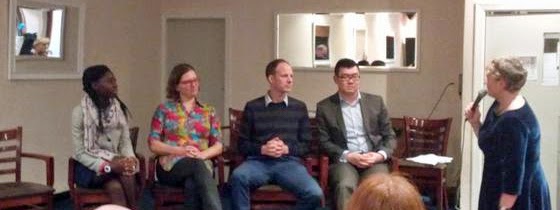
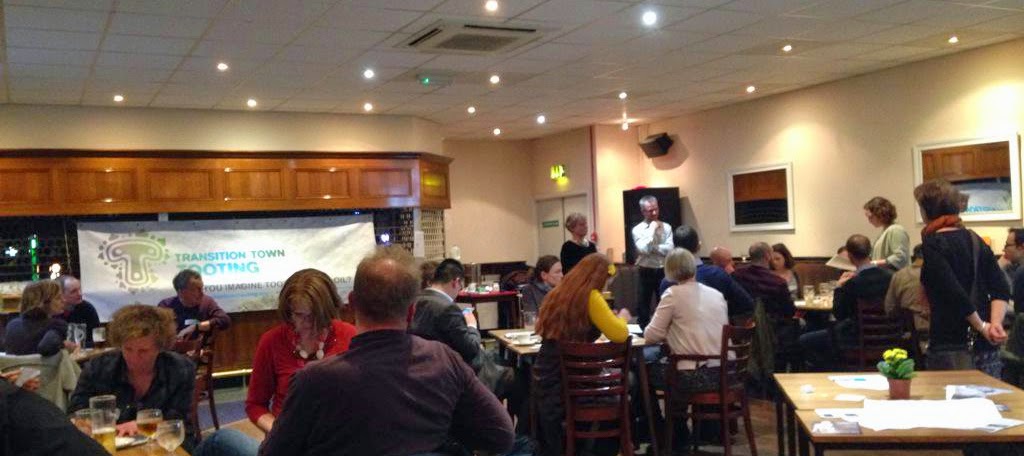
    30 passionate Tooting folk came to The Selkirk (thanks so much Ben and the team!) on Wednesday night to join our 4 fantastic speakers, Kemi Akinola, Robert Biel, Robyn Knight and Sue Sheehan, in wrestling with the big dilemmas of sustainable food systems and what we can do locally. Our title was “Local Food is an Expensive Luxury” and the discussion was hosted by TTT’s co-founder Lucy Neal. If you’re interested in these gatherings, they’re part of our monthly Green Drinks at The Selkirk on the third Wednesday of every month, details HERE.

    Local Food is an Expensive Luxury

    But what was it that contextualised food as “local”? Our first speaker, Sue Sheehan (Incredible Edible Lambeth) opened the account with the hyper local – food grown by you as being an active form of protest – claiming the land and building personal resilience for healthy, home grown, cheap veg and against the power of advertising and convenience, after all, gardening is the most “therapeutic and defiant act as you can do” according to the ultimate Guerrilla Gardener, Ron Finley, watch THIS and “plant some shit”. Switch to our second speaker, Dr Robert Biel, Senior lecturer at University College London and author of Sustainable Food Systems – the role of the city and we learn as recently as 1985, with population at 56 million, the UK produced 95% of its food from within its shores… a poignant and powerful statistic, particularly given the risk of a no deal Brexit and the threat that presents of us not being able to feed ourselves, which you can read more about in a recent article by Jay Rayner HERE.

    Read on for LOADS more…

    Zooming up a level, local food systems were championed as methods for plugging the leaky bucket of global finance – keep money circulating more locally through fresh fruit and veg and prepare food, cooked with love and shared in local eateries. Our third speaker, Robyn Knight joined us from Sutton Community Farm who supply 250 vegboxes to customers spread from Kingston to Greenwich. The Farm emphasises the social and environmental benefits of growing by engaging 1500 volunteers who benefit from exercise and socialising for increased wellbeing.

    which brings us to our first major dilemma… MEASUREMENT AND  NARRATIVE.


    Measuring impact in terms of monetary value alone compromises our ability to paint a more accurate picture of the role food plays in the beautiful complexity of life. And yet we’re required to do that to “make ends meet”, to be a “sustainable” business, to apply for and report back on funds. But how do we report back on the surrounding benefits, the positive impact on the wider community or even relieving pressure on the NHS through healthier, more active communities? Thinking beyond money, the language and metaphors become important, they can either “deliver us hope or foreclose possibility“, according to Robert Macfarlane, I’d much rather be opening the doors of possibility when ti comes to the future of food. The expense we talk about in the title of the debate could refer to the perceived prohibitively expensive farmers market produce, or could be juxtaposed next to the abundance of a well run allotment, garden, community garden or balcony, all requiring very little financial input, but a huge amount of time and love.

    Back to the debate and Robert Biel went on to talk about luxury as short, sweet, quick hits designed to make us want more. Can luxury be re-framed as being long term and slow, with richer, deeper rewards going beyond $£$money as the only factor in our food choices? Can Community Supported Agriculture schemes and online services such as  Open Food Network transform our food growing systems (maybe a truly long and slow project)? Can we learn to embrace “surprise” gardening – working with natural systems, in all their mess and chaos (from a human point of view) to produce abundance? Agro-forestry, permaculture and agro-ecology come to mind. Plenty to connect with in terms of your practice of growing food and which systems you may want to invest in for the weekly shop.

    This is all very well, but I was hugely grateful for the grounded view given by our fourth Speaker Kemi Akinola, founder of Be-Enriched and local Councillor (although she made clear the views she expressed were for the benefit of debate, the Devil’s Advocate had entered the room) and Co-Chair of both Lambeth food Partnership and Wandsworth food Partnership… Kemi gave a massive high five to Supermarkets, the way perhaps most of us shop for our food, for supplying consistently cheap, accessible food of huge variety and, in terms of the pressure on space in the urban landscape, super efficient. One shop does the lot. You can read more about the global food system HERE.

    Which brought us to our second major dilemma – LAND.


    For more on Land, check out Shared Assets


    In London particularly, land is seen as a driver for the housing crisis, and housing dominates conversation about land use in Town Halls across the Capital. Compare the use of land for food production against the use of land for a high density housing and you can see how challenging it is to fight for community gardens or inner city farms, in the context of the current capitalist regime. You only need to look across the Atlantic to see the effect of plummeting land value on opening up the possibilities for space use, let alone addressing urban food deserts which affect 26.5 million Americans, a staggering stat. Places like Chicago and Detroit, Michigan being recent examples of urban community farms re-valuing space for community benefit, addressing urban inequality and giving access to healthy food, community connection and exercise.

    Back to London and the definition of local that ran throughout the conversation. Scale became important, thinking about the productivity of local growing and the value of peri-urban agriculture. Imagine if it was the norm that we knew exactly where the food we bought was grown and that place was just down the road? However, its not just about local food being grown close to us. Knowing more about the food we eat is key in our decision making as food consumers. Ethical and sustainable choices are hard to make and often are a challengeable viewpoint at best. Would you support small local businesses over a globalised meat-free diet? How would you decide between packaging free and high provenance food choices? The Supermarkets may work to a globalised, season-less standard, but at least most food products are fully labelled as to where the food originates, empowering the consumer to make an informed choice. Audience member Jenny Teasdale even cited that lamb from New Zealand had a smaller carbon footprint than lamb raised in the UK, there’s an interesting article HERE outlining some of the research supporting this argument, I’d heard the same about apples (ah yes, the year round crop… fresh breaburns in January anyone?).

    Back to Tooting…  and we have just organised our 11th Annual Foodival, a celebration of what we can grow, cook and eat locally. David Thorne, one of the team of 5 who co-organise the event this year, reflected that this fundamental message behind Foodival was difficult to make stick with many of the 600 folks who attend. That’s not to belittle this fantastic event that brings all the communities of Tooting together in a spirit of celebration and food. Maybe some are just after a cheap plate of nosh.

    Which brings us to our third dilemma… CHEAP AND ACCESSIBLE VS “LOCAL” AND “SUSTAINABLE”

    This maybe a red herring and certainly harks back to Kemi’s point about Supermarkets. It wasn’t that long ago that Lidl and Aldi came over, offering substantially cheaper brands that we didn’t recognise and wonderfully random offers down at Lidl-de-Aldi-Lidl-Aldi-Lidl-de-Aldi dee. The reality of a lot of people’s lives right now is that the shopping needs to be quick, accessible, cheap. There are bellies to feed, demanding jobs to work and, some might say, equality to reach.

    But does local and sustainable need to be expensive and inaccessible?

    Our biggest dilemma of the night had entered the room… HOW DO YOU (S)MASH THE SYSTEM?

    We’d talked a lot about being active, one of NEF’s 5 ways of wellbeing, and most of the room had in
    some way taught or shared the joy of growing food with others. We’d talked about the multitude of benefits community gardening and local growing gives and the idea of communicating that, when measurement is challenging. And we’d shared another Foodival story of family food culture being expressed in a Top Tooting Cook entry using locally grown ingredients to make an award winning Indian dish – a true Tooting cultural mash-up. You could feel this sense of wanting to smash the silos and create a systemic shift towards true value beyond monetary cost, critically based in reality and meaningful for all.

    Finally, lets unpack that word “value”. Perhaps this word pushes against the “luxury” of our title, encouraging us to think more in the longer term using regenerative, circular practices rather than linear, wasteful ones. Value as regenerative refers to the social, economic and environmental – we heard about the value of social interaction at Sutton Community Farm, mirrored at Community Farms and gardens across the Capital and beyond. We heard about the value of exercise and connection to nature, so powerful some Doctors prescribe it for to aid Patient recovery. We heard about the value of organic food practices for the Earth, re-building soil layers so depleted by intensive, industrial scale agriculture (we are literally running out of soil, some would argue). Finally, we heard about the value of local food and the systems that support it – farms, shops and customers – meaning that money becomes a bit more sticky to neighbourhoods, providing more opportunity to stabilise local economies.

    And perhaps that’s the challenge at the heart of the debate, for us all to enact change based on the wider value of food for us, our Communities, and our future food systems. Kemi, Sue, Robyn and Robert were asked for their call to action and here’s what they said…

    Take responsibility in your choices, be informed and be active.
    Simply eat more vegetables than you do now.
    How are you spending your money? Spend it a bit more on food and bit less on stuff.
    Where are the growing spaces? Get involved in creating and supporting more.
    Work on the beautiful complexity by linking up social and environmental practice through projects.

    Thanks for coming, folks!

    And finally… here’s some additional resources passed on from Robyn and Kemi:

    The Landworkers Alliance
    Community Food Growers Network
    Capital Growth
    Greenwich Community Development Agency

    Kemi can be found on Twitter here @BeeKemiA
    Sue can be found on Twitter here @GreenCChampion

    “I’d never seen a ready meal until I came from Austria to live in England in 2000”

  • Inviting you to our series of free local events this autumn exploring sustainability in Tooting!

    We’re thrilled with the fun and buzz at the Tooting Foodival last Saturday! Thanks to all who contributed their time, equipment, skills and produce to make it a success (see the I Grew This 2018 blog post).  Over 600 people took part on a sunny Tooting afternoon!
    Much more to share about it soon on this blog.

    The Tooting Foodival was the first in a series of free local events this autumn, all about exploring, influencing and creating sustainability in Tooting, together.

    All invited to all of them!

    Click here for a copy of the flyer.

    The next event is a Tooting Debate on Weds 19th Sept:

    ‘Local Food is an Expensive Luxury’.

    Yes, we know…..that’s intended to be provocative after the success of the community Foodival based on locally-grown food, local cooking and local eating together. 
    Come along and share what you think! Details to come here on the blog.
    The debate is on Weds 19th Sept from 7:00 pm – 10:00 pm at The Selkirk Pub, SW17 0ES

    We’ll promote and share details of all the other events in good time.

  • Is Capitalism the best system for a sustainable future? Tooting speaks!

    Is Capitalism the best system for a sustainable future? Tooting speaks!

    On Wednesday 18th April, Tooting Green Drinks played host to our first debate! Why run a debate? This was an experiment to engage more people and look beyond our (albeit wonderful!) usual hard working suspects. And it was to explore some of the more divisive areas of sustainability.

    It worked! 40 people (ish) came along to join in our first debate on…

    “Capitalism is the best system for a truly social, economic and environmentally sustainable future”
    Standing Room only!

    The evening showed there is huge energy for ideas exchange in Tooting. We’ll definitely be planning more debates in the future, hoping to engage head, heart and hands by way of an invitation for us all to become active in Tooting.

    What would you like debated? Answers in the comments below please!

    Did we assemble a room full of raging anarchists, ready to march on Westminster? Or were the challenges of sustainability just another problem to solve by Capitalist innovation, motivated by profit? Read on for the lowdown on how the evening unfolded…

    Oli Griffiths, a Green Drinks regular, spoke for the motion and laid out a strong case for Capitalism being a tried and tested system around the world, lifting populations out of poverty, decreasing mortality rates, increasing access to education and even being the system that underpins the 5 most “happy” Countries… He cited the inefficiency of State actors to find solutions to societal problems affordably and the efficiency of the open market to scale up renewable energy, develop electric vehicles and even massively reduce the cost of reaching the International Space Station through Elon Musk’s gang at SpaceX!

    Dave Darby, founder of Low Impact , started with the big guns, literally, “any system that makes profit out of war has to be bad”… and went on to outline the ecological destruction at the hands of Capitalism, the power of the solidarity economy and the democracy of the co-op movement. He leveed the fundamental idea of Capitalism perpetuating more stuff and persuades us to be greedy in the face of hugely powerful advertising, and that, he argued, was fundamentally un-sustainable.

    Both speakers spoke with passion and belief, but it got most interesting when we opened questions to the floor. In the hugely appreciated, but pretty warm and stuffy, upstairs room of The Selkirk Pub our engaged and smart bunch of Tootingites insisted on firing in the questions and comments for an hour, prizing apart the Speakers arguments, testing their knowledge and airing their concerns.

    For me, the open questions highlighted the challenges we can all work on for a sustainable future, either within the current system of Capitalism or in preparation to supersede it…

    • How do we stem the tide of greed endemic to Capitalism? When is individual wealth enough?
    • The solidarity economy maybe hugely desirable, but can it operate at Global Scale? 8 billion people big? And would it even be suited to providing some of the Global Scale solutions for a sustainable future?
    • If profit isn’t the motive, as it is in a privatised economy, then what is? Why is it that State actors don’t perform with the same drive and urgency as the open market?
    • What role for the State, National or Global, given the complexity of the issues around Climate Change and the cleverness of Corporation to work around tax law, international agreements and “Externalities”??
    • How can a finite planet support perpetual economic growth, an underpinning mantra for Capitalism???
    I’ve come across the expression “appropriate technology” recently, in a book my good friend Chuck Whitehead, who posts here regularly, has lent me – “Rekindling Community“, a Schumacher Briefing by Alastair Macintosh. Appropriate Technology, for me, challenges us to think about what is appropriate for what circumstance. It is, I would argue, appropriate for our High Streets to be populated by local businesses with a strong relationship to the community they serve, providing social connection and avoiding the “leaky bucket” of shareholder-owned businesses. Considering the Global Scale, however, I wonder how the solidarity economy can scale up enough to provide wholesale replacement, for example, of fossil-fuel vehicles with low carbon alternatives, or operate train networks and all the infrastructure that goes along with it. I might well pose that question to folks who know a whole lot more about alternative business models and how those models would fit into a network or governance regime that would support them as well as keep them in check for the planetary good. It feels to me that something has to change from the current system that we have created for ourselves where owning more stuff is the norm, laying fake grass makes sense, throw-away fashion and umpteen holidays a year are all expected.

    In an exchange after the debate, Dave encouraged Oli to keep working on reigning in Capitalism (although I’m not sure Oli offered to do that…) while Dave keeps on building the solidarity economy. Dave suggested it needs all of us to work towards a better future in the best way we think, proving, perhaps, that the biggest winner in this debate, if indeed there had to be one, was the notion of that which we have in common is far stronger than anything that divides us. Build Bridges not Walls, as the saying goes, and keep talking with an increasingly diverse group of people – perhaps the principle reason for offering debates in the first place. Do come along to the next one… Richard Couldrey

    Useful Links: We asked for links from both speakers, this is what came through. Please do add links on this topic but commenting on this blogpost.
    For more on the “leaky bucket”, check out this from the New Economic Foundation: Plugging the Leaks
    To help build the solidarity economy: www.noncorporate.org
    For more on the current Mass Extinction Event: Biological Annihilation
    For lobbying for a stable economy: www.steadystate.org
    Fro building community business in the solidarity economy: Collaborative Credit.

    PS. We forgot to take a vote at the beginning, but in the end we had 10 votes “for”, 12 votes “against” and 12 abstentions… I recon there was a few more people in the room though…
  • Can Capitalism be Sustainable?

    On Wednesday evening this week at the Selkirk, Tooting Green Drinks presents a thought-provoking debate on whether:
    “Capitalism is the best way to achieve a truly social, environmental and economically sustainable future”

    In the UK we all live in a capitalist system,
    “An economic and political system in which a country’s trade and industry are controlled by private owners for profit, rather than by the state”. Source OED

    This system may currently provide us with all sorts of lifestyle advantages, but does it do so at the expense of the environment, democracy and human rights?

    Dave Darby
    Oli Grffiths


    Dave Darby founder of of lowimpact.org, will seek to persuade you that there are alternatives to an economy driven by profit. Chartered engineer Oli Griffiths will seek to support capitalism’s sustainable credentials.  More on our speakers here.

    Please come along!  Weigh up the arguments, ask a question, meet others who are interested in discussing what a sustainable solution for humankind might look like. We look forward to debating with you!


  • Capitalism Debate April 18th

    TTT & Tooting Green Drinks proudly present:
    “Capitalism is the best way to achieve a truly social, environmental and economically sustainable future”

    Find yourself in an echo chamber tailored specifically for you? Does your Facebook feed reinforce your opinions, back you up every step of the way and leave you dumbfounded when life doesn’t play out the same?
    Capitalism is the underpinning formula for much of what we enjoy today, particularly in the so-called “developed” world. Our basic human needs of shelter, food and water are met with a competitive market giving us the best service at the best price, driving industrial creativity to come up with solutions to all our problems at a scale that can soak up all the pressures of population increase, freak weather events and a changing political landscape. Even the challenge of climate change is met square on by industrial innovation in the shape of giant wind turbines, sucking carbon emissions out of the air and non-fossil fuel cars that fire you down the High Street in style. Meanwhile saving for the future in a global capitalist market structure maximises your investments whilst the cost of stuff just keeps on coming down …
    But … hold on … a truly sustainable future is about more than just economics isn’t it?  Who gets left behind in capitalism’s raging wake? Top-down hierarchies mean we need “a nation of doers, not thinkers”. Leave it all to the market and will you actually get cheaper and better? Zero-hours contracts and the threat of a privatised health service indicate life could be much worse for many. And what about the environment? Global resources are there to serve the markets, surely? And if economics is the prime driver, does anyone care about the waste that a linear system produces?
    On Wednesday 18th April, Transition Town Tooting will be holding a debate on Capitalism. Is it really the best way for us to reduce our impact on the environment and adapt to an already changed global climate? We have 2 wonderful debate Captains in Dave Darby (lowimpact.org) and Oli Griffiths and will be running it like a proper debate with opening statements, rebuttals, an opportunity for you to make your points and challenge Dave and Oli before closing statements., all in the wonderful confines of the upstairs room at The Selkirk in Tooting.
    We challenge you to be challenged! Encourage you to speak with opposing points of view! Reinforce your standpoints or have the courage and humility to change!
  • Tooting Green Drinks! Roll up! Roll Up!

    Lovely Green Drinks in Tooting last night at The Selkirk, thanks for hosting! 
    We got to know the London National Park City initiative better and asked how we would raise London’s green cover from 48% (current) to 51%???? Our answer is…, Parklets! Green up the base of trees, hand over 1 car parking space to green infrastructure! Guerrilla Garden where you can! Turn the small spaces green, lobby the council to use http://www.frontyardcompany.co.uk/products/plantlock.html
    So… where would YOU create a Parklet?
    We launched Green Book Club! Whoop! Want to join in? We have 2 articles to read which will be part of the discussion at the next Tooting Green Drinks: 
    • Is talk about it the most important thing we can do about climate change?

    https://thinkprogress.org/end-climate-silence-cbe439a31a8e…

    And…
    • After plastic bag tax what should we tax next?

    https://www.theguardian.com/…/six-billion-plastic-bags-cant…

    So… How could Green Book Club work best for you?? Online discussion? Articles? Youtube vids and TEDtalks? Books?
    AND… we talked about a programme of short, informal talks in the new year – watch this space for announcements on that.
    So… who would you like to come to Tooting Green Drinks to give short talks? What themes could we cover?
    AND!!!! We talked up Dipa’s secret, tasty idea… but you really will have to wait to hear more about that one… yum!
    Green Drinks is an International idea to create informal spaces for discussion and getting to know like minded people in your area. www.greendrinks.org
    We host a Tooting Green Drinks on the third Wednesday of every month at The Selkirk Pub, 60 Selkirk Street, SW17 0ES between 7.30pm and 9.30pm
  • #TootingFuture Comments

    Good to see that there has been some debate and reflection after last week’s Electing The Future event. 

    Low Impact’s Dave Darby in this thoughtful piece reflects on the elephant in the room – the incongruity of constant economic growth on a physically finite planet, an erroneous assumption that he feels the main political parties continue to make.

    Meanwhile LibDem candidate Phil Ling has blogged re his experience listing his party’s five green laws to safeguard the environment.

    On twitter @tomvwoodcock found the hustings inspiring, while Green Candidate Esther Obiri-Darko @GreenTooting commented on TTT showing real community activism. Labour’s Fleur Anderson (@CllrFleur) and Conservative Dan Watkins (@DanWatkins) also weighed in with their observations.

    What do you want for a #Tootingfuture?  Join the debate on twitter, tell us what you think via @tttooting.

  • #TootingFuture Great Conversations

    A successful Electing the Future event was held tonight at the USSR club. Loads of interesting discussion about Tooting past, present and future with local voices including some of the parliamentary candidates standing in Tooting.  Thanks to Dan Watkins, Phil Ling & Esther Obiri-Darko for attending and Fleur Anderson for standing in for an absent Sadiq Khan.

    Esther, Fleur, Dan & Phil with Lucy on the mic

    What a lot of great ideas around improving community, green spaces, better streets, controlling traffic & pollution, access to housing and independent retail environments to name but a few. Could we imagine Balham Boulevard or taking control of the Tooting Common Cafe or even just “More Green Beauty” in Tooting and around?

    A full write up will appear on the blog in due course. A #Tootingfuture is just that bit more easy to imagine.