Tag: Energy

  • Future Tooting! Local Air Quality and Energy Efficiency event, Saturday 21st April

    Have your say on local air quality and energy efficiency at Future Tooting!

    All welcome on Saturday 21st April 2:00 – 5:00 pm
    At the United Reformed Church, Rookstone Road, Tooting SW17 9NQ

    We have teamed up with local campaign groups to host an event on air quality and energy efficiency in Tooting, with speeches from local politicians and a chance to put your questions to the local representatives. 
    Tooting MP Rosena Allin-Khan will speak on the day, and representatives from the major political parties will join a discussion chaired by London Assembly Member Leonie Cooper.

    We are creating a space where:

    • local people of all ages can come and have their say
    • you can find out more about how air pollution and dirty energy production are affecting all our lives
    • you can explore what we can do about it

    Drop in to find out more about local and city-wide initiatives to measure and limit air pollution, the use of electric buses and local renewable energy.

    There will be stalls and activities for all ages from 2:00 pm, speeches start at 3:00 followed by live music from local singer songwriter Sherika Sherard.

    For enquiries, please email furzedownlowcarbonzone@gmail.com

    Future Tooting is organised by:

    • Furzedown Low Carbon Zone
    • Transition Town Tooting
    • Wandsworth Environment Forum
    • Community Renewable Energy Wandsworth
    • South Thames Colleges Group
  • TTT’s new series of practical & participative local ‘Carbon Conversations’ is running in April and May

    Carbon Conversations is back! Our new series of six free meetings in April & May in SW16 – organised by TTT’s Ben Cuddon. The six facilitated workshops enable individuals to explore how they can reduce their personal carbon footprints. The meetings bring together small groups of local people to discuss the areas of our lives where we can reduce our own carbon emissions: travel, food, domestic energy, consumption and waste.

    A quote from a past participant: “The beauty of Carbon Conversations is the optimism, creativity and shared ideas”

    During the six weekly sessions you’ll discuss in a supportive atmosphere all the practicalities of making your own ‘low-carbon lifestyle’ changes. Making these changes is never one size fits all. 

    Exploring your own situation, start point and preferences is so valuable and makes the series personal and practical. 
    The meetings are well structured with a mix of games, activities and exercises.


    Click here for the flyer and see below for summary details:
    Venue: in SW16 near Streatham Common Station 
    Timings: all meetings run from 7:00 pm to 9:00 pm 
    Dates: six Thursdays from April 19th to May 24th, one a week
    Free: there is no fee to take part. The only cost is currently £14 for the workbook and learning materials, which TTT charges at cost. Sessions are led for free by TTT’s trained Carbon Conversations facilitators. 

    TTT has run over 10 series of Carbon Conversations since 2011. 
    On average participants are able to identfy how to reduce their own carbon footprints by a third – by over 4 tonnes of carbon.
    Wait a minute! 
    What does ‘four tonnes of carbon’ mean? 
    You may already be worried about shorthand & jargon. The way we facilitate the meetings means that you do not need to be an expert
    Although it’s a complex subject, we guarantee that by the end of the sessions you will learn useful new language and concepts and understand the practical elements of household carbon reduction.

    This is a great place to start if you want to reduce your carbon footprint, meet some friendly and like-minded people and explore the topic as it affects you, rather than being lectured at!

    As a participant said: 

    “At the last session I don’t think anybody wanted to leave!”

     Join us to find out how to reduce heat loss from your home!  
  • Pop-up Cinema in Furzedown on Fri 27th January: Naomi Klein’s ‘This Changes Everything’

    Join the Furzedown Low Carbon Zone screening of Naomi Klein’s ‘This Changes Everything’ The film explores the global fight against climate change, the role of capitalism and what citizens can do.
    The film has been described as “purposely unsettling…ultimately encouraging”.
    When? Doors at 7:00 for film at 7:30 on Friday 27th January
    Where? The Furzedown Project, 93 Moyser Road SW16 6SJ
    Tickets cost £5 for waged and £2 for students / unemployed – including wine, soft drinks and our famous popcorn
      
    All welcome!
    Please reserve tickets by emailing us at furzedownlowcarbonzone@gmail.com 
    Your ticket entitles you to a 50% discount on the purchase of low-energy LED light bulbs for use in many parts of the home. 
    We’re making this LED offer available via our bulk purchase, to enable you to start saving money and reduce your home’s carbon footprint.
  • Community Energy in London – Question Time

    Tooting’s own Furzedown Low Carbon Zone (FLCZ) is joining Community Renewable Energy Wandsworth (CREW) and Repowering London to host the city’s first gathering of all local community energy groups:

    Community Energy in London – Question Time
    Free Entry!

    City Hall, The Queen’s Walk, London SE1 2AA, United Kingdom
    6pm to 9pm on Thursday 12th November 2015

    Please confirm your place as we are filling up. Email us at: communityenergyinlondon@gmail.com


    We have contacted over 30 community energy groups in London and are looking forward to bringing as many as possible under one roof at the same time. A solar roof? Yes please.

     
    This is a great opportunity to meet London’s local energy groups, hear about their good work and the challenges they face, and put community energy on the agenda. During the evening, London’s community energy groups will have the chance to say a few words about their group, their achievements and plans for the future. 

    We will be discussing how we can continue our work with the planned cuts to support for renewable energy. We will also have a Question Time with London’s Community Energy groups, practitioners, policy makers and other experts. 


    Click on this link to Community Energy Fortnight to see more about the event and the agenda.

    Let everyone know
    @LDNnrg
    #LdnCommEnergy

    Find out more about us
    ukcec.org/community-energy-london-question-time
    http://www.crew-coop.london/faq.html
    flcz.org
    repowering.org.uk


  • Carbon Conversations – Energy at Home

    We’re into week 2 of Carbon Conversations and this week, workshop attendee, Robin Dru, gives his report on the session focused on Home Energy.

    This week’s session on Home Energy was fascinating, full of tips and new technologies. Over the course of the evening we:

    • discussed what is important to us in making a home comfortable, 
    • played a game based around reducing a family’s carbon emissions (oh yes we did!) 
    • and had the chance to learn from Susan, a green architect who has set out to reduce the carbon emissions of her home by 80%. 

    We all left excited, with some practical tips and new ideas to implement in our own homes.
    First off we thought about the important things to each of us in our own homes. This ranged from practical things like bike storage and south vs. north facing through to things like positive family/house dynamics.

    The discussion hovered over the issue of how to get other house members on board with making changes. Several ideas were thrown up, like making things easy e.g. clear signs for what can be recycled, making things fun e.g. smart meters to monitor energy consumption and making things comfortable e.g. draught-proofing your house.

    After this we moved into playing a game based around a family with a limited budget trying to reduce their carbon footprint. Whilst the game was perhaps a little one-dimensional, it helped to expose us to different ideas, divided into good housekeeping, weekend jobs, appliances and building jobs. A flavour of things mentioned: housekeeping changes like regularly defrosting your fridge and freezer and monitoring your monthly bills; weekend jobs like draught-stripping windows and doors and bigger changes like triple-glazing windows and various types of insulation.

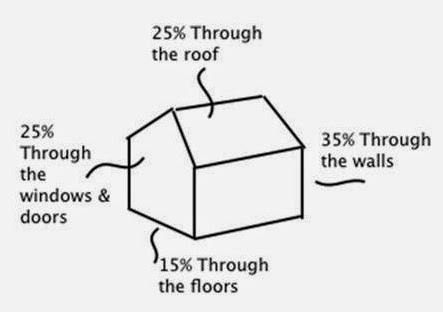
    How much energy do areas of your house lose?

    Finally we had the pleasure of listening to Susan, an inspiring architect who has managed to reduce the carbon emissions of her family home by over 50% in 3 years for ~£25,000. Whilst obviously she has the advantage of construction being her bread and butter, she offered us some a couple of key tips: 1) the importance of awareness and monitoring and 2) the importance of comfort (and how the vast majority of times carbon reduction goes hand-in-hand with this).

    We left excited and energised from the session, equipped with knowledge and greater understanding of energy consumption in the home. Right, now to find a smart meter!

    For more comprehensive information on changes you can make, please visit the Energy Saving Trust.

    If you’d like to find out more about the Carbon Conversations series of workshops, please contact us. We hope to run another series in the autumn.

  • Number 7 in TTT’s ’12 tweets to Christmas’

    Here is tweet number seven:
    No.7 tips for xmas: Wear jumpers, hug friends, lower the heating! More energy & money saving tips @thecarbontrust: goo.gl/j0VKqQ

  • Carbon Conversations Meeting 2 – Hunting Energy Use In The Home

    Report on Carbon Conversations by Eleanor. 
    On 27th May we looked at our carbon footprints and then at home energy. I’ll try to explain without jargon while recognising that learning new ‘carbon literacy’ skills is useful.

    Carbon Footprint:
    Our carbon footprint is a measure of the amount of emissions in tonnes of C02 equivalent (called C02e for short) that we use to live our lives. The average personal footprint in the UK is twelve tonnes of C02e.

    So … where would you ‘hunt for carbon’ if you want to reduce your own footprint?
    Our individual carbon footprints are made up of 5 main areas:

    As a group everyone was well below the national average, but we are all still keen to do better. The next conversations will give us the tools to take practical steps to reduce our carbon footprints overall.

    C02 in our homes
    Just to get everyone thinking we started with an exercise to determine what home comforts mattered to the group. The conclusion we came to was that once we have basic shelter, it’s all personal. Everyone has different priorities and will approach this opportunity from a different perspective.

    Turning to home energy, there are two routes to a low carbon home
    1. Use less energy (gas and electricity)
    2. Switch to an energy provider who puts renewable energy into the national grid.

    The Low Carbon Home game was a bit of fun to see if we could reduce the carbon footprint of a family house by 6 tonnes over 6 years. Some actions are free and easy to do like monitoring energy use and turning down the thermostat. Others require some time and a small investment like changing the light bulbs and some like fitting double glazing or a new boiler require building work to be carried out.


    A real life example

    The best bit was that all the points raised were backed up with a real life example. The venue for the session was in a property that had been modified to be as sustainable as possible. Susan had done exactly what the game set out to show, but in her own home.
    The house (see this link to Susan’s project) is an inspiration and it was great to see that it was achievable. The main thing was how comfortable it was, no drafts, good lighting, and still low energy. Low energy living doesn’t have to mean going without, in fact quite the opposite with the house being cosy and warm over winter. Reducing the heat losses of the house through insulation really made a difference to living in it.
    So where does heat loss occur….?

    Worth bearing in mind if you are making any improvements to your home; it’s not all about double glazing.

    Susan’s main recommendations are:
    1.   Start reading meters and measuring, so you know if you are really reducing energy use
    2.   Explore the options,really get to know your house or flat
    3.   Plan to take steps over 2-5 years, and think about the sequencing so each step is valuable


    I can’t wait to get started on implementing some of the measures discussed here today. The next meeting on June 9th will focus on consumption and purchasing ‘stuff’, and the impact our decisions on what to buy can have.
    Thanks from all the group to Eleanor for this report. 

    Please email transitiontowntooting@gmail.com if you have any questions or would like to inquire about our next series of Carbon Conversations. Other TTT blog posts on Carbon Conversations can be found here.   The Energy Saving Trust – website here – is a practical resource for practical energy reduction tips.

  • Three practical local projects: do join us!

    Furzedown Low Carbon Zone
    We had a productive monthly planning meeting last week – please see the minutes and actions here
    In outline we’re at the stage of visiting local partners to explore sites where there is space and interest to be involved by ‘hosting’ renewable energy generation equipment – whatever technology is appropriate – and sharing in the benefits.
    A second stage will be to engage with local people who can become involved as co-owners of a community generation scheme. The Furzedown Festival in June is a target for that, certainly for informal sharing of the project.
    Next planning meetings are on 8th May and 3rd June in Furzedown…please come along if you would like to be involved at this stage. Details will be on the TTT Events Calendar on this blog. Contact us on this email link for any further information.

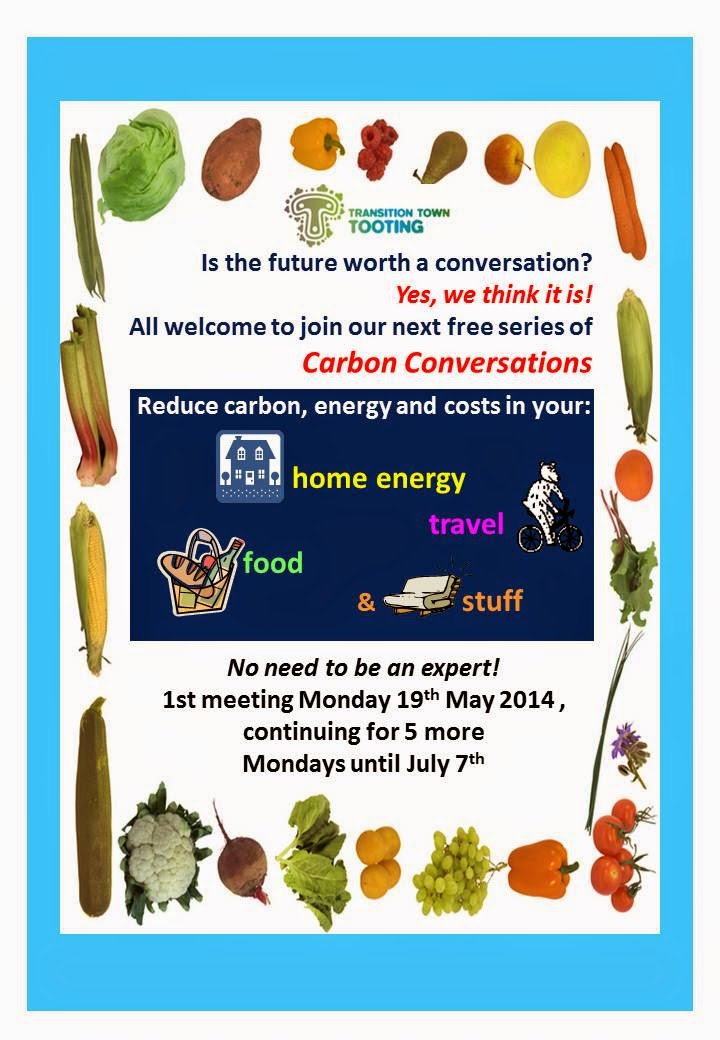
    Eighth series of our ‘Carbon Conversations’ meetings
    We are going to offer a free series of local Carbon Conversations from the 19th May to early July this year. Running on Monday evenings (with one Tuesday for luck), this will be a set of six participative meetings which enable individuals to discuss, understand and take control of their carbon footprint, and work out ways to reduce energy consumption and expenses.

    It’s a very engaging and practical set of meetings…..and even fun.
    We’ll cover home energy, food, travel and transport, and general consumption of ‘stuff’.
    All the details are in the flyer for this next series: please click here.
    Please contact Charles at transitiontowntooting@gmail.com with any questions.

    ‘Cleaner Air 4 Communities’ Project
    This project brings citizen science and local action to the challenge of measuring and advocating for clean air. The toolkit – click here to link to a pdf copy – describes some of the steps that can be taken by a community group.
    Graham Petersen recently took part in air quality measurement at Clapham Junction, with the Battersea Society (there’s a case study on this experience in the toolkit). There is some funding available to support this project, and Graham is investigating that, with a view to improving air quality in Tooting. Please use the Furzedown Low Carbon Zone contact email for more info.

    All welcome to join in with these three projects. Please get in touch!

  • Community Renewable Energy in Furzedown


    We want to share this exciting news from the Furzedown Low Carbon Zone (FLCZ) AGM last week. There’s no time like the present, and we have decided to take the plunge and try our hardest to establish a community renewable energy project in Furzedown.

    What will that look like?

    In outline we’ll be supporting the generation of local power that should bring local benefits; probably a co-operative enterprise with a legacy for the future.  There are several models for this across the UK and abroad, and there is good local advice available: at the same time it is a pioneering project, and it will be challenging.

    Much more information to come as we get going, and we welcome local participation, partners, and support. We have a diverse team who want to make this work. More contributors welcome!

    We covered other topics too in the AGM, and the FLCZ aims to keep being active on accessible social, behavioural and technical projects that help demonstrate the value of low-carbon living, now.
    Links: 2014 AGM minutes  For background: 2013 Annual Report.

  • Report on our ‘Energy we can all afford?’ meeting

    Our ‘Energy we can all afford?’ meeting in St Alban‘s Church, Furzedown was a very lively session (see the flyer and speakers here). Discussion was much more heated than the bitterly cold evening outside.
    We touched on a set of significant and interrelated topics: wellbeing, poverty, and our own capability to keep our homes warm; UK energy policy and supply; energy costs and affordability – and what we can do to take action in response.
    I won’t try to systematically summarise 7 diverse speakers, or the questions: here are some cross-cutting points from all, plus a few quotes, to consider as individuals and communities.

    Some social and physical facts to do with energy, cold, and poverty

    ·         Though our weather isn’t the coldest, UK homes are among the coldest in Europe
    ·         30-50% of winter deaths are caused by cold
    ·         37% of Wandsworth Borough’s homes were built pre-1919 (with solid walls, so cavity  wall insulation is not possible). The national average is 23%
    ·         Where can home heat be wasted? Have a look at this drawing
    ·        10,500 households in Wandsworth are in ‘fuel poverty’ (that is, the household spends  more than 10% of income on fuel) because of varying combinations of 3 factors:  poor heating and/or insulation, low income, the high cost of fuel
    ·         It’s estimated that by 2016, 1 in 3 households in London could be in fuel poverty


    How can we respond, and what support schemes are there?

    ·        We can act now in many different ways, without waiting for key future dates like ‘2050’ – and groups like the Furzedown Low Carbon Zone or Transition Town Tooting offer us a space for agency, and support, and a voice
    ·       Tackling home energy efficiency, developing our own understanding, measurement and monitoring (’We know the mpg for our cars, but don’t understand how our homes perform’), and adapting our own behaviours are steps to what Leonie called ’living our lives in our homes in different ways’
    ·       A 50% reduction in home carbon emissions is achievable now and is relatively affordable. Based on doing the jobs that make a big difference first, click here to see Susan’s local 3 year reduction project in a pre-1919 house. As she said, the lower-carbon future feels good now: ‘Our house is a warm home for the first time’
    ·       There is good local experience developing on community renewable energy co-operatives – in Brixton, Streatham, and Kingston – as well as other initiatives in Merton (and the wonderful Archimedes screw turbine at Morden Hall, for those with a river handy)
    ·       Some schemes to reduce carbon or to enable lower bills are very complex – and even the apparently simpler hurdles such as dealing with Direct Debit, or with online registration, may defeat the very people who need these schemes most
    ·       Giles provided a set of contact numbers for several current schemes (link to his presentation here) and recommended the Age UK Winter wrapped up Guide which can be read here. Wandsworth residents can use the number suggested for the Coldbuster Affordable Warmth programme: 0800 358 6668. One more contact for Wandsworth: tenants who want advice on landlords’ responsibilities over repairs and heating: ring  020 8871 6171
    Carbon emissions, UK policy and the energy market
    ·        27% of the UK’s carbon footprint is consumed in the flats and houses we occupy  
    ·        In 2050 we’ll still be occupying 87% of these homes
    ·       The Climate Change Act of 2008 led the world with binding targets for carbon reduction across the UK, with milestone dates though to an 80% reduction by 2050
    ·       The Energy Bill going through Parliament now is intended to guide energy policy in the UK for decades. A Conservative and Labour-sponsored amendment has been proposed which would ensure the Bill includes a ‘clean’ carbon-free target for UK power supply. An up-to-date advocacy and briefing sheet on the Bill is available here.
    ·        Sadiq Khan MP sent this message to our meeting:
    “To meet the.targets set by the last Labour Government to reduce greenhouse gas emissions by 80% by 2050 the UK needs to substantially decarbonise electricity generation.
    That is why I support decarbonising the UK’s electricity supply by 2030 and believe the Energy Bill currently going through Parliament should be amended to include it. This needs to be a Government priority; to create jobs, growth and a reliable energy future supply.
    The Energy Bill is due to return to the floor of the House of Commons shortly for Report Stage. We are absolutely committed to the inclusion of a target to clean up Britain’s power sector by 2030 in this Bill. I can assure you that I will be doing everything I can to work with MPs on a cross-party basis to put a decarbonisation target into the Bill.”


    Thanks to all who took part and supported the meeting, particularly to St Alban’s for hosting us and providing the laptop and projector.

    And looking forward to our April 23rd event: ‘Better choices for a better future’. The current project with South Thames College is drawing to a close. We will be sharing the learning (and the video) from the project in an event on April 23rd at the Wandsworth campus of STC. The meeting will include a talk on supporting jobs for a low carbon economy by Jonathan Cook, Deputy Leader of Wandsworth Borough Council. All welcome, and the flyer is here.