Tag: Low-carbon living

  • Call for Climate Emergency Hustings in Tooting

    We are calling for Climate Emergency Hustings for Tooting on Tuesday 10 December in a joint effort between TTT & Extinction Rebellion Wandsworth, supported by our colleagues at the Wandsworth Cycling Campaign, and Wandsworth Living Streets. The date is not yet agreed with all candidates but we hope to host it at Mushkil Aasaan, just 2 days before the polls.

    On 1 May the UK Parliament declared a Climate Emergency. By the end of the next Parliament we will be halfway through the 12 year time period that the IPCC declared to be critical if we are serious about preventing the worst outcomes of climate change. 

    A recent Opinium poll showed that almost two thirds of the population say that the ecological and climate emergency is the biggest issue facing humankind, and 54% of all voters now say that climate change would affect how they would vote, rising to 74% for under-25s. Tooting voters need to know what our elected representatives would do in government to tackle the climate emergency which we believe to be by far the most important issue in next month’s election. Brexit will be long forgotten squabble in the future, the climate will not.

    Just for an interesting reality check, this map, taken from Climate Central’s report Flooded Future (October 2019) shows Wandsworth’s likely vulnerability to climate-related sea level rise by 2050. The red areas show the land projected to be below the annual flood level by that date.

  • ReSparkle! with TTT at Tooting Library, 2pm to 4 pm on Saturday 15th December 2018

    All welcome to join TTT’s free Christmas crafts workshop at Tooting Library, creating beautiful presents and decorations to take home.

    We’ve been inviting everyone to ReSparkle! since 2012, and it’s always a magical event.


    When? Saturday 15th December from 2:00pm to 4:00pm
    Where? 75 Mitcham Road SW17 9PD
    We’ll be upstairs in the lovely children’s library.  
    Free, drop-in and for all ages.

    All materials provided – and everything we’ll use to make beautiful creations is waste that’s being saved from going to scrap.
    “Reduce…Re-purpose…ReSparkle!”

    Thanks loads to our partners at Tooting Library – if you have any queries, please phone the Library on 0208 767 0543. NB children under 8 must always be accompanied by a responsible adult.

    Come and join the fun – please spread the word and tell your friends. Click here to read or download the poster.

  • TTT’s new series of practical & participative local ‘Carbon Conversations’ is running in April and May

    Carbon Conversations is back! Our new series of six free meetings in April & May in SW16 – organised by TTT’s Ben Cuddon. The six facilitated workshops enable individuals to explore how they can reduce their personal carbon footprints. The meetings bring together small groups of local people to discuss the areas of our lives where we can reduce our own carbon emissions: travel, food, domestic energy, consumption and waste.

    A quote from a past participant: “The beauty of Carbon Conversations is the optimism, creativity and shared ideas”

    During the six weekly sessions you’ll discuss in a supportive atmosphere all the practicalities of making your own ‘low-carbon lifestyle’ changes. Making these changes is never one size fits all. 

    Exploring your own situation, start point and preferences is so valuable and makes the series personal and practical. 
    The meetings are well structured with a mix of games, activities and exercises.


    Click here for the flyer and see below for summary details:
    Venue: in SW16 near Streatham Common Station 
    Timings: all meetings run from 7:00 pm to 9:00 pm 
    Dates: six Thursdays from April 19th to May 24th, one a week
    Free: there is no fee to take part. The only cost is currently £14 for the workbook and learning materials, which TTT charges at cost. Sessions are led for free by TTT’s trained Carbon Conversations facilitators. 

    TTT has run over 10 series of Carbon Conversations since 2011. 
    On average participants are able to identfy how to reduce their own carbon footprints by a third – by over 4 tonnes of carbon.
    Wait a minute! 
    What does ‘four tonnes of carbon’ mean? 
    You may already be worried about shorthand & jargon. The way we facilitate the meetings means that you do not need to be an expert
    Although it’s a complex subject, we guarantee that by the end of the sessions you will learn useful new language and concepts and understand the practical elements of household carbon reduction.

    This is a great place to start if you want to reduce your carbon footprint, meet some friendly and like-minded people and explore the topic as it affects you, rather than being lectured at!

    As a participant said: 

    “At the last session I don’t think anybody wanted to leave!”

     Join us to find out how to reduce heat loss from your home!  
  • Exploring Food and Travel in your carbon footprint – stories from May’s ‘Carbon Conversations’

    TTT’s 10th local Carbon Conversations series continues – the free weekly local facilitated meetings where participants can explore their own practical options for low-carbon living.

    The sessions are not only about ‘counting carbon’ and understanding our carbon footprint; they are also about exploring our own values and preferences in a safe and facilitated setting with a small group. Understanding the meaning of our choices…. the ‘why’ as well as the ‘what’…. means we are more likely to take steps which we can sustain over time.
    Quoting one of the participants in this series:

    “The beauty of Carbon Conversations is 
    the optimism, creativity and ideas
    that are shared and emerge”


    Each of the six meetings has a theme – for example home energy, or waste. We reported on the first two sessions in this blog – read it here, and below two more participants describe the discussion points and feelings raised by the third and fourth meetings: about food and travel.


    1 Food: probably the issue that goes to the core of our identities more than any other.
    We did an activity reflecting on all the aspects of food production that worry us most. One of the group shared a really heart-rending story of playing a game with a child where they had to mime different animals. They wagged their tail like a dog, pranced like a horse, but when asked to enact a chicken they curled up into a ball on the floor. This child only knew a chicken as a dead body wrapped in clingfilm on a supermarket shelf. It was a poignant moment…

    We also played a board game to figure out the carbon emissions embedded in all the different stages of the food production process: growing, processing, packaging, transport.
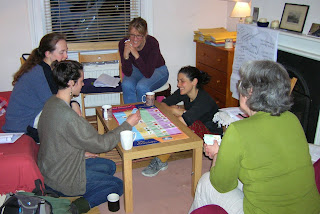
    It was illuminating, but it also made us realise the complications of solely judging things based on carbon emissions. What is something is ‘really low carbon’ but harmful in other ways? There are lots of factors to take into account.
    It also made us reflect on the foods we eat. As one group member said: ‘it does make you think….what ARE we eating?!’

    2 Travel: The slow and rewarding journey
    As I cycled to the little flat in Tooting where our intimate group meets every week to talk through the labyrinthine emotions and values of our relationships with carbon, I was reminded of my first year after graduating from university with a degree in Geography. I wanted to live overseas and make the world a better place. That year alone I took 18 flights. 
    “Take a couple of minutes to think of your favourite journey to date – and also your nightmare journey – to share with the group.” This is how Ben introduced the session of Carbon Conversations with the theme of travel. 

    There was a surprising and reassuring synchronicity to everyone’s answers about their favourite journeys. A cycle trip with friends across Europe, a train ride, a walking pilgrimage to a friend’s cottage, a botched ferry booking requiring troubleshooting cycle journeys to make it to Portsmouth on time. In nearly all the examples, the journey was more memorable than the destination. 

    And why are these journeys so memorable? It’s the slowing down, the views from the windows, the conversations with strangers, the human pace. But then one participants looks confused. “But you can’t do it to all the people all the time”.. she says, half asking, half hoping, about talking to strangers. True that. 

    So if the journeys are the most memorable, why do we all fly everywhere so quickly? Why do we insist on so many destinations?  One participant suggests that it’s ‘constructed desire’. “I don’t want to go to Vietnam”, she says, “but sometimes I feel like maybe I should.”
    And it is complex. Families are spread around the world, jobs require meetings in far flung corners of the globe, billboards promise escape on golden beaches, and that super amazing permaculture training course I’ve had my eye is in the South of Spain. So is it possible to live in the world today while maintaining sustainable modes of travel?


    Since moving back to the UK, I’ve decided to live as locally as I possibly can. I only cycle, I dumpster dive for much of my food, I grow veg in a community garden, I switch off my lights when I’m not in the room, oh and I’ve cut down on international travel, to the extent that I’ve missed a friend’s wedding for the sake of reducing my carbon footprint. 

    And here’s the moment of truth. Ben hands me my carbon footprint calculation. The USA average is 20 tonnes of carbon per person by year, followed by the UK at 15. The world average is 4.5 tonnes while the sustainable world average is 1.5 tonnes. Tanzania’s average is 0.1 tonnes. I’m feeling optimistic.   

    I look at the sheet.
    19.18 tonnes. 


    It’s the two flights I took this year. Both of them to destinations which meant a lot to me. 

    ‘Tonnes of carbon’ is shorthand used to refer to the tonnes of CO2 and other ‘greenhouse gases’ released into the atmosphere. The impact that air travel has on our carbon footprint is undeniably unsustainable! Yet our lives are so scattered around the world already that it’s near impossible to imagine reining them in.

    The beauty of the Carbon Conversations program is the optimism, creativity and ideas that are shared and emerge. The lengths that some participants go to to find solutions is admirable. So is the faith that every change each of us makes as individuals will slowly but surely contribute to a change in emissions and in the global carbon culture. 

    So if you’re looking for alternatives, then two easy things you can do are:
    Oh and one more thing.. if the journey is just as interesting and exciting as the destination, then I think we can make the journey towards a carbon neutral world also just as rewarding. It can be slow, full of surprises, and of course, include conversations with strangers – which is just what Carbon Conversations gets us to do!


    We’ll share the stories of the last two sessions in this series. And if you like the sound of the content and style of these meetings, keep in touch and look out for the next series of Tooting Carbon Conversations.  

     – Charles

  • Update from the first two meetings in TTT’s current series of local Carbon Conversations

    TTT’s tenth series of local Carbon Conversations began in April with a group of 8 local people. Thanks to all, the sessions have been lively and informative.
     
    The series facilitator Ben has shared a short report of the first two sessions:
     
    “For our first session we had several interesting and far-ranging discussions.
    One of them was about what a low-carbon future would look like
    Several people suggested that everything would be conducted at a much more local level. But this left us thinking: does this mean we will have to unravel everything that globalisation has delivered? Is it possible (and desirable) to dismantle globalisation, or should we aim to retain aspects of it and go local only in certain ways?  
     
    For our discussion about a low carbon future we spoke about the importance of having more regulation from government to control carbon emissions, fossil fuel extraction, etc. But the issue of regulating ourselves was also raised. How will we regulate our own behaviour? Several people suggested education and how important that would be in the process.

    Ben continues his report:
    “For session two we discussed carbon reduction in our home energy consumption.

    Everyone agreed that the whole process of overhauling your house can feel very complex and overwhelming. There are so many things one can do, and most people don’t have the technical expertise to understand all the options thoroughly.
    We discussed the problems of the current housing market and how the energy rating of a home is often not very important to the people purchasing it. This is especially true in a housing market like London where people are just desperate to get on the housing ladder and probably aren’t too concerned about the energy efficiency of a home.
    The issue of being a tenant came up – we noted how there is little incentive for landlords to renovate their homes if their tenants are paying the bills.
    We also talked about communicating these issues and how to point out someone is overfilling the kettle without appearing a nag! You can tip-toe, or you can just tell someone they’re being daft…. (we will return to the issue of how to communicate climate change in session 6).
    Finally, the question came up of how to make carbon reduction at home glamorous. Loft conversions are glamorous. But carbon reduction isn’t. Or at least, at the moment. That could change….
    There were some positive notes as well.
    One potentially fun way of tackling the issue is by engaging children. If engaged they could be enthusiastic supporters of carbon reduction, if it is made fun, and if they have the chance to receive education on the issue – linking with what we discussed in week one.”
    Heat loss in a simplified detached house travels in all directions…would you have guessed those percentages?
    We’ll continue the coverage of this series of meetings, and more information about Carbon Conversations can be found by clicking here.
    Get in touch with TTT if you would like notice of when we are offering the 11th series – or get the core of a group together yourself, and we’ll find more people and maybe run it in your home!
  • Our tenth series of Carbon Conversations postponed to start on 20th April

    TTT’s tenth series of local Carbon Conversations is going to start on Thursday April 20th
    We promise you will enjoy and also find a lot of practical value in this exploration of your own ‘low-carbon living’ choices and opportunities. 

    The outcome of the series is an action plan for reducing your own carbon footprint by understanding the impact of what’s in your own control – home energy, travel, food and purchases.

    An active game about the carbon footprint of food

    You’ll find it friendly, fun & surprising
    – and there’s just two places left!

    For all the details, please click here.
    And for our recent blog post (including the new dates)click here.
    Don’t hesitate to get in touch with Ben at bencuddon@gmail.com even if you can’t make every date over the series of 6 meetings. 
    We look forward to seeing you!

  • New series of free Carbon Conversations workshops starts April 20th

    All welcome to join our Tenth Series of free local Carbon Conversations!
    Do you want to make some changes to reduce your carbon footprint, save energy and save on your bills, but you’re not sure how or where to start?

    Join a group of local residents in a series of 6 meetings to explore how small changes can make a big difference.
    You’ll assess your own carbon footprint, then together we’ll look at home energy, transport and travel, food, consumption and waste to help you make changes that fit your situation. We’ll help you make an action plan of practical steps to take. The workshops are free.

    When?

    • Sessions will take place on Thursdays between 20th April – 25th May 2017
    • Specific dates are 20th April, 27th April, 4th May, 11 May, 18 May, 25th May
    • they will run from 7:00 – 9:00pm

    Where?

    • At 96 Besley St, SW16 6BD

    What do we do in the sessions?

    For a start, they are enjoyable!
    We discuss what’s important to us about ‘low carbon living’ – our values as well as technicalities. We’re meeting in the home of one of the facilitators, so it’s a friendly atmosphere and you can bring cake or samosas…!

    We play some creative and instructive games, which lead to more discussion and planning. This one is about making travel choices.

    We look at technical information, too. 
    In this example we’re exploring where heat loss occurs in a normal house.

    For all the info on the workshops, download the series flyer

    Please email Ben to join in, express an interest, or ask any questions. 

    We ask for a voluntary contribution of £16.00 per participant to cover the direct cost of “In Time for Tomorrow?” the excellent Carbon Conversations handbook published by The Surefoot Effect.

    To read personal blog posts by participants in an earlier series of meetings, click here and scroll down all six (they are in reverse order as we posted them live after each session).

    All welcome – you do not have to be an expert!
  • Tooting Green Drinks! Roll up! Roll Up!

    Lovely Green Drinks in Tooting last night at The Selkirk, thanks for hosting! 
    We got to know the London National Park City initiative better and asked how we would raise London’s green cover from 48% (current) to 51%???? Our answer is…, Parklets! Green up the base of trees, hand over 1 car parking space to green infrastructure! Guerrilla Garden where you can! Turn the small spaces green, lobby the council to use http://www.frontyardcompany.co.uk/products/plantlock.html
    So… where would YOU create a Parklet?
    We launched Green Book Club! Whoop! Want to join in? We have 2 articles to read which will be part of the discussion at the next Tooting Green Drinks: 
    • Is talk about it the most important thing we can do about climate change?

    https://thinkprogress.org/end-climate-silence-cbe439a31a8e…

    And…
    • After plastic bag tax what should we tax next?

    https://www.theguardian.com/…/six-billion-plastic-bags-cant…

    So… How could Green Book Club work best for you?? Online discussion? Articles? Youtube vids and TEDtalks? Books?
    AND… we talked about a programme of short, informal talks in the new year – watch this space for announcements on that.
    So… who would you like to come to Tooting Green Drinks to give short talks? What themes could we cover?
    AND!!!! We talked up Dipa’s secret, tasty idea… but you really will have to wait to hear more about that one… yum!
    Green Drinks is an International idea to create informal spaces for discussion and getting to know like minded people in your area. www.greendrinks.org
    We host a Tooting Green Drinks on the third Wednesday of every month at The Selkirk Pub, 60 Selkirk Street, SW17 0ES between 7.30pm and 9.30pm
  • Celebrating Local Food Together as a Community: Preview of #Foodival2016 on the 10th & 11th Sept

    We’re very excited about TTT’s ninth annual Tooting Foodival which is all about Celebrating Local Food Together as a Community. 
    We’re planning the details now – here’s a snapshot preview.
    Plenty more information to come later on.

    ‘Local food plus local community’ is the weekend’s theme:

    I Grew This! (Foodival 2015)

    Saturday 10th Sept activities run from from 1pm to 5pm and are based at Mushkil Aasaan, 222 Upper Tooting Road SW17 7EW. 

    On Saturday we welcome all local growers to share and donate some of their local produce – maybe a bag of potatoes, or a single chilli pepper…whatever you would like to share.

    Mark where you’ve been growing on our Growing Tooting Map.

    We’ll take your photo proudly holding your fruit or veg for our 2016 I Grew This! poster and we’ll display what’s shared.

    Where will all this wonderful donated local produce go?

    Top Tooting Cook! 
    First, donated produce goes to anyone who wants to enter our fun Top Tooting Cook event. Take some produce or recipes away (or cook with what you have grown at home), and bring back what you make on Sunday for the light-hearted judging and more at Mushkil Aasaan from 4 to 7pm.

    The TTC hat – not the only prize you might win

    Show off your culinary skills using fruit and veg grown locally and you could win a prize… and the coveted title “Top Tooting Cook”!
    Find out all about the competition here and get in touch with Belinda to enter.
    For inspiration, look at these delicious dishes – sorrel soup, risotto with cavolo nero, fava bean toast with egg – cooked by visitors to the Tooting Community Garden, using produce picked that day!

    Thanks Naomi, Charles and Janine.

    Soup Disco!


    Second, local produce donated on Saturday will go to Sunday evening’s Soup Disco party from 7pm to 10pm in Tooting Market, 21-23 Tooting High Street SW17 0SN.

    From 7pm, we will all starting chopping the veg to make our delicious Tooting soups for a shared meal. And throughout this collective cook-up, our top local DJ will be spinning the tunes so you can show off your dance skills as well as your kitchen skills.

    Beginners welcome throughout… fabulous outfits very welcome!
    Plus, some Graveney Gin and Unwined will also be open for business – it’s going to be a memorable night!

    Other activities for all ages on Saturday at Mushkil Aasaan from 1pm to 5pm will include:

    Celebrate reducing waste and having fun by displaying your Ugly Veg. Or as it’s called in the USA: Produce with Personality.

    Learn about urban beekeeping, taste SW12 and SW17 honey and get close to bees. Local beekeeper Richard is bringing a demonstration hive of live bees. He can chat about bees & honey – and about sources of info for planting and gardening to encourage bees and other pollinators.

    Sprouted teff seed

    Practice being a successful home farmer by sprouting seeds – easy and delicious. Fresh seeds sprouted at home only have to travel a few inches ‘from plot to plate’
    NO food miles!

    Play our fun low carbon living games including exploring food’s footprint and much more.

    Get hands-on and creative with crafts linked to food and the Soup Disco – all ages can come and enjoy making.

    In the garden…

    Explore the local network of community gardens which can offer you fun, exercise, friendship, time outdoors in nature and a place to grow healthy local food.
    Plus, you will pick up plenty of growing advice and encouragement to grow your own fresh food on window sill, a balcony or in a front garden.

    Discuss the other local sustainability projects that Transition Tooting facilitates with many different partners, find out how to get involved – and we welcome your suggestions and new ideas.

    All welcome to #Foodival2016!

  • Wandsworth Oasis UPFest: Tuesday 3rd November

    ‘It’s all about waste’  That’s how Gill Perkins, CEO of the Wandsworth Oasis charity, describes the driving theme behind UPFest: the Oasis event on Tuesday November 3rd:

    All welcome to a fun and original evening: a catwalk and showcase of the joy of upcycling clothes and textiles. 
    TTT are proud to be involved via Jeni Walker and her initiative Sustainable Making and Arts TootingSMArT

    Location: the Oasis shop at 234-250 Mitcham Road, Tooting SW17 9NT
    Timings: 5:30pm to 10:00pm on Tuesday 3rd November.
    More UPFest details online here– entry by donation.

    Jeni has been making scrap silk skirt scrunchies in World AIDS Day red – available on the night next week. Here she is last week in the decorated window of the new Oasis shop at Amen Corner in Tooting:

    Oasis supports local people who are affected by HIV and have successful charity shops around the borough. Gill and the team work (tirelessly) to sell as many of the items donated as they can, but inevitably there is still so much that may be fated to become landfill. 


    Charity shops are a key local and affordable route for helping us all to ‘Re-use, Reduce and Recycle’. Shops across the UK may not think about this, but they are in the front line of supporting low-carbon living in the community and that should be celebrated.

    Gill and the Oasis team take this relationship with waste-reduction very seriously. They have struck up some ingenious partnerships over the years that have enable them to starve the dump of a bit more waste – for example engaging with a company who make shiny new candles from all the remnants that come in. 

    Oasis is offering TTT and SMArT materials that may not be saleable in the shops but which can be re-purposed in our projects: perhaps broken jewellery, or waste books…it’s an inspiring offer, and much appreciated!

    For example: The Rooting in Tooting project with CARAS hopes to use waste textiles from Oasis to make wall-hanging exterior planters, as shown here – in this case for strawberries.

    It’s fascinating that Oasis as an enterprise has the primary objective of raise funds for their charitable purpose and has the complementary positive goal of reducing waste in creative ways. 
    Others please take note!

    We hope to see you at the Oasis shop at Amen Corner on Tuesday evening.
    – Jeni and Chuck