Author: Transition Town Tooting

  • ‘Bringing Nature Closer to Home’: Wildlife Gardening Forum November 2015

    ‘Bringing Nature Closer to Home’ is the tagline of the Wildlife Gardening Forum, which held its tenth anniversary meeting yesterday at the Natural History Museum in London.

    Several of us from Tooting and TTT attended – along with 80 other gardeners, enterprises, government agencies, charities and community groups. It’s always a stimulating day (available to all; the Forum has 800+ members now).
    Anyone can use the Forum’s rich resources at www.wlgf.org/
    Forum meetings are held twice a year and give us a valuable chance to hear practical ideas from across the UK, learn about brand new research and discuss key topics with experts and practitioners – in sessions or over coffee.

    I’ve found there has always been learning to bring home to Tooting from these Forum meetings. 

    Plus practical things to do – here is a citizen science survey that will let us contribute to earthworm research (ie ‘soil ecosytem services’).


    Some highlights of the day:
    ‘Gardening is very personal’

    • Gardening is very personal. We do it for many reasons, and age demographics and our perceptions of child safety mean that the importance of having nature right on our doorstep is more significant than ever (Chris Baines, author, broadcaster and gardener )

    Why do people garden?

    • To offer scope for: making a place we like, creative decisions, relaxation, socialising, children’s play, growing food, spirituality, hobbies, storage, showing status
    • And front gardens and back gardens are viewed very differently by their owners. (both Lee Dixon, PhD research)

    How has our recognition of the value of gardens to wildlife (and vice versa) developed?

    • At horticulture college in 1966-69 I spent three years being taught to kill everything that moved (Chris Baines)
    • In the old days gardeners arranged plants entirely for the benefit of people. We used to ask how to get rid of it? Now we ask how can we invite wildlife in?
    • We may not understand all about garden biodiversity. But if we build wildlife-friendly gardens, then wildlife will find it’. (both James Alexander-Sinclair, garden designer and RHS judge)

    How can communities get involved?

    • Gardeners and groups in rural settings or cities are already involved: for example feeding birds and growing pollinator-friendly plants, and observing nature in and around their gardens.
    • Buglife outlined Urban Buzz. It’s a national project for 8 cities which will be launched next week, aiming to get 800 pollinator plant hotspots buzzing over the next few years, with thousands of people joining in as guides, volunteers and participants.
    • We heard about Plants for Bugs – new Royal Horticultural Society research on whether native or non-native plants (typically mixed in our gardens) are more beneficial for insects. Info here.

      Development at the Natural History Museum
      WLGF co-ordinator Steve Head offered a passionate plea to the Natural History Museum to reconsider aspects of their recent proposal to resolve how to get ever-growing numbers of visitors into the museum.
      Steve suggested that the proposed new route that would obliterate the Museum’s twenty-year-old Wildlife Garden could be improved, and that this oasis of inner-London biodiversity could be preserved. (Background details to NHM proposal online here).


      We’ll share the full report of the day when available. 
      The next Forum meeting is in 6 months – all are welcome.

    • Community Energy in London – Question Time

      Tooting’s own Furzedown Low Carbon Zone (FLCZ) is joining Community Renewable Energy Wandsworth (CREW) and Repowering London to host the city’s first gathering of all local community energy groups:

      Community Energy in London – Question Time
      Free Entry!

      City Hall, The Queen’s Walk, London SE1 2AA, United Kingdom
      6pm to 9pm on Thursday 12th November 2015

      Please confirm your place as we are filling up. Email us at: communityenergyinlondon@gmail.com


      We have contacted over 30 community energy groups in London and are looking forward to bringing as many as possible under one roof at the same time. A solar roof? Yes please.

       
      This is a great opportunity to meet London’s local energy groups, hear about their good work and the challenges they face, and put community energy on the agenda. During the evening, London’s community energy groups will have the chance to say a few words about their group, their achievements and plans for the future. 

      We will be discussing how we can continue our work with the planned cuts to support for renewable energy. We will also have a Question Time with London’s Community Energy groups, practitioners, policy makers and other experts. 


      Click on this link to Community Energy Fortnight to see more about the event and the agenda.

      Let everyone know
      @LDNnrg
      #LdnCommEnergy

      Find out more about us
      ukcec.org/community-energy-london-question-time
      http://www.crew-coop.london/faq.html
      flcz.org
      repowering.org.uk


    • Help shape a 2016 vision for Tooting

      We’re running a couple of fun events in the next week and you’re invited!

      Join us to reflect and celebrate 2015’s activities and achievements and let’s imagine what we might want to do for Tooting in 2016.

      Come along. Everyone welcome!

      • Saturday, 07 November, 10am – 1pm, at Mushkil Aasaan, Upper Tooting Rd (next to Nando’s)
      • Tuesday, 10 November, 7pm – 9pm, at the Trafalgar Arms, Tooting High St (back room)

      If you can’t make it, take some time to think about these questions and get in touch with your thoughts and ideas.

      • What could TTT do in Tooting in 2016?
      • How can TTT support people in Tooting in 2016?
      • What ideas do you have for our projects and activities?
      • How could Foodival evolve, or the community garden?

      There are plenty of ideas brewing and we hope some of them become an exciting 2016 reality!

    • Wandsworth Oasis UPFest: Tuesday 3rd November

      ‘It’s all about waste’  That’s how Gill Perkins, CEO of the Wandsworth Oasis charity, describes the driving theme behind UPFest: the Oasis event on Tuesday November 3rd:

      All welcome to a fun and original evening: a catwalk and showcase of the joy of upcycling clothes and textiles. 
      TTT are proud to be involved via Jeni Walker and her initiative Sustainable Making and Arts TootingSMArT

      Location: the Oasis shop at 234-250 Mitcham Road, Tooting SW17 9NT
      Timings: 5:30pm to 10:00pm on Tuesday 3rd November.
      More UPFest details online here– entry by donation.

      Jeni has been making scrap silk skirt scrunchies in World AIDS Day red – available on the night next week. Here she is last week in the decorated window of the new Oasis shop at Amen Corner in Tooting:

      Oasis supports local people who are affected by HIV and have successful charity shops around the borough. Gill and the team work (tirelessly) to sell as many of the items donated as they can, but inevitably there is still so much that may be fated to become landfill. 


      Charity shops are a key local and affordable route for helping us all to ‘Re-use, Reduce and Recycle’. Shops across the UK may not think about this, but they are in the front line of supporting low-carbon living in the community and that should be celebrated.

      Gill and the Oasis team take this relationship with waste-reduction very seriously. They have struck up some ingenious partnerships over the years that have enable them to starve the dump of a bit more waste – for example engaging with a company who make shiny new candles from all the remnants that come in. 

      Oasis is offering TTT and SMArT materials that may not be saleable in the shops but which can be re-purposed in our projects: perhaps broken jewellery, or waste books…it’s an inspiring offer, and much appreciated!

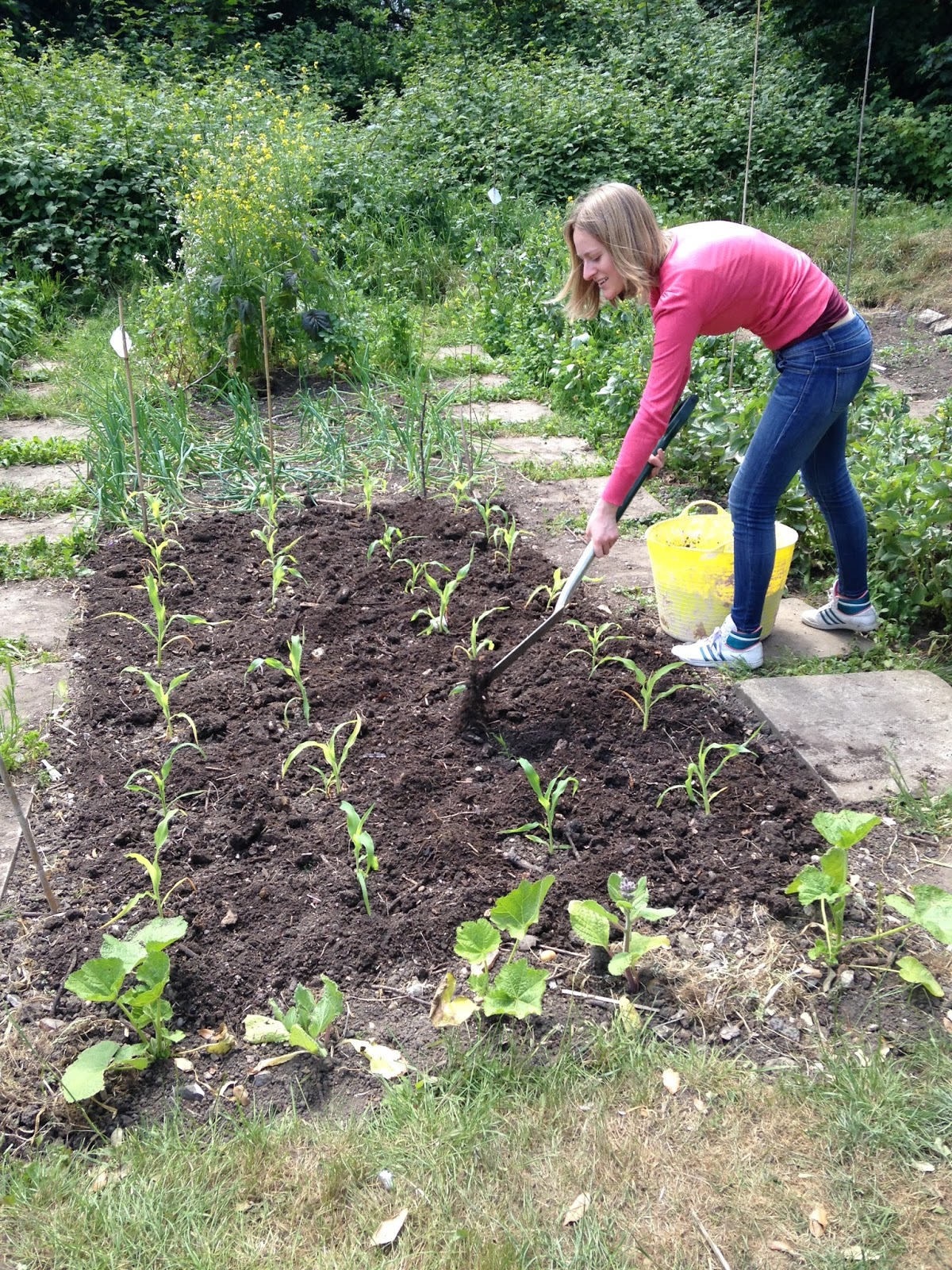
      For example: The Rooting in Tooting project with CARAS hopes to use waste textiles from Oasis to make wall-hanging exterior planters, as shown here – in this case for strawberries.

      It’s fascinating that Oasis as an enterprise has the primary objective of raise funds for their charitable purpose and has the complementary positive goal of reducing waste in creative ways. 
      Others please take note!

      We hope to see you at the Oasis shop at Amen Corner on Tuesday evening.
      – Jeni and Chuck

    • Leo’s Garden: an oasis tucked above Tooting

      Tooting has a new and delightful asset!

       
      A new garden balcony for all the staff at the Tooting campus of South Thames College opened today in memory of Mumney Olusanya (or Leo, as he was better known). Leo was Facilities Manager at the Tooting campus, and died on the 31st October 2013. Leo’s Garden is a University and College Union initiative and was opened by Angie Birtill of the Trade Union Studies Centre.

      Angie raising a fizzy apple juice as a toast to Leo’s memory

      Spring bulbs were planted later today in memory of Leo, adding to the planting done over spring and summer this year – all funded by the volunteers themselves. As well as a memorial to Leo, the garden is consciously about health and safety – creating an attractive place for any college staff to boost their wellbeing during a busy day. 


      It’s an environmental project too: showing what can be done collectively by volunteers to make their surroundings at work come alive. Kate Turney from STC said the intention is “to support biodiversity by growing a mixture of flowers, vegetables and herbs which can turn a small concrete space into a greener cleaner wildlife friendly haven”.

      Cutting the cake: “I now declare Leo’s Garden open!”

      “This space is meant to be a green space in a very built-up area,” said Angie, “and it’s meant to be a place for the staff to relax. Leo was one of those people who made it good to come to work. He was kind, he was funny, he always did everything he could for you. When we sit here and we think of nice things, it’s Leo that we want to think about”.

      Artura West, wood and stone carving tutor at the STC Wandsworth campus, designed and carved the ash plaque.
      “If you look closely, you’ll see each “E” has a flowering motif, to keep the theme of the garden,” he said.

      The view from the supermarket carpark – you’d never know the garden is there.
      And look at the unusual views from the balcony (this one in July this year) – giving visitors a brand new new insight into Tooting.
      More photos online courtesy of Dave Mauger at Tooting DailyPRSS here.
      It was great to be invited to the opening of the Leo’s Garden – thank you!
      We’re sure that other groups may like to do something similar at work or in their neighbourhood. TTT has a brand new project called Growing Tooting which can offer support to beginners or experienced gardeners who want to get growing together. Please get in touch with TTT to explore how we can assist….we look forward to hearing from you!

      A new balcony for the staff at the Tooting campus of South Thames College opened today in memory of Mumney Olusanya (or Leo, as he was better known).

      Leo was the Facilities Manager at the Tooting Campus, and died on the 31st October 2013. The aptly named Leo’s Garden was opened by Angie Birtill of the Trade Union Studies Centre, and is a University and College Union (UCU) initiative. Bulbs will be planted later today in memory of Leo.
      The balcony has also been created as a green space, as demonstrated by the different flowers and plants dotted around the area
      – See more at: http://tooting-news.dailyprss.co.uk/tabs/blog/preview/2015/10/leos-garden-opens-at-south-thames-college-in-tooting#sthash.tDWV7sDv.dpuf

      A new balcony for the staff at the Tooting campus of South Thames College opened today in memory of Mumney Olusanya (or Leo, as he was better known).

      Leo was the Facilities Manager at the Tooting Campus, and died on the 31st October 2013. The aptly named Leo’s Garden was opened by Angie Birtill of the Trade Union Studies Centre, and is a University and College Union (UCU) initiative. Bulbs will be planted later today in memory of Leo.
      The balcony has also been created as a green space, as demonstrated by the different flowers and plants dotted around the area
      – See more at: http://tooting-news.dailyprss.co.uk/tabs/blog/preview/2015/10/leos-garden-opens-at-south-thames-college-in-tooting#sthash.tDWV7sDv.dpuf

      A new balcony for the staff at the Tooting campus of South Thames College opened today in memory of Mumney Olusanya (or Leo, as he was better known).

      Leo was the Facilities Manager at the Tooting Campus, and died on the 31st October 2013. The aptly named Leo’s Garden was opened by Angie Birtill of the Trade Union Studies Centre, and is a University and College Union (UCU) initiative. Bulbs will be planted later today in memory of Leo.
      The balcony has also been created as a green space, as demonstrated by the different flowers and plants dotted around the area
      – See more at: http://tooting-news.dailyprss.co.uk/tabs/blog/preview/2015/10/leos-garden-opens-at-south-thames-college-in-tooting#sthash.tDWV7sDv.dpuf

      A new balcony for the staff at the Tooting campus of South Thames College opened today in memory of Mumney Olusanya (or Leo, as he was better known).

      Leo was the Facilities Manager at the Tooting Campus, and died on the 31st October 2013. The aptly named Leo’s Garden was opened by Angie Birtill of the Trade Union Studies Centre, and is a University and College Union (UCU) initiative. Bulbs will be planted later today in memory of Leo.
      The balcony has also been created as a green space, as demonstrated by the different flowers and plants dotted around the area
      – See more at: http://tooting-news.dailyprss.co.uk/tabs/blog/preview/2015/10/leos-garden-opens-at-south-thames-college-in-tooting#sthash.tDWV7sDv.dpuf

      A new balcony for the staff at the Tooting campus of South Thames College opened today in memory of Mumney Olusanya (or Leo, as he was better known).

      Leo was the Facilities Manager at the Tooting Campus, and died on the 31st October 2013. The aptly named Leo’s Garden was opened by Angie Birtill of the Trade Union Studies Centre, and is a University and College Union (UCU) initiative. Bulbs will be planted later today in memory of Leo.
      The balcony has also been created as a green space, as demonstrated by the different flowers and plants dotted around the area
      – See more at: http://tooting-news.dailyprss.co.uk/tabs/blog/preview/2015/10/leos-garden-opens-at-south-thames-college-in-tooting#sthash.tDWV7sDv.dpuf

    • From the Local to the International – Journeys of imagination and generosity at the Transition Network International Conference

      Back in September, Charles Whitehead wrote a preview piece about 8 of us from Tooting heading to the Transition Network International Conference at Seale Hayne, Newton Abbot. We went by caravan, car share and train arriving the day before, early afternoon and late at night.

      You can read all about how we contributed to the conference in Charles’ blogpost here. Following the conference, we were all excited to share our experience of it as it had so much energy to give! Please do click on the links in the highlighted words, if they are of interest. There is also a Storify of the Conference and a blog on the Transition Network site.

      Tooting heads West!
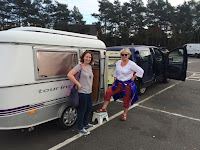
      Home away from Home, with cake!

      After arriving, pitching our tents, siting and re-siting our caravan and finding our rooms, Jenny , Hilary and myself participated in the Transition Skills day, learning lots about Transition Thrive , designing a new economy in “REconomy” and how to “Become your own Developer” before the conference actually began.

      Meanwhile, Lucy was running her own workshop on Creative Engagement, she writes…

      “Once I’d recovered from the news that my main collaborator, Ruth Ben-Tovim (she of the Tooting Transition Shop from 2012), was sick and I would have to get on and run the day long Transition workshop on the arts and creating community on my own, I decided this Transition Conference (my 4th) was going to be about getting on and doing it with the resources I had to hand. I calmed myself by imagining the 14 strangers I was about to meet and wondering why they could be interested in learning about the craft of making things happen, and the art of creative participation. The knowledge they would all be doing this in a Transition context i.e. making the world we want to live in by modelling the changes in how we live where we live, immediately made me relax. I felt I could be myself and invite them to give all of themselves to the workshop, which they did! The day was astonishing for the rich diversity of their expertise, their generosity to give and gain from one another and the final artworks they created together. I was bowled over by how much creative ground we covered and my abiding faith in the central role our imaginations and creativity play in Transition. I have spent 3 years capturing this in the transition book in the arts, Playing for Time – making Art As If the World Mattered and it felt as if the book had in a sense, come home.

      This feeling of generosity, sharing and common goals was echoed by Jenny’s experience, she reflected later:

      “It was inspiring and encouraging to meet other people from around the world who share a vision for a fairer, more community-led world. A focus on collaboration, partnerships and relationship building was a common theme. It’s something we cherish in Transition Town Tooting and will continue to build in 2016. A Neighbourhood Plan, Foodival and our garden projects wouldn’t be possible if it weren’t for the generosity and energy of our partners and volunteers”.

      My experience during the Transition Thrive training was similarly applicable to our activity in Tooting and encouraged me to be active in looking after the wonderful volunteers and core group of Transition Town Tooting as well as offering the opportunity to participate to more people through Open Days and outreach.

      Our Workshops: Outdoor Learning with Young People and Creative Facilitation with FanSHEN

      Day 2 and the conference proper begins… Jenny, Charlie, Sharon and I hosted a workshop on Outdoor Learning with Young People. We shared our work in Outdoor Learning in 3 areas:

      • with children of Gatton Primary School at the Community Garden – both Reception/Year 1 and Year 6.
      • with teenagers, creating a garden space at CARAS.
      • with families during our regular Sunday sessions at the Garden and through our collaboration with FanSHEN during the 6 Field Days that ran through he summer. 
      We asked the group what Outdoor Learning meant to them and even got outside to share 3 Outdoor Learning exercises, including the Human Camera…
      What is Outdoor Learning?
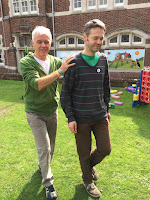
      The Human Camera – one
      of 3 Outdoor learning games

      It was fascinating to bring it together for one workshop. Really valuable for us not only to present together, but also to hear each others experiences in a different way. It was also representative of the Conference as a whole that we had 7 participants from 7 different countries! Hearing their experiences gave us food for thought.

      Hilary’s reflections echo this:

      “The single best thing was the opportunities to meet and discuss with others in the Network Worldwide – supported by a great blend of facilitation and self-organisation. From the opening session were a group of 300+ individuals from 40+ countries met and mingled through to focused discussions in the workshop and Open Space sessions and the random conversations over meals, the programme provided every opportunity to connect and talk. Most of all, I enjoyed the capacity of Transitioners worldwide to self organise a room in moments – as demonstrated here!”
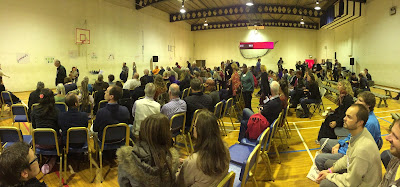
      The First Gathering, anticipation builds…

      Lucy goes on to say…

      “The next 2 days of the conference felt like a brilliant holiday! Meeting new people, feeling the pulse of so many international initiatives connecting worldwide; enjoying a session with Tom Crompton from Common Cause on intrinsic and extrinsic values; learning about COP21 in Paris in December and being in a home group with Alajie from Gambia, Pete from Perth and Gill from Transition Exeter. My highlights? Selling all the copies of Playing for Time and attending a brilliant bicycle maintenance workshop with Mike Jenner: as much about a philosophy of life about looking after things, community and compatibility as about chain tools and gear cogs.”

      Meanwhile, Dan and Rachel, aka FanSHEN – our collaborators in the Tooting Field Days – ran a workshop on Creative Facilitation with 50 attendees! Complete with hurling eggs and plasticine models.

      The shear variety of activity on offer was mind-blowing, as can be seen by our mind-map of things to follow up.

      The Paris Climate Change Conference: COP21

      One of those strands was COP21, the International summit on Climate Change happening in Paris. This conversation was convened by a participant of the Conference during one of two Open Space sessions, here’s Charlie’s digest of some key points:


      “The conference runs for the first 2 weeks of December: a vast stage-managed event where final negotiations are thrashed out, and at the same time citizens and groups worldwide watch the process – and make their feelings known, if possible. A good article to sum it all up can be read here. It’s even pretty optimistic!

      Paris is the 21st of these global conferences, and the Transition Network has commissioned the publication of “21 stories for COP21” – inspiring stories from around the world of transition groups taking practical action that has an impact now on carbon reduction, and social and environmental benefits. We’ll circulate that publication as soon as its ready.
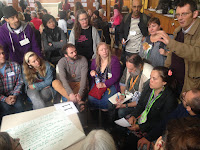
      What should we do for COP21?

      At the Transition Conference in September, a very active group focused on what could be done in Paris to support visiting Transition groups who want to be close to the action – witnessing the talks, maybe adding their voices to the marches, and also running events and workshops to demonstrate what we are achieving together now. We’ll share those details.

      Of course there are many events in London too – workshops, films and a major Climate March on November 29th. Never “marched”? Have a look at the post on the TTT blog to consider what its like, and why do it. On the day described, 700,000 people marched all around the world. We’ll share details of a TTT group taking part.”

      Final Thoughts…

      The Valley view, early morning


      From a glass of wine overlooking the valley in brilliant sunshine to Local Entrepreneur Forums to co-creating a network across the world’s Megacities, it was a wonderful weekend. Lucy writes…

      “I came away glad to put so much of my life energy of the last 7 years into a movement that has taught me so much about the broad picture challenges we face, and the practical, immediate and enjoyable ways in which these challenges can be turned to opportunities working day-by-day over time with like minded people.

      Above all it was magic to be there with so many others from Tooting. What a place to come from and go home to! Onward!”

      And the last word to Sharon, who describes her experience of going to the Conference for the first time:

      “As a first-time conference goer, I was anxious about being out of my depth. However, I met lots of fascinating, friendly folk and felt I made valuable contributions – from the outdoor learning workshop I co-hosted, to the lively sessions on professionalising Transition work and creating livelihoods. It was also great to meet non-Transition people at the conference who shared similar goals, values and ideas. All in all, an exhausting yet very energising weekend.”

      All best, Richard

    • So what is outdoor learning?

      For the past 2 1/2 years, TTT has been running outdoor learning classes with pupils from Gatton, a local primary school in the community garden. From weekly sessions with Reception and Year 1 classes, to 7-week projects with the Year 6 students, the classes encompass a huge range of cross-curriculum learning, developing new skills and vocabulary and allowing the children to fully interact with nature in the safe and beautiful environment of our garden.

      But I still get asked regularly, what exactly is outdoor learning? So, here’s a brief example of my class today, on a beautiful autumn morning with a lively Year 1 group…

      After warm greetings and not-at-all-exaggerated reports on how much they had grown over the summer holidays, the children discussed the different seasons, today’s weather and how the sunshine made them feel: happy, bright and a bit sweaty! We then looked at some of the plants we had been growing – a cherry tomato that I picked just before they arrived and a beetroot. They were very excited to discover that beetroot acts as a natural dye and took great delight in getting a red thumb. We also went to look at the green and yellow pumpkin that was growing in the vegetable beds.

      Then we played an energetic game of seek and find, bringing back different numbers and colours of grasses, leaves, pinecones, sticks and acorns. The children learned that the squirrels love to eat acorns and hide them away so that they can eat them later in the winter; we found lots of buried acorns in the garden – sorry squirrels!

      And then, while half the group help collect objects for the Big Draw, the other half used trowels (remembering the safety instructions I taught them last year) to dig up the old pea plants in their little veg bed. The plants went on the compost heap to be recycled in the garden. We all put our hands into the freshly dug soil to feel how it was drier on the top and damper underneath but was also loose like crumble mix. And the numerous worms that were unearthed during the process were all gently and kindly transported to the bush where rumour has it they were having a big worm party…

      Finally, after making big shapes, small shapes and star shapes, the children exploded with an impressive “Acorns!” for their “word jump”. Exit one group of happy, rosy-cheeked, energised children.
      Sharon


    • From the outside looking in

      Mena participating in the garden

      Earlier in the year, we had a visit by an MSc student from Edinburgh called Mena Grossmann. Mena, as she describes below, used Transition Town Tooting as a case study to explore diversity within the Transition Town Movement for her MSc research project.

      For us and the Transition Movement as a whole, engagement with academic research has to be 2-way, with both parties benefitting. We hope Mena’s research will give us real insight into who we are reaching through our work in Tooting.

      Mena will be publishing her dissertation after it has been marked, we can’t wait! And will share it when we can.

      If your Transition Initiative is interested in engaging with academic research, The Transition Network do have suggested guidelines to help negotiate the first steps of partnership between a Transition Town and a Researcher, these can be found here. There is also the Transition Research Network who focus on this area and provide a forum to link a researcher with an Initiative. However, we sort of made it up as we went along…

      Over to Mena…

      “Somebody told me that Tooting was like an onion, because it has many layers. During my 2-week stay in Tooting, undertaking interviews and participating in TTT’s activities as part of my MSc dissertation on diversity and participation in the Transition Movement, I was able to have the incredible opportunity of unpeeling some of those layers.

      Coming to TTT, and Tooting in general, as a complete stranger, my first days felt like when you’re cutting an onion; eyes watering furiously and impaired vision. However, after a few fascinating days visiting the community garden, going along to a neighbourhood planning meeting and undertaking a couple of interviews, a map began to develop bit by bit in my mind as I started to develop an understanding of the functioning of TTT, of the multitude of community groups working in the area and of the social networks and connections that link them.

      Of the many wonderful impression I take with me of TTT and Tooting a few have particularly stuck in my mind. One is the massive dedication and motivation of the TTT core group. Incredible amounts of time go into organising events, maintaining, developing and improving longer term projects, as well as building working relations and friendships with other actors in the Tooting community. And each is done with a sense of joy and passion. TTT offers an incredibly wide range of activities from community gardening to restart workshops (to repair broken gadgets), thus appealing to people with different interests. It also collaborates with a large number of local restaurants, charities, politicians and schools through events and projects, thus embedding itself in the community and playing a part in strengthening the sense of community in Tooting.

      This leads me to my next impression, which is the incredible generosity and willingness of the people of Tooting to be of assistance and to openly share stories with a stranger. I experienced this first hand when, on one of my first days, I went to a restaurant called Al Mirage to ask the owners about their collaboration with TTT during the annual Foodival. Without quite realising what was happening, I was promptly ushered to a table and invited to have lunch free of charge with the owner and his son whilst talking about TTT, the restaurant and life in general. For me, this one event characterises my entire research trip to Tooting. The openness of people outside of TTT to tell me about their experiences of collaborating with them is certainly a testimonial to the favourable reputation that TTT enjoys among the wider community.

      On this note I would like to thank all my interviewees within and outside of TTT, to Richard as my main point of contact in TTT and who worked tirelessly to organise interviews, to all in TTT for making me feel welcome and to Al Mirage for setting the tone of my visit.”

    • From today: the new 5p tax will be charged for single-use plastic shopping bags

      The long-debated tax of 5 pence per single-use plastic bag becomes law from the 5th October in England, and applies to ‘free’ bags from larger shops and chains (enterprises employing more than 250 people). Smaller shops can also charge if they wish. The sums charged go into pots for charity…so there are some complex processes, rules, exceptions (and fines for non-compliance) behind the scenes. 
      Read the government’s guidance for retailers here.

      So what? 
      In 2013 we used 8 billion of these ‘free’ bags per year, just from UK supermarkets….with year-on-year totals growing.
      Wales, Northern Ireland and Scotland have already implemented this tax – the latest figures show that in Wales, the use of these short-life bags nationally has been reduced by 79% over 4 years.

      The majority of these bags are instant waste, with an enormous cumulative impact in terms of costs of dealing with household and business rubbish, and blight from windswept litter all around us. 
      Read TTT’s earlier 2010 post about global plastic pollution here
      They are derived from oil, a non-renewable resource. (There are other options such as bidoegradeable cornstarch).

      Of course there is a carbon saving if bag use is reduced – savings in terms of materials used to make them, and their distribution, and the carbon costs of disposing of them. 
      ‘Reduce’ has much more positive impact than ‘re-use’ or ‘recycle’ and is much more within our own control.

      What does this mean for me?
      There’s a new article – click here – which summarises exactly that.

      Which shopping bag to use today?

      There’s an easy option that can suit all pockets: 
      use a textile ‘bag for life‘. 
      Made of jute or cotton, they are recyclable when they finally pack up – cut up and composted, or used as mulch.

      For a good short article about re-usable bags, click here.

      Cloth bags also have a carbon cost in their own production and distribution; some long-life shopping bags are made of plastic textiles.

      We can make a positive statement
      Eagle-eyed readers will see a cloth shopping bag from Modbury, Devon in the photo above. That same image is used on the ‘Welcome to Modbury’ road signs outside the town. 
      There, a local voluntary campaign in 2007 encouraged shops and shoppers in the town to stop using plastic bags.

      That brought a double win – not only reducing oil-derived waste, but also developing social glue and a sense of teamworking in the community. That is not necessarily easy: Rebecca Hosking who championed this idea in Modbury said in 2007:

      • “It seems to have really brought people together. The shops have sent all their unused plastic bags to Newcastle where they are being made into plastic chairs, and they have all set up plastic bag amnesty points where people can bring in the hundreds of bags that they keep under the kitchen sink. Now it’s just a question of seeing if people accept it. We are all trembling now. To be a pioneer is pretty scary.”

      And in Tooting?
      Now, 8 years after this pioneering in Modbury, larger enterprises all over in England will be charging for single-use bags from today. 

      • What can we do locally to build on this opportunity to make a positive statement about Tooting and its environment?
      • How can we encourage small retailers to reduce bag use? 
      • Can we make upcycled Tooting bags with charity shop textiles?
      • Grow our own shopping bags? …any more ideas?

      Fashionable on eBay, but still plastic


    • Urban Heat 2nd October ’15: our third Tooting workshop on community-led approaches to urban heatwaves

      Today we hosted the third workshop in the Urban Heat research project. This is an 18-month research process into community-led responses to urban heatwaves, with a particular focus on the local impact on vulnerable people. The research is led by the Policy Studies Institute at the University of Westminster, with funding from the Joseph Rowntree Foundation.
      For the details of the wider project, please see our short posts on the two previous workshops in June and July. TTT has been inviting and convening local groups to take part, and hosting the events.

      Today’s workshops saw diverse Tooting community organisations meet a group representing the strategic and borough-wide institutions who have a mandate to act on heatwaves alongside many other priorites.
      This was not intended to be adversarial…! The purpose was to bring together key players who respond at different local and city ‘levels’ to heatwaves, all in the interest of local people’s wellbeing and health.

      The community groups summed up their ideas and proposals identified so far, and these were grouped into three themes:

      • Bridging and making connections
      • Communications and awareness
      • Resources and infrastucture

      Everyone present discussed each theme in detail – so we can all understand, anticipate and respond to the impact of urban heatwaves, together. There was a lot to talk about!
      The research team will be summing up points made and actions proposed. This is ‘action research’ – it is up to us all locally to decide which of these ideas are most valuable and can be put into practice, while the researchers continue with the next steps of the project.
      We’ll keep you informed.

      Represented today were: Age UK (Wandsworth), Be Enriched, Emergency Planning at St George’s Hospital Trust, Furzedown Low Carbon Zone, Housing Strategy & Development at London Borough of Wandsworth, Neighbourhood Network SW17, Public Health at London Borough of Wandsworth, Thinking Works and Transition Town Tooting. Thank you all!