Category: Gardening

  • So what is outdoor learning?

    For the past 2 1/2 years, TTT has been running outdoor learning classes with pupils from Gatton, a local primary school in the community garden. From weekly sessions with Reception and Year 1 classes, to 7-week projects with the Year 6 students, the classes encompass a huge range of cross-curriculum learning, developing new skills and vocabulary and allowing the children to fully interact with nature in the safe and beautiful environment of our garden.

    But I still get asked regularly, what exactly is outdoor learning? So, here’s a brief example of my class today, on a beautiful autumn morning with a lively Year 1 group…

    After warm greetings and not-at-all-exaggerated reports on how much they had grown over the summer holidays, the children discussed the different seasons, today’s weather and how the sunshine made them feel: happy, bright and a bit sweaty! We then looked at some of the plants we had been growing – a cherry tomato that I picked just before they arrived and a beetroot. They were very excited to discover that beetroot acts as a natural dye and took great delight in getting a red thumb. We also went to look at the green and yellow pumpkin that was growing in the vegetable beds.

    Then we played an energetic game of seek and find, bringing back different numbers and colours of grasses, leaves, pinecones, sticks and acorns. The children learned that the squirrels love to eat acorns and hide them away so that they can eat them later in the winter; we found lots of buried acorns in the garden – sorry squirrels!

    And then, while half the group help collect objects for the Big Draw, the other half used trowels (remembering the safety instructions I taught them last year) to dig up the old pea plants in their little veg bed. The plants went on the compost heap to be recycled in the garden. We all put our hands into the freshly dug soil to feel how it was drier on the top and damper underneath but was also loose like crumble mix. And the numerous worms that were unearthed during the process were all gently and kindly transported to the bush where rumour has it they were having a big worm party…

    Finally, after making big shapes, small shapes and star shapes, the children exploded with an impressive “Acorns!” for their “word jump”. Exit one group of happy, rosy-cheeked, energised children.
    Sharon


  • Young people’s garden project leads to Rooting in Tooting

    If you’ve walked past the Derinton Community Centre in Tooting recently, you may have noticed vibrant yellow planters bursting with colourful flowers, where rubbish used to reside, and young people sitting on bright benches doing their homework.

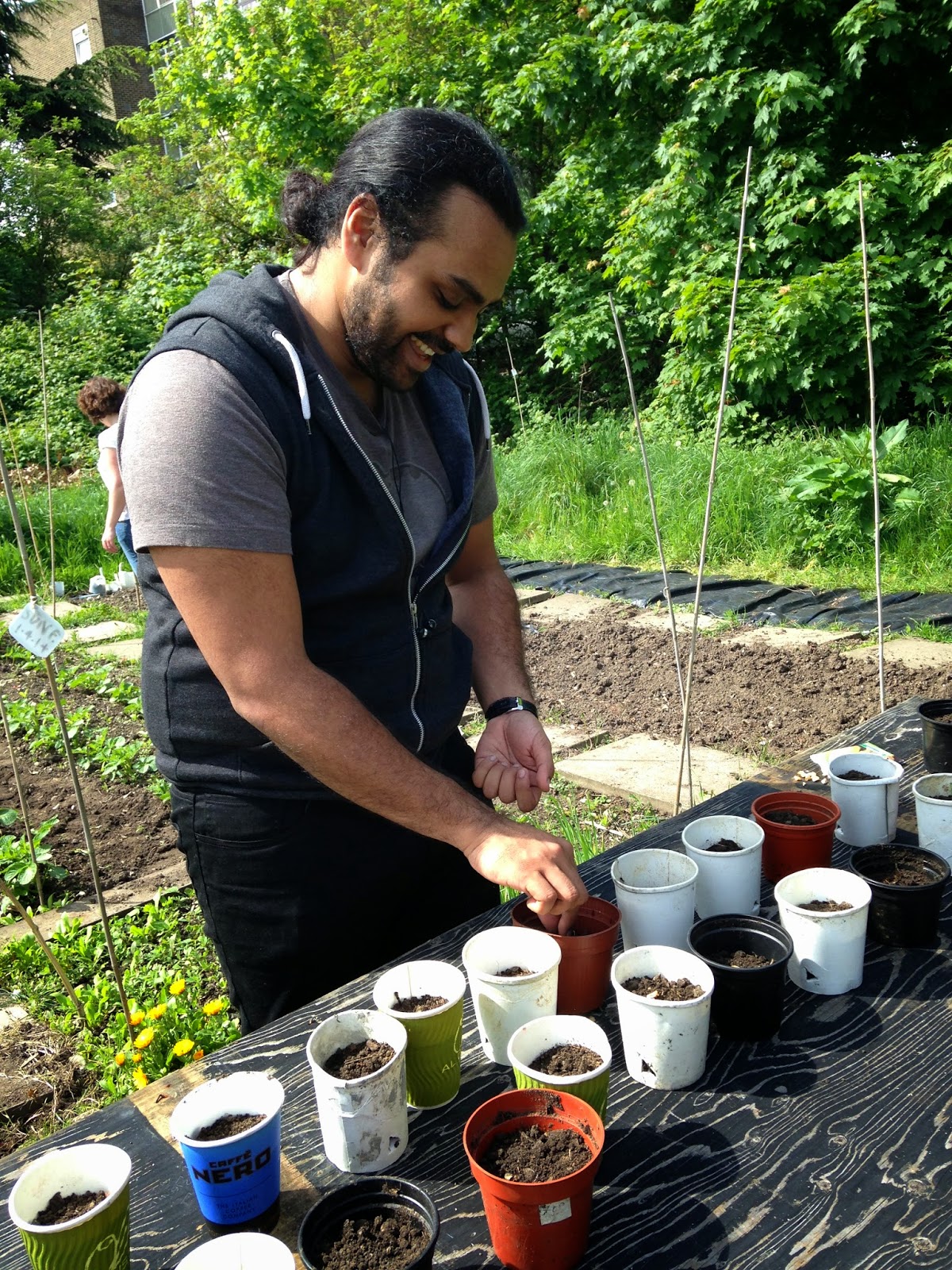
    Those young people, who attend the CARAS youth club on the site, worked with a team from Transition Town Tooting to build the planters and the benches and paint them over a number of weeks. They sowed seeds early on in the project and also chose plants that now grow there, during a visit to Share Community Garden

    The project came about after the youth club made a visit to Tooting Community Garden.  This led to the idea of the teenagers creating an urban garden on-site over eight weekly Saturday sessions.

    “Before this, I didn’t know how to plant and grow plants, but I learned how, and I enjoyed making the planter too”, said Waseem, one of the young people who transformed the space.

    CARAS (previously Klevis Kola) is a community based organisation working with refugees and asylum seekers.  The gardening project was developed with the young people, encouraging teamwork and communication, developing and practicing new skills and meeting new people in the wider community.

    Jenny Teasdale, who coordinated Transition Town Tooting’s involvement said,

    “Working with these young people over the last couple of months has been wonderful. Together, we imagined the possibilities of an urban garden, creating a mood board of ideas, and then we made some of those ideas a reality.

    Everyone planted seeds in the first few weeks and the kids tended them throughout, watching sunflowers, beans and salad leaves growing, ready to be planted out in the final weeks. With wooden materials from the community garden, the kids cut, assembled and painted planters and benches – making design decisions on the fly and developing new skills along the way. As a group, we decided what plants to grow and where to site what we built.

    I know I wasn’t the only person sad to see the project come to an end, having enjoyed every second of the process. At the same time, we are all really happy to see the transformation in just two short months.”

    CARAS Youth Coordinator, Molly Abraham spoke about the project,

    “The gardening project with TTT has been a fantastic opportunity for young people who attend CARAS to gain skills, share knowledge and create something we are all extremely proud of.  It’s been amazing to watch the group grow in confidence as they became proficient with drills, saws and secateurs, and to relax into sharing stories of growing in their home countries.  Working with the wonderful team from TTT has been a real pleasure for all of us and we are excited to be able to develop the work, and the friendships, over the coming year.”

    “We painted the pallet planter and the yellow planter, and I sowed flowers and beans. They’re still growing”, said Hafso, shown here painting.

    Spurred on by the development of the space and the enthusiasm of the youth group, we are delighted to announce that CARAS and Transition Town Tooting are now working in partnership with the RHS over the next year, running monthly sessions with the youth club and adults at CARAS.

    The new project is called Rooting in Tooting, and is part of the RHS’s Greening Grey Britain scheme. We’ll be developing more flourishing, attractive growing ideas that will transform the site.  This practical, experiential project is just one of the ways CARAS is helping newly-arrived people to integrate into the vibrant community of Tooting.

    Chris Young from the RHS led a session with the youth group last Saturday:

    “I was very excited to make my first practical visit to the CARAS youth club, and had a great afternoon working with the youth club members and volunteers. We started by talking about our project to grow plants in various spaces surrounding the centre and then looked at propagating some herbs that could be used later on.
     

    I gave a quick demonstration of how to take cuttings from the plants I’d brought and then everyone got stuck in and had a go.We finished up by extracting seeds from dry seed heads and sorting them into origami seed packets we’d made earlier.

    Everybody was incredibly helpful, enthusiastic and welcoming. I was also impressed that some of the young people knew the plants I brought and told me about how and where they grow in their home countries.Fingers crossed that the cuttings root!
     

    Looking forward to my next visit for the community fun day on Saturday where we’ll set up stand for the project .”

    We’ll be promoting the new project at the CARAS Family Fun Day on Saturday, 22nd August.

  • A lovely Tooting Community Garden Open Day

    Our Open Day on Sunday 14th June was full of contrasts. A damp and quiet start with a steady trickle of visitors, good conversations and storytelling with Aesop Grimm gathered pace in the afternoon as the sun came out. We cooked delicious treats prepared by the Tooting Field Day group on the charcoal fire, while fanSHEN’s The Apple Cart was performed all around us, with the Furzedown Oak sculpture underway and our plastic bottle greenhouse being raised by many hands (it was great to have tall visitors for some of the key jobs…). 

    By the end of the day all was quiet again, and the morning felt a very long time ago, a different time and place. That’s what is great about the social and growing microclimate of the Community Garden!

    To share our own first reactions, we’ve posted a slide show below. We’ll return to some of the themes of the day again – the garden as a place for nature, to be outdoors, for learning, for creativity, for growing and cooking, and for enjoyable company of all ages. 

    Enjoy the photos and come and visit again or for the first time. We’re open every Sunday between 11:00 and 1:00 for our welcoming sessions at 5 North Drive, SW16 1RN.

    And for the diary, the free July Field Day is on Saturday 12th. Details are here online.

  • The Great Greenhouse Build – we need your help!

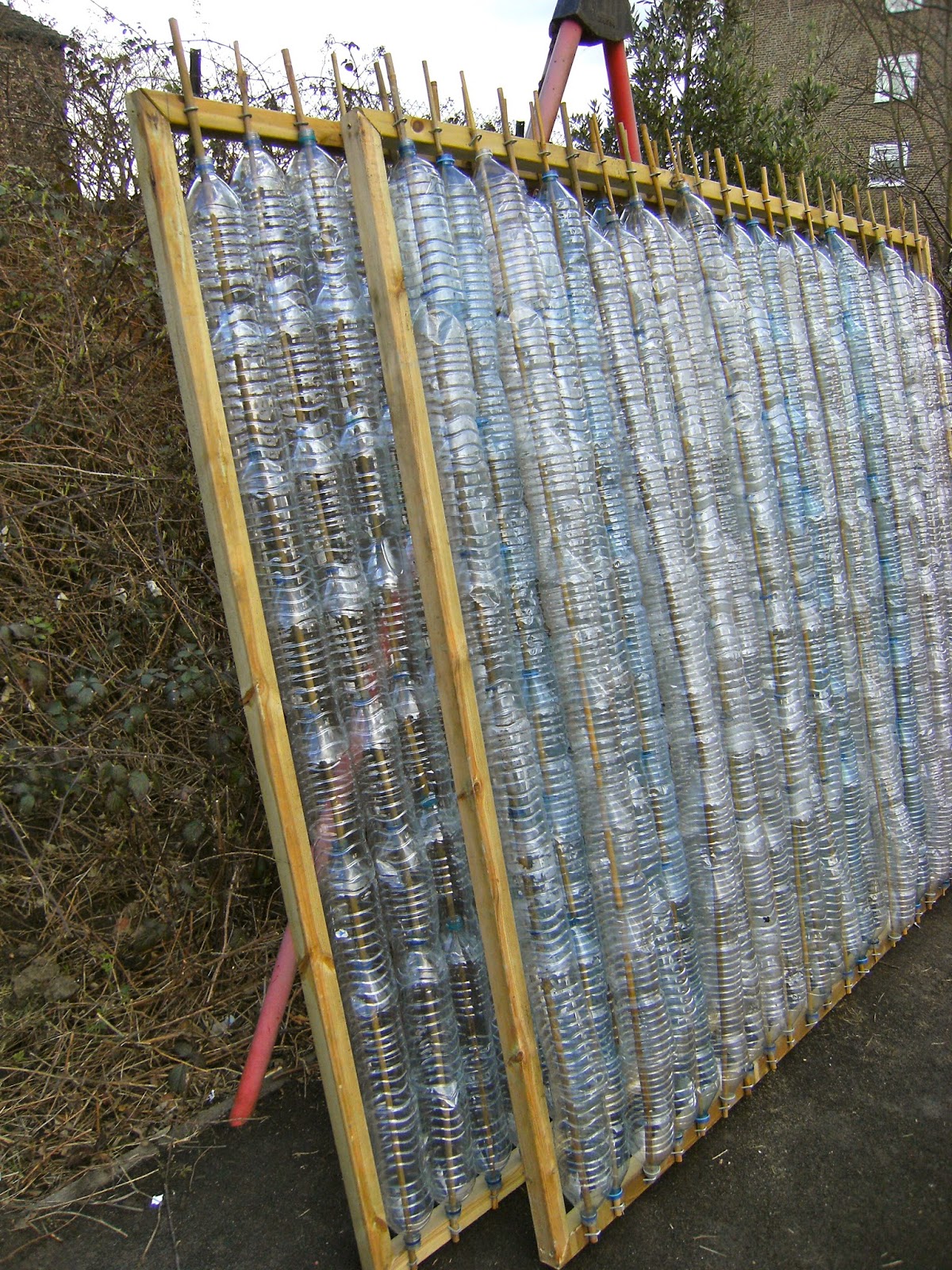
    Our current outdoor learning project with Gatton School is to build a greenhouse in the community garden made from recycled plastic bottles (see picture below – this is what we hope the finished greenhouse will look like). The year 6 pupils come to the garden for an hour a week to work on this and despite lots of hard work on their behalf, it is slow going. After the Easter holidays, we have just two more lessons (ie two hours!) to finish the project. 
    Clearly this is going to be impossible – currently we have completed two side walls of the greenhouse (below), but we still have the back wall, the front wall with a door, two roof panels and two gable ends to make, and then we have to fit all the pieces together! Plus we have many more plastic bottles to cut.
    So we really need some volunteers to rally round and help out. At the first community session during the Seed Swap we had some great helpers and managed to build a wall of the greenhouse.
    Here’s how you can help:

    Because two more hours with 12x 10-year-olds isn’t going to be enough to finish the build, Sharon will be hosting some working parties in the garden in the Easter school holidays. Please come and help – we REALLY NEED YOU! There are tasks for all abilities so don’t feel you need any particular skills to make a contribution. If you have a hammer or a cordless screwdriver and can bring them along, even better.

    The drop-in sessions will be from 12pm-4.30pm on:
    Good Friday April 3
    Thursday April 9
    Friday April 10

    The Community Garden is at 5 North Drive, SW16 1RN.
    We’re tucked in behind the big red-brick house at that address, with entrance through the black fence to the left of the building. We’ll have a sign on the road.

    Bring your friends, bring your family (there’s even a playground for little kids to occupy themselves). And if you know anyone else who might be interested in helping out, please spread the word. The more the merrier. It really is good fun and hugely satisfying.
    If you would like to come along, or have any questions, please drop us a line at TootingCommunityGarden@gmail.com or the Tooting Community Garden Facebook page so we know how many people to expect.

    Hope to see you at the garden!
  • Food: Carbon Conversations Meeting 5

    We’re continuing the glimpses into what we’re covering in our current series of informal Carbon Conversations. Here is the fifth…
    Participant Ben has written his own response to this week’s meeting, all about exploring carbon reduction in our Food.
    Ben’s comments:

    ” Monday evening in Tooting….cold, damp with a mid-summer mist clinging to the trees across the common.
    And here we are, huddled around Jane’s dining room table for our fifth Carbon Conversations session.
    This evening’s topic is food. As ever, the discussion is thought-provoking and far-reaching.

    We discuss our personal relationships with food. We feel that food can be the source of positive things (pleasure, socialising, creativity) as well as negative (neuroses, ethical dilemmas, health concerns).

    Then we play a board game where we assess the carbon footprint of different food items. I’d never thought about food production in such an atomised way (production, processing, packaging and transport are all very distinct parts of the production line from plough to plate).

    The game throws up some surprises.
    Frozen chicken nuggets flown to the UK from Thailand are bad all round – high carbon at every stage of the process.
    But because 48% of food’s carbon emissions are embedded in the production part of the process, a piece of Irish cheddar comes out pretty high in C02 emissions as well (the production of cheddar involves the rearing of cows, their feed, methane the cows produce, etc, which is all very carbon-intensive).

    It is also interesting to note that something that’s travelled from afar isn’t necessarily bad –slow, long distance transport of non-perishable items by ship can be quite low in carbon. So, a few surprises here!

     
    Very Local:
    British-grown, good for you!
    Very Very Local:
    Sown, grown and
    eaten in Tooting!


    What are the prospects of making lifestyle changes on the basis of all this?
     

    The prospects are good I’d say. Low-carbon food tends to be healthier and cheaper. Indeed, the best food of all is stuff you’ve grown yourself: low-carbon, super cheap, and super healthy. So, the moral of the story? Dust off your gardening gloves, grab a trowel, and get planting.
    The future of food consumption is local produce.
    It’s a no-brainer.”


    Thank you very much, Ben!
    Next week is our 6th meeting: the finale of our 8th Tooting Carbon Conversations. All welcome to join us next time we offer the series.
    STOP PRESS:

    A very relevant article titled: Planting potatoes into policy: why town planners must think about local food’ was in The Guardian on 14 May. Read it by clicking here.
    
  • Six gardens to inspire us

    TTT people have made six fascinating garden visits (well five visits to new gardens, and our garden seems fresh every day). We want to share our impressions of things that excited us in many settings, from diverse and creative points of view, all of which can inspire our growing in Tooting.
    Yes we are only showing snapshots – on another day, and for another visitor, there’d be a different experience.
    Two gardens are in New York, in Manhattan’s Alphabet City – where guerilla gardening began in the early 1970s in a bid to develop community ties and reduce unsafe areas. It wasn’t set up by politicians, but by individuals mobilising together.
     
    Which is your favourite garden; what inspires you to grow?
    Share a comment below this post…
     
    First, the Tooting Community Garden. We have been sowing beans, corn, and more beans – one of our contributions for Growing for the 2014 Foodival. Come and see them at our Garden Open Day, from 1000-1700 on Sunday 15th June, when we’re open as part of Open Garden Squares and the Furzedown Festival.
     
    Bursting out on 21st May

    Sowing on 5th May


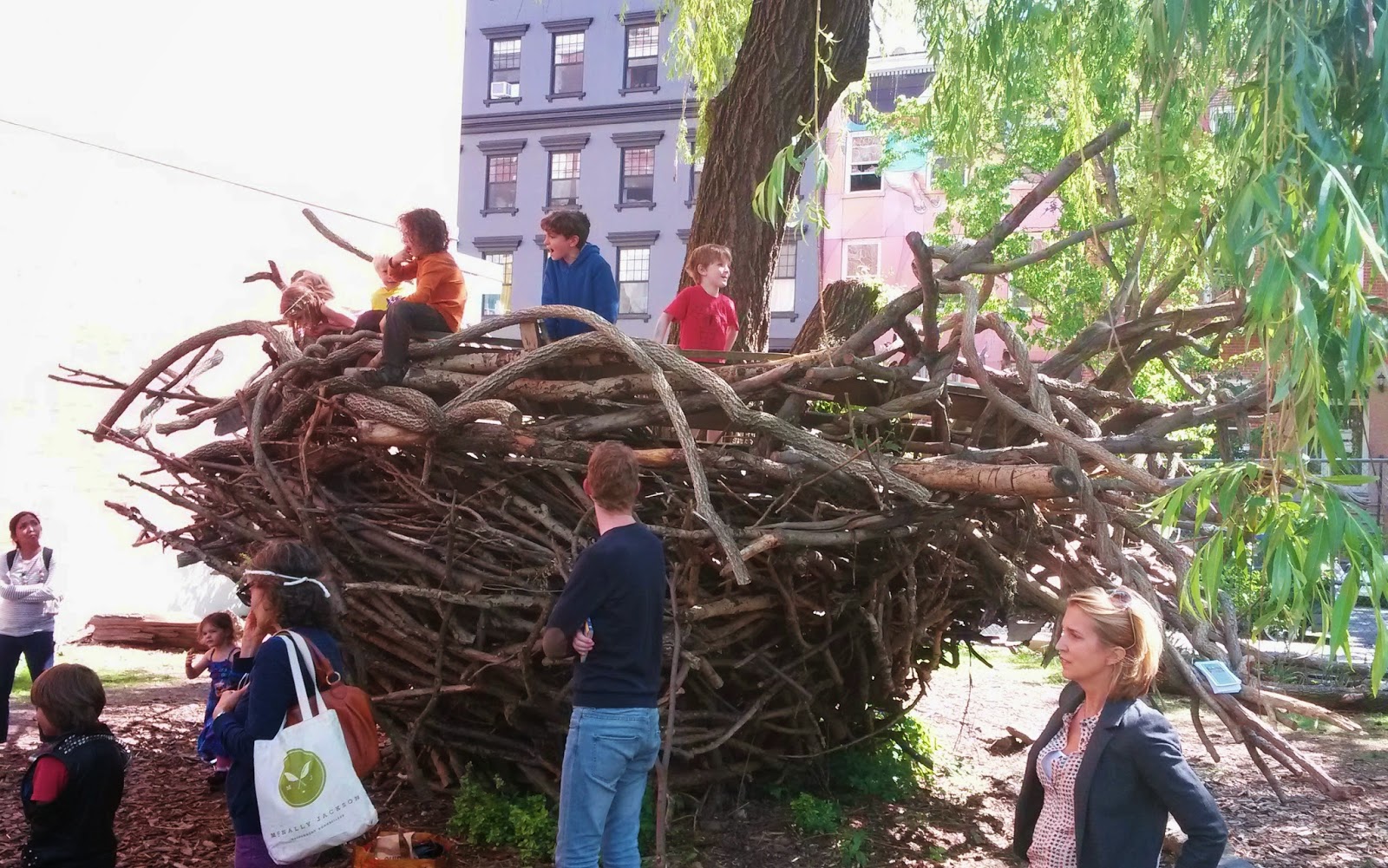
    Second, El Jardin del Paraiso in New York City.  Home to the most fantastic tree house (or should I say tree nest) I’ve ever seen. It was great to see so many children enjoying the space and hear music being played (much like our garden every Sunday).
    The tree nest was the result of a partnership with local artists, and

    reminded me of the Furzedown Oak project that we’re part of in Tooting. It really brought to life how art can inspire people’s connection with the natural environment around them and help their enjoyment of that space. http://evpcnyc.org/eljardin/

    Third, Chelsea Physic Garden.
    A paradise since 1673 for lovers of plants and botanical history, right on the Thames near the Royal Hospital (and the Chelsea Flower Show right now). It is very welcoming, and in beautiful condition, with the wow factor of expert planting and interpretation.

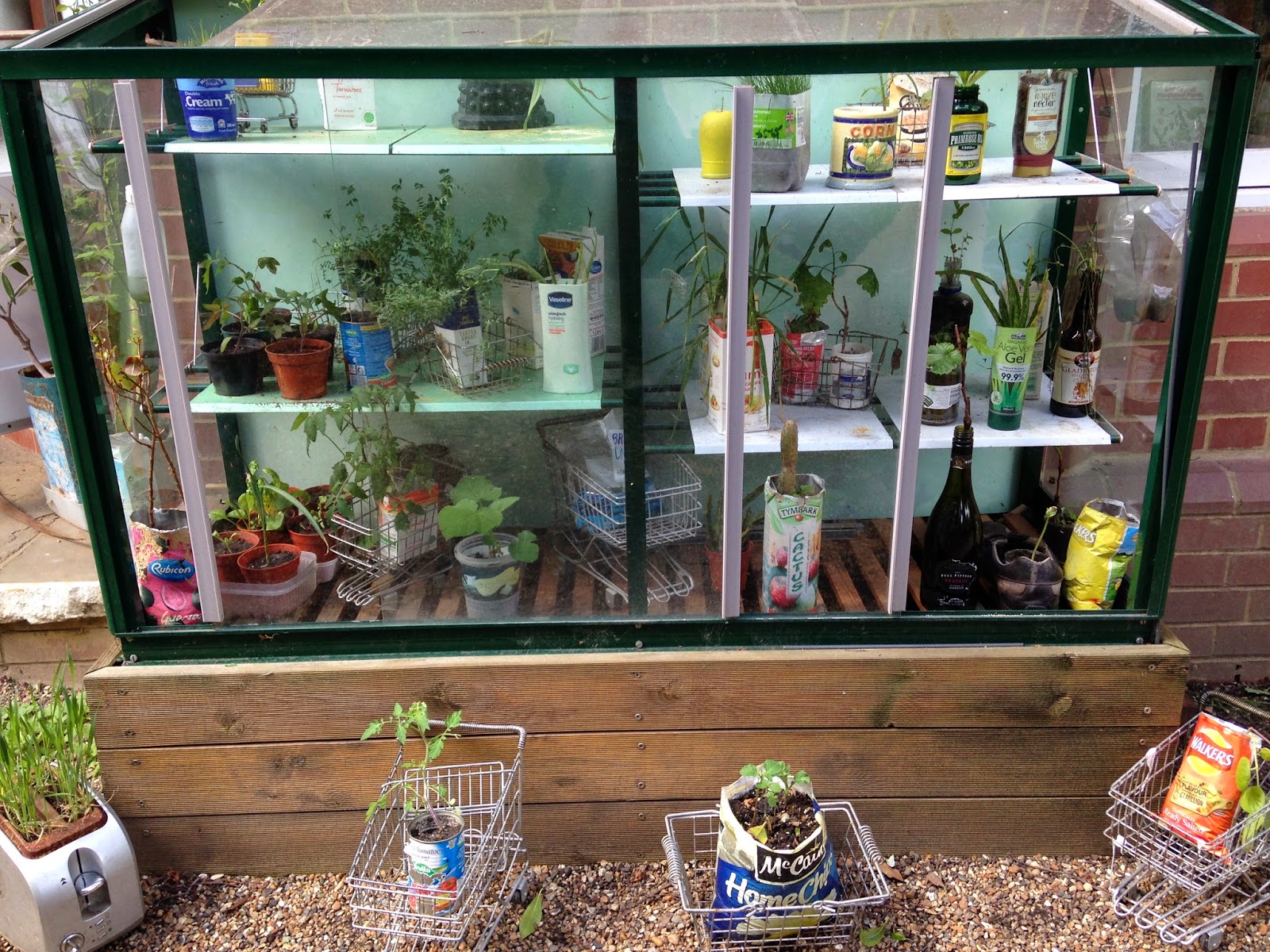
    I love the ‘Shelf Life’ project tucked away in the teaching area: growing common shop and supermarket foods in their sales packaging: from aloe vera to guava to wheat.


    Fourth, Rosendale Allotments in Dulwich. Founded in 1908, the allotment assocation has 480 plots (and a long waiting list). The site lies on a steep hill, and every kind of crop is grown around the gardeners’ benches and sheds – some for relaxing to enjoy the view towards Canary Wharf and The Shard. Thanks to the Site Officers Marco and Sophia!
    The website is full of good growing guidance http://www.rosendale-allotments.org.uk/


    Fifth, Sissinghurst Castle, in Kent.  There’s the stunning National Trust garden (really, there were no weeds in the beds), and also a new kitchen garden to reduce the ‘food miles’ of the fresh food used in the two cafes. There are two full time kitchen gardeners – yes we are envious!http://www.nationaltrust.org.uk/sissinghurst-castle/


    Sixth, it has to be the 6th Street and Avenue B Garden in New York City.
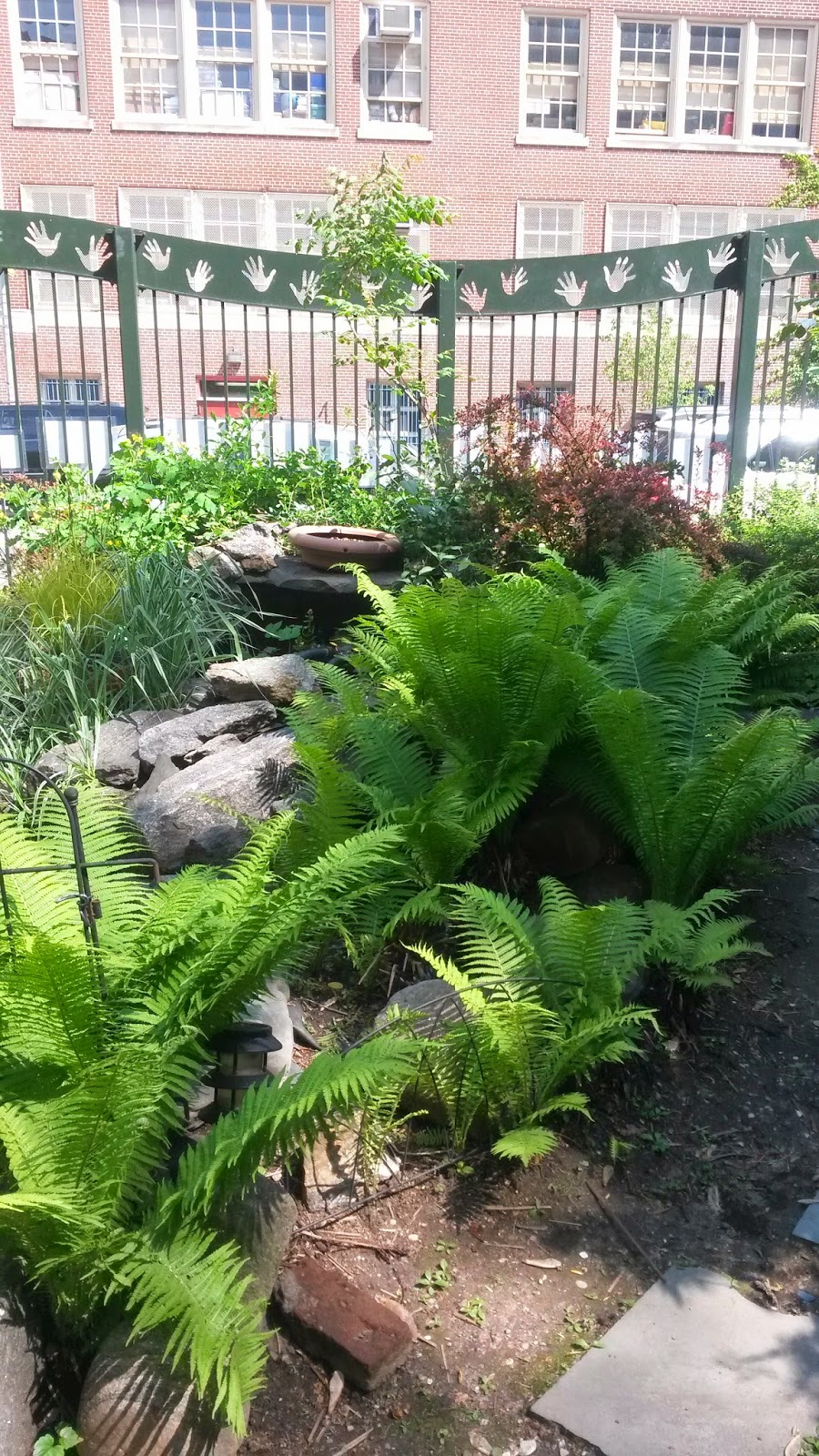
    What struck me about this garden was the beauty and variety of the space – it was full to bursting with flowers and plants, grouped closely together. The joy was the exploration along tiny paths and under canopies – each revealing another space – a pond with fish, plentiful raised beds for herbs, wild flowers, ferns and vegetables, a stage for community events, shady secret seating areas for tranquility and reflection, and much more besides.

    I discovered that this site is so loved by the community that it is now permanent, and welcomes 200 children through its doors every week as part of an education program that has gone from strength to strength. Truly inspirational.
    http://www.6bgarden.org/history.htm


    And:
    As well as coming to garden with us in the Tooting Community Garden any Sunday, another great activity is the wonderful and creative Chelsea Fringe, running now until 8th June.  


  • Community Garden: 20° Sunday morning!

    A dozen helpers came along to the Community garden today (well, two of them were dogs…)


    We: finished digging a new plot, sowed 4 different kinds of bread wheat, planted potatoes, cleared up the herb patch, sowed radishes, shifted some ancient logs about to make seats in the ‘secret corner’, spread some top-dressing from the compost heap, admired the wild primroses – and definitely enjoyed the sun, the warmth, and good company of all ages.


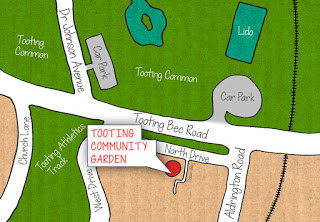
    All welcome to come along any Sunday: 11:00 to 1:00. The entrance is to the side of  the large house at 5 North Drive, on the south side of Tooting Common.

  • Obstbäume im Görli!

    (The title means ‘fruit-trees in Görli’….)

    On Saturday 6th April I was in Berlin, and was lucky to be able to join a local fruit-tree planting session along with my daughter. Coming in late after all the preparation had been done, we got involved with planting,and with making the timber protection / supports for the trees.

    Nine tall bare-rooted fruit trees were being established in nine big holes – the third annual planting in Görlitzer Park by the organisers: Transition Town Friedrichshain-Kreuzberg: http://www.transitiontown-friedrichshain-kreuzberg.de/so36/obstbaeume and at http://kiezwandler.de 
    Here’s their great vision:
    ‘Berlin 2030: climate-friendly, people-friendly, post-fossil fuels’

    There were over sixty people there of all ages on a very cold day, and the whole setting felt like Tooting to me: doing something practical in a big urban public park in a very diverse neighbourhood, and with a very warm welcome. As in Tooting, you could sense a web of links to other city projects, funders, community groups…

    Pictures by Belle tell the story:

    1 Setting up the wooden posts

    2 Sledgehammering


    3 Tree protection at ground level
     
    4 Plenty of support


    5 Delivering a bare-rooted apple tree


    Continuing the photos of a Berlin Transition group and friends fruit-tree planting on 6th April:

    6 Firming the new soil
     
    7 Tying on hessian protection


    8 Was this the correct tree for this hole?


    9 Packets of Tooting seeds find a  new home in Görli!
    TTT looks forward to keeping in touch with this great group in Berlin – lots of learning to share…and maybe some exchange visits? Danke!      – Charles
  • Wildlife Gardening Forum, London

    Two of us from TTT joined the Wildlife Gardening Forum on 28 November – a hundred people face to face from many sectors and all sizes of organisation: government departments, researchers, urban farmers, scientists, community enterprises, architects, ‘green infrastructure’ experts…and individual gardeners.

    The programme (see it here.) was an excellent fit with local steps to a sustainable Tooting – at the very practical level of bringing more of nature into all our lives, and appreciating nature’s relationship with our wellbeing, as well as responding to global challenges like the growth of cities and climate change.

    For interest: do you know…
    That over 60% of the area of the City of London is roofed – a third of which is suitable now to become ‘green roofs’ growing native plants, cooling the environment, and looking beautiful?

    The Forum aims to share practice, knowledge, and science, not hot air – and that reminds me, the meeting was held in a retrofitted tram shed which has been developed to the ‘passive house’ standard: super-insulated, airtight…and with no supplementary heating at all. Great to have the location, and the topic, all joined up!

    It left me with positive examples of things we can do together locally. In particular it was great timing in relation to the current community consultation on plans for Springfield Park, and the opportunity to make sustainability and biodiversity the foundations for all the activities of the new Park.
    We’ll follow up with more about that – for now, see www.springfieldregeneration.co.uk