Tag: Tooting

  • Please vote by 12:00 Friday November 18th for ‘Gardens of Refuge’ project funding from Aviva

    This week is the home straight for voting online for funding support for Gardens of Refuge at the Aviva Community Fund. It will come down to our tally of votes at the end of 18th November, and of course the other ‘Aviva projects’ are also doing a push this week.

    Please vote by Friday 12:00 for Gardens of Refuge, and ask your family and friends to vote too. Together we can support this creative and forward-looking Tooting partnership project with the refugee and asylum-seeker community centred on the Tooting charity CARAS.
    Every Vote Counts, and every vote is appreciated!

    How to vote?
    You have to register individually before you can vote. To register, please click here for the Aviva webpage
    Then search for CARAS or Gardens of Refuge to vote!

    Project Details:
    Read the description of the project online here.

    For the future: bulbs for 2017

    You’ll see that the project is all about growing the therapeutic benefits of gardening plus greening the community we share in Tooting.
    And it’s about building ways to enable refugees to share their own knowledge and skills locally.
    Together we’ll imagine and create a more beautiful neighbourhood as a legacy for all.

    Legacy: flourishing from 2015’s cuttings
    There are three partners in Gardens of Refuge:

    CARAS – with whom we have worked in depth for 18 months on Rooting in Tooting.

    The Grange – a residential respite and permaculture centre in Norfolk who work with CARAS. Please see The Grange.

    & Transition Town Tooting


     Thank you so much for your support & please vote by 12:00 on 18th Nov!

  • ‘Gardens of Refuge’: our new partnership project for 2017 with CARAS & The Grange. Vote for funding online through the Aviva Community Fund!

    “To plant a garden is to believe in tomorrow.” (Audrey Hepburn)

    We are thrilled that Gardens of Refuge, our new partnership project plan has reached the final public voting stage of the Aviva Community Fund! The project is centred on the refugee and asylum-seeker community who are supported by the Tooting charity CARAS.

    Read the description of the project online here.

    For the future: bulbs for 2017

    Gardens of Refuge is listed under ‘CARAS’ on the Aviva Community Fund website.
    You’ll see that the project is all about growing the therapeutic benefits of gardening plus greening the community we share in Tooting.  
    And it’s about building ways to enable refugees to share their knowledge and skills locally to imagine and create a more beautiful neighbourhood as a legacy for all.

    Legacy: flourishing from 2015’s cuttings
    There are three partners in Gardens of Refuge:

    CARAS – with whom we have worked in depth for 18 months  on Rooting in Tooting.

    The Grange – a residential respite and permaculture centre in Norfolk who work with CARAS. Please see The Grange.

    & Transition Town Tooting

    As of today, the website is live for the public to vote for the projects they would like Aviva to support. 
    Voting is open until 18th November: but please don’t delay!
    Please vote and encourage Aviva to support Gardens of Refuge!  

    You have to register individually before you can vote: to register, please click here for the Aviva webpage
    Then search for CARAS or Gardens of Refuge to vote!

    Thank you so much for your support, 
    and please contact us by email if you have any queries.

  • Two inspiring & successful sustainability projects!

    Sharing two inspiring projects! 
    Both projects aim to demonstrate and create something that is beautiful and functional, creating results which please people and show that sustainability is achievable and attractive now.

    One is in Tooting: a front garden restoration that takes into account affordability and biodiversity.
    One is north London-based: an bamboo bicycle enterprise which is imaginative and practical.

    Tooting Front Garden Restoration
    The project has been a partnership between a housing association, residents, project leader and a professional team including Community Gardener Rose deFalbe. The intention was to carry out the restoration in a way that is participatory, affordable, adaptable, biodiverse and with zero environmental footprint. There’s a full description of the project downloadable here.
    Here’s the result photographed earlier this week. 37 Manville Road – go and have a look as it’s a beautiful sight!

    In April the restoration was Commended at the Wandsworth Design Awards. Here’s the team in front of their display with the Mayor of Wandsworth who gave out the awards.
    Congratulations!

    Bamboo Bicycle Club
    Engineer James Marr has established this business designing cycle frames out of bamboo (imported at the moment) and hemp (grown in Yorkshire). All the details online here.

    A unique element is that BBC sells no finished bikes at all: the new owners and riders make the frames and fit out the bikes themselves. James want to offer cycles that are sustainable, recyclable and designed collaboratively according to need.
    As a consumer, the maker-rider is in charge and makes all the decisions. Each maker practices or learns new skills.

    ‘His and hers’ road bikes

    Over 200 have been designed and built in all shapes and sizes (look at their Hall of Frames) – either from kits at home or on weekend courses where the output is a bamboo cycle frame that you then fit out with the drive train, wheels, handlebars, etc. Track bikes, tandems, balance bikes…and a new project in Africa where farmers will make their own bikes that can each carry 100kg.


    Another practical BBC project now: school groups of 5 children are making bamboo BMX frames for shared use – fantastic teamworking and design & technology experience.

    A vision for the future is that a family will plant bamboo on their urban plot. When the children are 8 they’ll cut their materials in the garden to make their first bikes at home… a lovely image.

    TTT met the Bamboo Bicycle Club at the London Permaculture Festival last Sunday, which we mentioned in our recent mailout.
    It was a great scene of stalls, children playing, several hundred people chatting and engaging, good food and a demonstration garden – plus two dozen workshops to choose from.

    We explored permaculture in our Growing Tooting grow-your-own workshops (for example in the 6th class and handout). While the concept covers far more than gardening, it is rooted in growing.

    Permaculture teacher Patrick Whitfield described it like this: 

    ‘Permaculture is a design system for human habitats which work with nature rather than against it. 
    It is modelled on natural living systems, and makes use of both traditional skills and modern science’.
     
    ‘Transition Towns’ and ‘Permaculture’ have very similar approaches. There’s a lot of shared history, research and ideas (plus some jargon which may not always help); both cover a huge international and diverse range of activities; both are practical and can-do. 
    The hall of stalls at the Permaculture Festival on 31st July
  • Growing Tooting finale – the 8th weekend of TTT’s local grow-your-own classes completes the series

    In the final local growing sessions in Balham, Tooting and Wandsworth we celebrated progress and looked at what comes next now the programme is complete. 

    We discussed harvesting and preparing food (and bringing any surpluses to the Tooting Foodival), and asked about what the participants might need next in their growing journey. 
    Suggestions so far: ‘local gardeners’ question time’, a Facebook group, occasional meetings, visiting each others’ growing spaces.

    Plus, local community gardens including Tooting Community Garden and Wendelsworth Community Garden can offer support.

    Exploring the herb bed
    With the Balham group, Rose identified plants and explained how the herb bed at Tooting Community Garden is managed, in particular how foliage is cut and left lying to suppress weeds and help prepare the ground for sowing – and the group raised a glass to celebrate.
    Fresh produce laid out on the Eatwell pie chart
    With the Tooting group, Belinda took us through the new Public Health England Eatwell Guide. The Guide illustrates how to achieve eating a healthy dietary balance of good food – including what we can grow in our gardens.
    Our 8th Growing Tooting Handout is available for all: please click here. To see all 8 handouts, and to read each fortnightly blog post, click on GROWING TOOTING in the quick links above.  
    Hats off to Martin for writing the handouts and facilitating the delivery of Growing Tooting so brilliantly! And to the others who co-facilitated: Eleanor, Belinda, Rose, Jeni and more.

    In summary the Growing Tooting series of 30 local workshops reached 24 people who came to each session, another 24 who came to some of each local series, and another two dozen who are interested for another time.  70+ people are connected in a new way to local growing and each other. 


    There’s an evaluation under way, and we’ll share the results.

    There’s been a second major part of Growing Tooting’s activities. As agreed with the Wandsworth Big Society Fund who gave us financial support for the whole programme, we also supported local gardeners with the development of growing spaces. We’ve been working with six gardens. Please see our blog post from March for more info.

    Two examples include:
    Ravenstone Primary School. The school garden’s layout and access has been improved so children do not get so muddy on wet ground before returning to their next class.
    The school Gardening Club has been encouraged and enthused by Mary, Barbara and Richard.
    The garden has extended its reach to link with the teaching at the school, school events such as the Summer Fair and the parent body and wider community networks.
    Talking of community links, Thomas from Ravenstone pushed a planted-up wheelbarrow in TTT’s #TourdeTooting extravaganza ten days ago.

    CARAS Women’s Drop-in Group. TTT already work with CARAS on TTT’s Rooting in Tooting project. Growing Tooting support helped us work with a new group of CARAS service users, 12 to 18 adult refugee women who attend a weekly class devoted to english language and to participation together exploring new skills. A programme of seven facilitated sessions saw the women planting at their drop-in site, exploring favourite foods and recipes, and learning about sprouting seeds and grains at home. 
    Many thanks to Silvia, Fio, Jane, Lucy, Hilary, Rosalind, Jeni and more who helped to run these classes, and to many friends who donated plants, including Martin, Jane, Deb, Fio, Chuck, and Brockwell Park Community Greenhouses.

    Finally – do get in touch with us at TTT to explore how to start or keep on Growing Tooting (and Balham and Wandsworth). 
    Thanks all for taking part!
    – Chuck 

  • 3 current and vivid research projects about climate change and UK communities – Tooting included

    In 2015 TTT helped facilitate a research project by the University of Westminster all about the impact of urban heatwaves – for the details please see past blog posts by clicking here on Urban Heat.

    TTT worked with the researchers and with many local partners in Tooting: voluntary and community groups plus borough-level and statutory bodies.

    The funder for this research project is The Joseph Rowntree Foundation, and yesterday TTT took part in a workshop comparing the early research results of three JRF-funded projects.  
    Each of them explores the links between climate change and UK communities and households. Each aims to give new information to local and national policy makers.
    Participants included national bodies such as Public Health England & Defra, & the Cabinet Office, local authorities and universities.

    An overall view? That there are synergies of relationships between all the topics outlined below..and that communities with local knowledge and energy have an opportunity to get involved and contribute.

    One project is looking at the impact of climate change on UK households’ cost of living between now and 2050.
    A valuable prediction so far is that lower-income households will experience the most impact, on part because a larger percentage of their budgets goes on climate change-sensitive expenditure – for example food costs (negative impact because of UK and global events), or energy (a positive impact as winters will be warmer), or repairs after flooding (very negative impact if a low-income household has no insurance).

    Workshopping in Tooting

    The second project looks at how to enable climate resilient communities.
    The research area covered three towns and villages in a single large rural local authority that spans the Scottish Borders, and a main focus turned out to be the impact of local flooding which was taking place at the end of ’15 as the research groups were meeting.
    Flooding is a known risk, is recognised and visible, and has a funding stream with tangible (sometimes debated) results…so gives a definite point of focus to rally around.
    Local responses to flooding also led to valuing other aspects of community resilience such as the local ‘creative capital’ – the energy the community can generate to work together in new ways.
    Anyone else reminded of ‘Tour de Tooting’ and ‘Rooting in Tooting’?

    Thirdly, the Urban Heat project has worked across 3 diverse London boroughs: Tooting, Hounslow and Hackney. Like the Scottish research taking place amidst flooding in Hawick, one of our meetings took place on a day the temperature reached 30 degrees C – designated a risk by the heat health warning system.
    Findings include that yes, voluntary groups are interested and understand the impact once they can explore it in depth. So do the borough and other bodies..however the way these two ‘slices’ of the local community can work together is not yet defined.

    Heatwaves are not perceived in the same way as flooding – heatwaves seem to ‘just happen’ (in fact we may want some warmer weather), we soon forget them, we don’t realise the impact can be so serious, the responsibility for policy and communication is not so clear.
    Yet in 2003 2,000 people in the UK died in heatwaves; a far greater number of tragic fatalities than in recent UK flooding.

    We’ll share links to these research results when they are formally published.

  • Report from the seventh weekend of Growing Tooting ‘grow your own food’ classes

    Here’s the report from the seventh weekend of our Growing Tooting ‘grow your own food’ local fortnightly classes. We’ve been offering these in Balham, Tooting and Wandsworth since April.

    The common themes this week have been exploring more ambitious planting schemes, visiting other local gardens, and looking at forest gardening.

    So: here’s a group planting a ‘Three Sisters’ bed in Balham: 
    That means establishing a bed with three complementary crops (sweet corn, beans, pumpkin) which combine well in terms of habit, shade needs and care. It’s a fascinating traditional native american method making good use of limited cultivated land.

    The Tooting group visited the Tooting Community Garden
    Here they are comparing our bread wheat with an experimental bed of teff, a ‘wonder grain’ from Ethiopia.


    One of the Wandsworth groups
    visited members’ allotments in King George’s Park.
    That’s a nice scene!

    This fortnight’s Seventh Growing Tooting Handout is available to everyone by clicking here.
    The focus is Forest Gardening: as a development of the permaculture conversations in the 6th weekend of Growing Tooting. It’s a fascinating method where short-term crops are not planted, and the plot is managed to produce from perennial ground cover plants, bushes and trees.

    That’s very different from the experience most of us have on our allotments or balconies! 
    Keeping up the theme of visiting inspiring gardens, a great place to experience a half-way house between growing in beds and developing wilder forest growing is at Spiralfields Community Garden, part of the wonderful Spitalfields City Farm in Tower Hamlets. 

    At Spiralfields they have dumped 60+ tons of soil in hillocks and valleys right on top of existing paving…and planted trees which will break through the concrete in time.

    The whole space is a super-productive oasis right alongside the Eurostar tracks.
    Visiting info for Spitalfields City Farm – click here.

    One of the UK’s gurus of Forest Gardening is Martin Crawford.
    He finds that with a mature forest garden, just a few day’s work per year produces a big proportion of his family’s food -though some of the crops are not very familiar. Info here.

    Martin’s garden is just under a hectare (as it’s Euro 2016, that’s the size of two football pitches).
    Many of us make plans of our planting beds; Martin has identified every tree on his site….!

    He’s written a comprehensive guide and runs regular courses in Devon (see details online here).
    Courses are highly recommended if you want to immerse yourself…

    Always new things to explore in gardening!
    – Charles

  • Growing Tooting – the sixth weekend of our local grow-your-own food workshop series

    Last weekend we enjoyed the sixth crop of fortnightly ‘triple-header’ Growing Tooting workshops – one each in Balham, Tooting and Wandsworth. (Plus there’s the fourth series: an extra Wandsworth group running on the intervening weekends).
    As ever, thanks to Martin for the energy and co-ordination!

    What did we do this week?
    As a comprehensive gardening topic we looked in detail at Permaculture – a growing approach that aims to integrate natural systems with social and individual needs for food, clean water, energy… (click here or here for two in-depth web resources).

    To make that practical, in one group Donna presented her own garden as a case study.

    She filmed a video of the back garden, plus photos of the front, for us to get an idea of the spaces and how the garden fits into her life.

    Donna’s team of advisers – an unusual opportunity!

    ‘Observing’ before diving in is as useful in gardening as it is in swimming. Thank you Donna!

    How is the potato progressing?

    Secondly about observing – in our classes we encourage participants to be ‘grower scientist – investigators’ alongside enjoying being outside and putting good food on the table.
    Here’s an example from someone who likes to measure and celebrate her plants’ progress! Why not try it – you learn a lot.

    We have our latest Growing Tooting Handout 6 available – click here to download. The handout includes interrelated features of good common-sense gardening (and of permaculture):

    • Attracting wildlife to control pests
    • Mulch
    • Compost
    • Mycorrhizal soil fungi
    • No-dig gardening 

    To illustrate combing several of these elements, the second Wandsworth group planted up a square foot raised bed which had been prepared with a no-dig approach. First we removed the weeds then covered with a couple of inches of leaf mould from one of the housing estate’s leaf pens, then covered that with sieved soil to achieve a fine tilth for sowing seeds.

    You can see the separate layers

    We planted spinach, nasturtium, basil, plus marigold and tomato seedlings under bottle cloches (we’re experimenting with companion planting for the latter two).

    Finally: two more illustrations of this week’s topics:

    Attracting beneficial insects.
    It’s useful to provide habitats for predators such as ladybirds (the larvae eat loads of greenfly).
    This is a roll of corrugated card inside a plastic bottle with its base cut off.

     
    No-dig and mulch gardening.
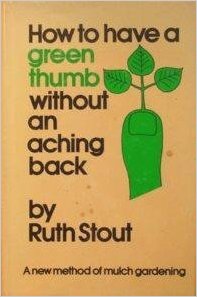
    One guru for this approach was Ruth Stout. We’ll share some excerpts from her 1970s book, which is worth looking out for.

    A practical no-dig resource online is SPUDS (Society for the Prevention of Unnecessary Disturbance of the Soil).

    It really works.

    Happy Gardening – Charles

  • Growing Tooting: the fifth weekend of our enjoyable local grow-your-own classes

    Gardeners in Balham, Tooting and Wandsworth are seeing results in the soil, in trying out new skills and having some fun together.
    As our fortnightly free Growing Tooting classes continue, have a look below at what we’ve been doing, and do get in touch to share ideas or with any queries.

    Very proud gardeners! 

    Basil seedlings transplanted into the ground at Melanie’s allotment.


    More proud gardeners, indoors this time:

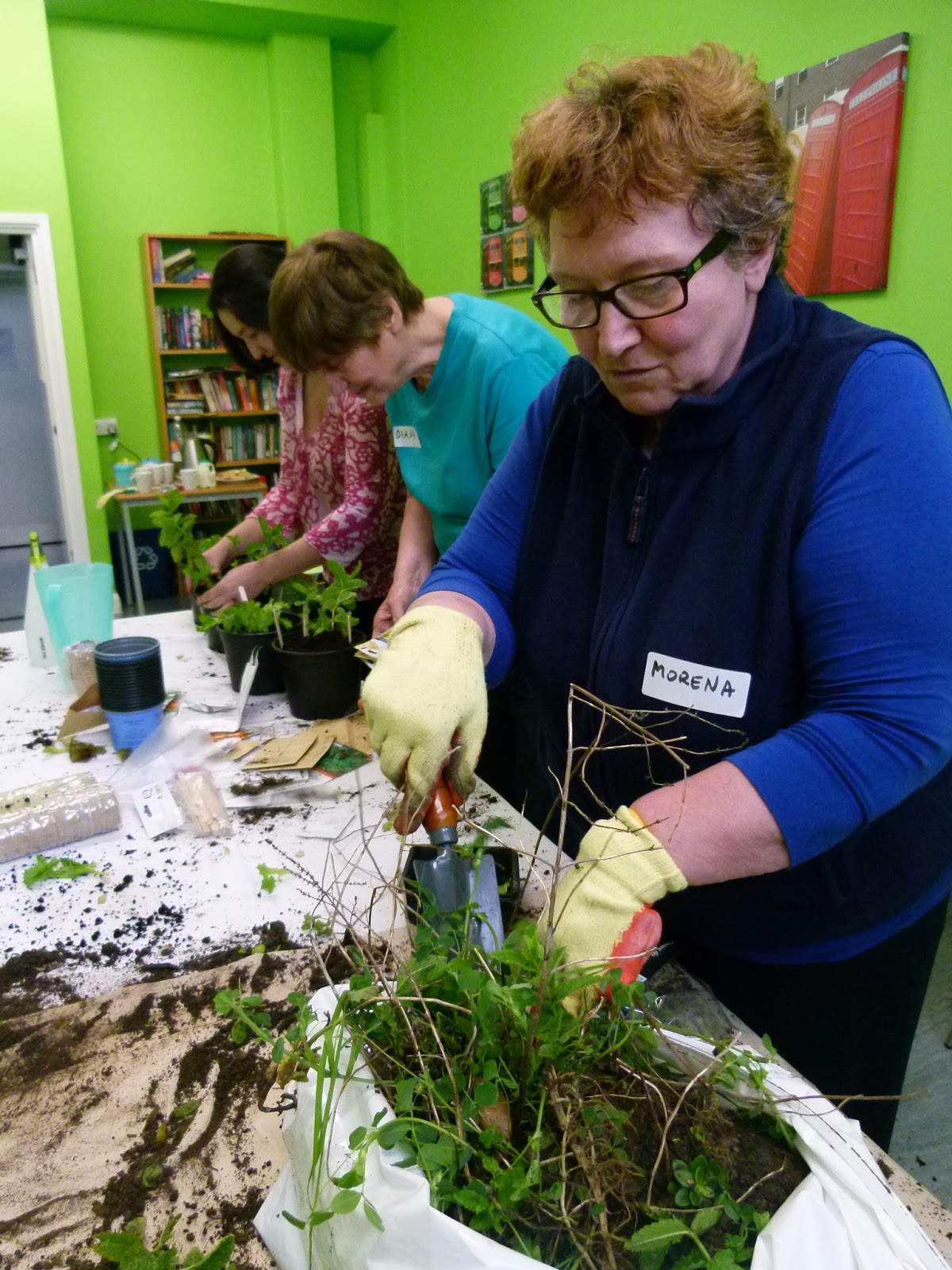
    Veronica, Diana and Morena sowing seeds, transplanting lettuce seedlings (Sainsbury’s, 60p), dividing Moroccan mint to take home in pots.

     
    Back outdoors, gardeners of all ages at Ravenstone School are getting their school raised beds going

    Growing Tooting Handout 5 This is now available for participants and for TTT friends who read this blog and who would like to catch up on the details. 
    Themes are Pests, Companion Planting, Square Foot Gardening
    Please click here to download and keep a copy of Handout 5.

    Square Foot Gardening is useful for the home gardener because it helps you focus on making best use of space, putting plants together that make sense, and creating an interesting mini-landscape.

    What’s in the square foot bed below?
    Tallest plants top RH corner (= north side).
    Gail’s donated tomato and borage (top RHS squares).
    Maxine’s lemon balm and 2 strawberries (top LHS).
    Seeds elsewhere – bell peppers (top), English marigold (centre), radish, dwarf nasturtiums, basil (bottom L to R)

    Square foot bed planted with veg, herbs and flowers for pollination.

    Here’s a small bed full of different herbs, spotted at Brockwell Park Community Greenhouses


    Some more from weekend 5 on the scientific and growing judgements and choices we make when we are gardening:

    Selecting seeds:
    Bean bed in Balham: last year’s white flowered  beans (which weren’t very productive) and conventional scarlet-flowered beans to plant; sweet peas for extra decoration and pollination.

    Trimming when transplanting to keep plants healthy:
    Trimming off excess leaves on lemon balm and strawberries donated by volunteer, Maxine, who dug them up that morning; we put them in the square foot bed.

    Adding nutrition to a plant in a pot:
    Giving the Brown Turkey fig a top dressing of John Innes No 3 and planting with dwarf nasturtiums to give ground cover and colour.

    And for some insights into high-end gardening, it’s Chelsea Flower Show this week, with lots of media coverage.
    Good growing, everyone!

  • Growing Tooting: the fourth weekend of our flourishing grow-your-own classes

    The fourth weekend in our fortnightly series of workshops on growing your own local food was fun and successful. We’re half way through the run of 8 workshops at each of the sites.
    The Balham-Tooting-Wandsworth structure is stimulating as there are differences and common ground in the settings and interests – plus there’s healthy cross-pollination between locations and local partners

    Have a look at the Fourth Growing Tooting Handout by clicking here – all welcome to download and use to help your own garden choices. Collect the set! (And any feedback welcomed, of course).

    Do you know your Rooster from your Vivaldi?
    One theme in the Handout is building awareness of varieties of vegetables and fruit. What’s the benefit of there being so many?

    So, here is a ‘Brown Turkey’ variety fig being planted at the Balham class site, St Mark’s URC


    TTT recently won a prize draw from The Conservation Foundation (see last item below). Our reward was a diverse bundle of 3 varieties of potatoes: ‘Sherine’, ‘Rooster’ and ‘Vivaldi‘. Each has different characteristics and cropping times…the result of plant breeding over the past 400 years. Thank you! – we have some to give away.
    Plus there’s ‘Centurion‘ onions and ‘Red Sun’ shallots which we’ve planted.

    More news from the classes: Here’s Donna from Balham’s mighty mangetout, with lots of pods set already. You get a sense of gardener’s pride from the tape measure draped alongside. Donna has now planted this out in the polytunnel at Doddington and Rollo Community Roof Garden, with lots of supporting sticks. To complete the synergy, the seeds came from Tamworth Farm Allotment Society….see below for their plant sale next weekend.

    Another theme in the fourth Growing Tooting Handout is watching the weather…and after a May weekend of hotter-than-Ibiza weather, staying aware of frost is probably going to be replaced by hoping for heavy rain (preferably at night). We’ll cover more in the future about growing successfully with low or unpredictable rainfall.

    Two interesting notices looking ahead:
    1 On 14 & 15 May, Tamworth Farm Allotment Society plant sale runs on their site opposite Figge’s Marsh.  A great way to buy plants cheaply and get tips from the gardeners who grew them!

    2 Tools for Change (click on link for details): through this project from The Conservation Foundation, from 9 May to 9 June anyone can donate spare, unloved or broken garden tools at any Wyevale Garden Centre (there’s one in Morden). You’ll receive a 10% discount on new hand tool purchases. There is give and gain in the project: the tools are then repaired at Tools Shed workshops in prisons including HMP Wandsworth, and donated to community groups and schools. Local groups who wish to receive garden tools in spring 2017 can get in touch here.

    In Tooting Community Garden we’ve received tools from this innovative scheme.      
    We’re proud that our outdoor learning project with Gatton School has benefited. See these young gardeners with some dramatic cultivators!

    Tools for Change reduces waste, helps community groups build participation and save their limited cash and has a positive social impact. 
     

    • Growing Tooting: our third weekend of free local food-growing classes went very well

      The third weekend in our practical, sociable and free Growing Tooting workshops went well in Balham, Tooting and Wandsworth. 
      A fourth ‘waiting list’ group starts on the 24th April in Wandsworth. 
      Please scroll down this blog to see our earlier posts.

      At this stage of our classes, participants have seeds sown or seedlings coming through in their own planting pots and trays at home: here’s some spinach on the right. We discussed together just how to get to this stage successfully!


      We also looked at dividing clumps of perennial plants such as mint as in this photo. 
      Each smaller clump can be planted out to multiply your crops. 
      Hands-on superhuman strength sometimes needed if the old clump is dry…

      We have a Third Growing Tooting Handout – all welcome to click here for a copy.

      One group of participants has a new allotment, so the timing is great to share what they are doing and trying out.
      A key message in the classes is to learn from each other, that’s certainly more fun.

      You’ll remember we are encouraging participants to be partly garden-detectives and partly growing-scientists…there’s no need to shy away from some helpful technical tips when learning about growing good local food. One ‘technical’ but practical topic in the third handout is ‘crop rotation’ – swapping around what you grow where, year by year.

      In our Tooting Community Garden plot, we do ‘rotate’ what is planted in the beds every year exactly as in the handout. We keep a sketch map of what we are growing, so we can remember what’s planted, and to help plan for next year.


      Come and visit us sometime at the Community Garden: all welcome to pop in and chat about growing or help out. We’re open every Sunday from 11:00-1:00 at 5 North Drive, SW16 1RN. 
      Latest info on Facebook: Tooting Community Garden.
      Good Gardening!  – Charles