Author: Transition Town Tooting

  • Countdown to Foodival

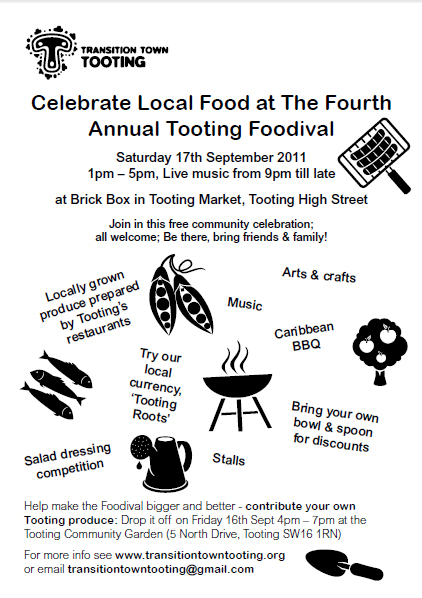
    The Food Group are gearing up for Saturday’s Foodival, this year taking place at Tooting Market, 21-23 Tooting High St.  All donations of fruit and veg to be magically transformed by local restuaurants into special low food mile Tooting dishes are very welcome.  There’s a drop off at the Tooting Community Garden on Friday evening 4-7 pm and also a collection service.  Please see the Foodival page for full details.  We look forward to seeing you there!

    To get involved, donate produce or ask a question please mail Giles
  • A weekend spent getting ecologically deep

    I thought I’d take a few minutes to write a bit about a recent ecological/environmental conference I attended, which I found completely inspiring, energizing and life affirming.  If you’ve not come across Green & Away, it’s Europe’s only tented conference centre, with everything in the open air or under canvas.  Set in rolling fields outside Worcester, by the river Teme, I’d highly recommend it.  I took part in the Resurgence summer camp, and as well as several great speakers and workshops, found the experience of living outdoors for 4 days (including taking open air showers!) really lovely.  Satish Kumar, peace activist and ecological campaigner, ‘headlined’ and spoke of a trinity of ‘soil, soul and society’, which in essence I took to mean thinking of ecology as three inter-connected spheres which we must nurture as a whole if we’re to find sustainable solutions to the challenges of climate change, inequality and the many other ills facing the world.  I was particularly interested in the ‘soul’ aspect, and the importance of connecting with our inner landscapes whilst moving away from a constant outer focus, for example on material possessions.

    Related to this I attended a workshop on creativity and deep ecology, which drew on Joanna Macy’s work (see Joannamacy.net).  This involved making connections with fellow ‘work-shoppers’ in a way you might not normally do, writing, telling stories and drawing.  I’ve not come across this approach before, but am keen to find out more (hopefully with TTT) – Joanna’s website sets out a goal: ‘to help people uncover and experience their innate connections with each other and with the systemic, self-healing powers in the web of life, so that they may be enlivened and motivated to play their part in creating a sustainable civilization’

    Kirsty Schneeberger also inspired the conference with her talk on climate change and intergenerational equity. An amazingly self-assured and natural speaker, she spoke about how she came to attend the UN climate negotiations in Bonn as part of a youth delegation, where she presented her ‘how old will you be in 2050?’ campaign.  I’d really recommend looking out for her at other events

    Finally, I’d love to get a (small) tented structure like one of these up at the community garden – let’s see what might be possible!

    Charlotte


  • News from a Tooting front room near you!

    Liz has been hosting a series of ‘Carbon Conversations’ meetings with neighbours in her front room: 

    Our latest ‘CC’ is now taking a break for the summer, so I thought I’d take the opportunity for a quick update on how it’s gone so far, since we started meeting once a week. In mid June a group of intrepid Tooting dwellers ventured up the hill into Furzedown, and we began by discussing :
    ‘why on earth are we even having a conversation about carbon anyway?’ 

    And what do these ‘tonnes’ consist of, and what is ‘carbon equivalent’, and why should we bother when China builds a new coal power station every week? We all concluded that we did want to bother, and for me it felt good to be doing something positive.  
    We had some fun thinking about what we’d say to the current prime minister about climate change if we got the chance; things like ‘don’t wait for other countries, just take a lead’, ‘be proud of the UK’s Climate Act – do more to promote it’ and ‘tackling inequality will help with climate change and vice versa, don’t forget the multiple benefits to society’.

    With thoughts racing through my mind we went on our way to ponder for a week before the next session. 
    In the second session we imagined life in a draughty 1930s home and plotted a 6 year plan to save some serious amounts of energy, and 6 tonnes of carbon emissions to be precise. We separated into two groups to do our plotting and were surprised at the different approaches each group took – and that we all left the extremely high cost but huge financial benefit option of installing solar panels till last, favouring more woolly jumpers first!
    The next session began with a mouth-watering description of life as a child in rural Greece from one of our participants, wow those tomatoes sound delicious!

    We managed to make some pretty easy-to-remember rules for ourselves when buying food – ‘Jane’s rules’:

    • meat is higher carbon than veg
    • the more ingredients the higher the carbon
    • producing the food takes way more carbon than packaging it
    • and refrigerated stuff can be high carbon even if it comes by road, not plane

    The fourth session looked at transport: we stepped into the shoes of Sarah and Edward and their two daughters. It turned out that they could save a lot of carbon through changing their lifestyles, without spending any money, just doing things a bit differently.
    Real food for thought there.

    And so we break for the summer, I am busy thinking about the actions I can take and look forward to the next session in September. On a personal note, I’ve really enjoyed having the group come together and meet in my house. I’ve enjoyed hearing seven other people’s points of views, and their way of dealing with some of the things I find challenging.

    I am looking forward to hosting some more conversations in my front room again soon!!!

    If you would like to join a local ‘Carbon Conversations’ group in September,
    please email us at transitiontowntooting@gmail.com All welcome!

  • Transition Conference Report – Charles

    Two of us have just been to the annual Transition Network Conference in Liverpool

    Each of the 200-plus participants probably had a unique experience of the 3 days. Much of the time was offered in chunks of options…

    Exciting choices, because most of the parallel sessions looked tempting…but you needed to select just one!  What would you do:  choose a very popular one with 40 people signed up, or go for a topic with a smaller group of 5? And would you prefer to be meeting the same people, or new ones?

    My choices took me to sessions on social justice, on community renewable energy, on health in cities, on a long evening walk with a forester in local woods and fields, and on Kids in Transition.  

    In the Kids in Transition session I was moved by responses from adults and children to 2 connected questions:

    Why does Transition need kids in order to flourish?

    ‘kids have the power to persuade people to change’, ‘kids are good at direct connection to their surroundings and to nature’, ’kids come up with new ideas’, ’kids know how to have fun’.

    Why do kids need Transition in order to flourish?

    ‘so I can change my future’, ‘to give us some tools to make sense of a difficult world’, ‘to help us to make new friends’, ’so kids can get to grips with real things’, ‘to encourage a healthier lifestyle’.


    Another choice: what would you do at meals…sit with ‘strangers’ you had not met before? That’s what I decided to do, and I loved hearing about Transition projects at different stages of development: in Paris or Sao Paulo, on an island in Denmark, in Switzerland, and in Liverpool itself.
    So, you could make your own conference very personal…which I felt was exactly as it should be. ‘Transition’ has straightforward goals: building resilient communities in a post-carbon world – and it’s the diversity of routes to get there, and of local needs, that offers each of us as individuals the challenge to use our different skills. We’ve got some great things to do together in Tooting!
    A fuller report on the conference, contributed by many participants, can be read at:
    http://transitionculture.org/2011/07/15/full-round-up-of-materials-from-the-2011-transition-network-conference/

  • Transition Conference Report – Lucy

    ‘The change in direction represented by the Transition movement is as profound as any intentional change experienced by a civilisation’.

    I have been at the national Transition Town Conference in Liverpool for three days. An intense experience, characterised by almost constant conversation with 259 other ‘transitioners’ from all over the world and the UK. The conference was on the campus of Hope University near Chilwall Woods in the North East of the City.


    The conference recognised that after 5 years of existence the Transition movement has a great deal to reflect on. The movement can begin to look back at the evidence of its impact with confidence.  With initiatives across the world putting ‘transition’ principles successfully into action, responding quickly as communities pulling together has shown how resilience really counts. This has been especially so in the stark contexts of national crises such as New Zealand’s earthquake and Rio’s floods.   When things are destabilised you have to be ready with new ways of doing things. 
    The structure of the conference reflected a desire to ‘deepen, mature and focus’ – looking at issues that were at the ‘edge’ of the movement’s experiences to date with an honesty around areas that are difficult such as ‘scaling up’ to the next stage after initial successes, running group processes and ‘resolving conflict’.  Imagining a world beyond dependency on oil did not have to be a choice between ‘a roll in the mud eating mouldy potatoes and going nuclear’.

    So said the ever cheery and constantly surprised Rob Hopkins (Co-Founder of movement) who opened the conference along with Peter Lipman (Chair of Transition Network). They cited  the recent announcement by the World Economic Forum in Davos on the major threats to the plant as ‘Climate Change, the Extreme Price Volatility of Energy and the Fiscal Crises’. This was not acknowledged in 2006 when the movement started. This morning Rob closed the conference citing David Fleming’s new book  Lean Logic: “The change in direction represented by the Transition movement is as profound as any intentional change experienced by a civilisation”. (He read that out twice)
    The number of workshops had been kept to a manageable choice but it was still hard to choose. Creating local food systems, up date on local currencies, kids in transition (by Tooting’s own Charles Whitehead), social enterprises – turning transition friendly ideas into jobs, Renewable energy systems and Forests invading cities, the latest on Brazil turning the tide were just a few. 
    I had a busy time. I was running a workshop on Playing For Time, facilitated a theme group on the arts, oversaw a number of art installations by Ruth Ben Tovim and played a role in the overall travelling story of the conference (I wore a handsome red haversack on my back throughout).  My workshop went well and served as a beginning for the Transition book I have been commissioned to write on transition and the arts. To create a different future for ourselves and our communities, first we have to imagine it and the role our imagination and however we understand the arts and our own creativity has a huge role to play in that. So scarey and exciting at the same time. I got a lot of really great practical ideas and much food for thought thanks to a great bunch of people who turned up.
    There was also a fair amount focused on making groups work and on  ‘inner transition’ recognising how demanding the work in transition can be emotionally at a very deep level.  This proved a key theme of the conference and it brought home to me how important this was. We did a ‘group process’ yesterday with 260 people. We looked at how we facilitate groups,  celebrate their achievements, discuss matters, agree and decide. Assumptions that get made, how people get excluded or made to feel included. There was a major emphasis on making this work and not taking anything for granted. What happens when you have to work with people you don’t get on with?  We looked at what gave us courage and what made us vulnerable. It seemed that everyone shared similar feelings of frustration, insufficiency, over work along with empowering feelings of shared joy and achievement.  I had sewn a large cloth onto which everyone at the end of this session pinned something they felt they had to offer as a strength to transition and something they felt they were challenged by. The results were beautiful and moving! Someone said that transition was like an alchemy of the self, turning what we have ourselves into gold. 
    I went to a workshop on inner transition run by Sophy Banks and Ben Yeger which looked at how we construct our own ‘bad’ and ‘good’ realities and how very hard it is to ‘hold the line’ on helping people look at ‘bad realities’. Inner resources need to be strong.  It explained  a lot about why people avoid wanting to confront global challenges.  We also learned that something negative has 15 times the force of something positive on us, so we do have to work hard to create a positive sense of the future!!  
    Another workshop this morning looked at evaluation and how we measure the impacts of transition. How do you measure change, resilience, well being and a successful local living economy? Fascinating stuff. Apparently we respond more quickly to negative feedbacks so we have to work hard yet again to build up the positive. 
    Escaping from hot rooms on Sunday evening, I went on a tree walk with Robin (from Shaftesbury) from Trees for Transition in Childwall Woods where we saw Beech, Holm Oak, Birch, Lime, orchids, meadows and deep dark woods and gulleys with plants and flora. Robin hopping ahead with his enthusiasm and knowledge about how trees and woods can build environmental, social and economic good into the biosphere and the quality of our lives. As a forester he said he had to always be thinking 50-100 years ahead, NO point in planting a tree which will be in drought conditions in 50 years time. Very inspiring man, taking his passion and creating a whole new movement around transition with trees. 
    No doubt about it – we are part of a very powerful movement. Many people came from abroad, emphasising how far and fast the movement is growing in Brazil, Portugal, Spain and elsewhere. There were also a good number of London people and it would be great to get us all together again – even in South London where our numbers have really grown recently. 
    It felt a privilege to be part of this huge thing we call transition changing the way we can see and build a future we want to live in – becoming better connected as a species, not separated out. We are already doing wonderful things here in Tooting and it is inspiring to know we are connected up to such a hard working network of supportive colleagues and fellows. The support really is there for everyone. We can rely on one another.
    The day we arrived there was an article in the Guardian asking if the Green movement had lost it’s way. WRONG QUESTION said Rob: “has a new, emergent culture which embraces resilience and localisation, equity and partnership, even scratched the surface of its potential?  I think the answer is a resolute NO!‘   We’ve all had a taste of that this weekend. Here are Rob’s own reflections on the weekend.

    And here are some words from Naomi Klein’s Shock Doctrine, quoting Milton Friedman:

    “Only a crisis—actual or perceived––produces real change. When that crisis occurs, the actions that are taken depend on the ideas that are lying around.  . . That, I believe, is our basic function: to develop alternatives to existing policies, to keep them alive and available until the politically impossible becomes politically inevitable”. 
    Go Tooting Go!
    Lucy 
  • Tooting Community Garden

    We have had an exciting few weeks at the Tooting Community Garden so here’s a little update on recent activities. On 18th and 19th June we invited volunteers to come to the Big Dig. We certainly have some talented gardeners and knowledgeable people in Tooting. Sharing skills and knowledge was a feature of the weekend. We began by preparing the rectangular bed in the middle of the garden so we can grow some veggies. Although we are a bit late in the season we are confident we can grow some produce in time for the Tooting Foodival in September. A few weeks previously we had been prepared to dig by hand but the soil was so compact that when we were offered use of a rotivator (thanks to the lovely people at Share Community Garden!) we accepted. Following rotivation we marked out beds with concrete slabs we found in the garden. After preparing the soil a little more and adding some compost we were ready to plant.
    Seeds and carefully nurtured seedlings were brought along by volunteers and now we have rows of veg in place. Theses include tomatoes, beans, courgette, rocket, kohl rabi, nasturtiums and leaf beet. This was the big job of the weekend but we also made three compost bins from disused pallets (thanks Wimbledon Wickes!), cleared space for a seating area, collected manure (thanks Dean City Farm!), set up water butts and raided nearby skips for bits and pieces (thanks unknown Tooting residents!) that we can put to good use and keep them away from landfill. Thanks to everyone who came along and made it such a fun and productive weekend.  


    Another inspiring event this month was the Open Meeting and Tour of the Garden on 5th July. All week we had been praying for rain as the garden had been looking dry and the night that it decided to come, and torrentially at that, was Tuesday 5th July! So, thanks to the Christian Education Centre on Tooting Bec Road we had a warm and dry place to discuss ideas for the garden. We ended with a tour of the garden spent mostly hiding under the huge oak in the corner. In the early part of the evening we handed out plans of the garden and, in small groups, we depicted our visions for the land and how we could use it. We had a multitude of ideas including a living willow tepee, permaculture, hammocks, plant and animal study, yoga, skills courses, espalier fruit, colourful signs, aromatic herbs and plants and a wetland area. All very exciting ideas! However, we did all agree that we need to tread carefully and before we do much more we should conduct an audit of the garden so we know exactly what we have and need to preserve. It is important that we work with the existing ecosystems that have developed in an area of land that has been untouched for a few years. It was also agreed that we can use this rich variety of flora and fauna to learn more about our natural surroundings. Thanks to everyone who came along and contributed to a very interesting evening.

    If you would like to get involved or hear about the garden more regularly please email me at abigailcallen@gmail.com to join the email list. Please visit our Facebook page to see lots of photos (taster below!) and ‘like’ it to show your support. You can find it here.

  • Furzedown Low Carbon Zone

    Transition Town Tooting is a partner in promoting the “Furzedown Low Carbon Zone”, a new project that will help achieve the goal of an energy efficient, resilient Furzedown.  TTT has a stand at the Big Day Out and will co-host an inaugural meeting at the Furzedown Project, 91-93 Moyser Rd, SW16 6SJ on Monday 18th July, 7-9pm.  Further information will be posted soon!

  • Recycle Week June 20-26th

    This has been Recycle Week and we were delighted to welcome Wandsworth Council’s Recycling Team Sophie Chitty, at this week’s TTT co-ordinating meeting. She writes about her visit hereelderflower cordial made from elderberry plants grown in Tooting

  • Fancy a Tooting Carbon Conversation?

    The next Carbon Conversation in Tooting starts next week on Monday 20th June.  Organiser Liz Darley says: “It should be fun and you should learn some new things!!”  

    Carbon conversations are six meetings that explore how individuals and families can reduce their carbon footprint. Participants will find out how to make practical plans to reduce carbon consumption in areas such as home energy, travel, and food purchasing, as well as talking about their own personal visions and feelings on a low-carbon future in London.  Find out more details about how to join the conversation here.