Tag: Carbon Conversations

  • Carbon Conversations – free workshops to reduce your carbon footprint

    Do you want to make some changes to reduce your carbon footprint and save money, but not sure how or where to start?

    Join a group of local residents in a free series of 6 sessions to explore how small changes can make a big difference. You’ll assess your own footprint, then together we’ll look at home energy, transport and travel, food, consumption and waste to help you make changes that fit your situation.
    To read personal blog posts by participants in our 2014 series of meetings, click here and scroll down the six posts (they are in reverse order..).

    Sessions will take place every Monday, 7pm-9pm, from 22nd June – 27th July 2015, at 43 Woodfield Ave, SW16 1LE (near Tooting Bec Common).

    Trained facilitators from Transition Town Tooting will run each session. Please email Jane at transitiontowntooting@gmail.com to join, express an interest, or ask any questions. 

    The workshops are free.  We ask for a voluntary contribution of £14.00 per participant to cover the direct cost of “In Time for Tomorrow?” – the excellent Carbon Conversations handbook.

    For more information, download our flyer.

    All welcome – you do not have to be an expert!

  • The Finale: Carbon Conversations Meeting 6

    We have hosted the last meeting of the May-July series of Tooting Carbon Conversations.
    Please come and join us for the next series! 
    More information on next steps below, and to go straight to the other five recent blog posts by series participants, click here.

    Dan has written this response to taking part…

    The Final Conversation in the series
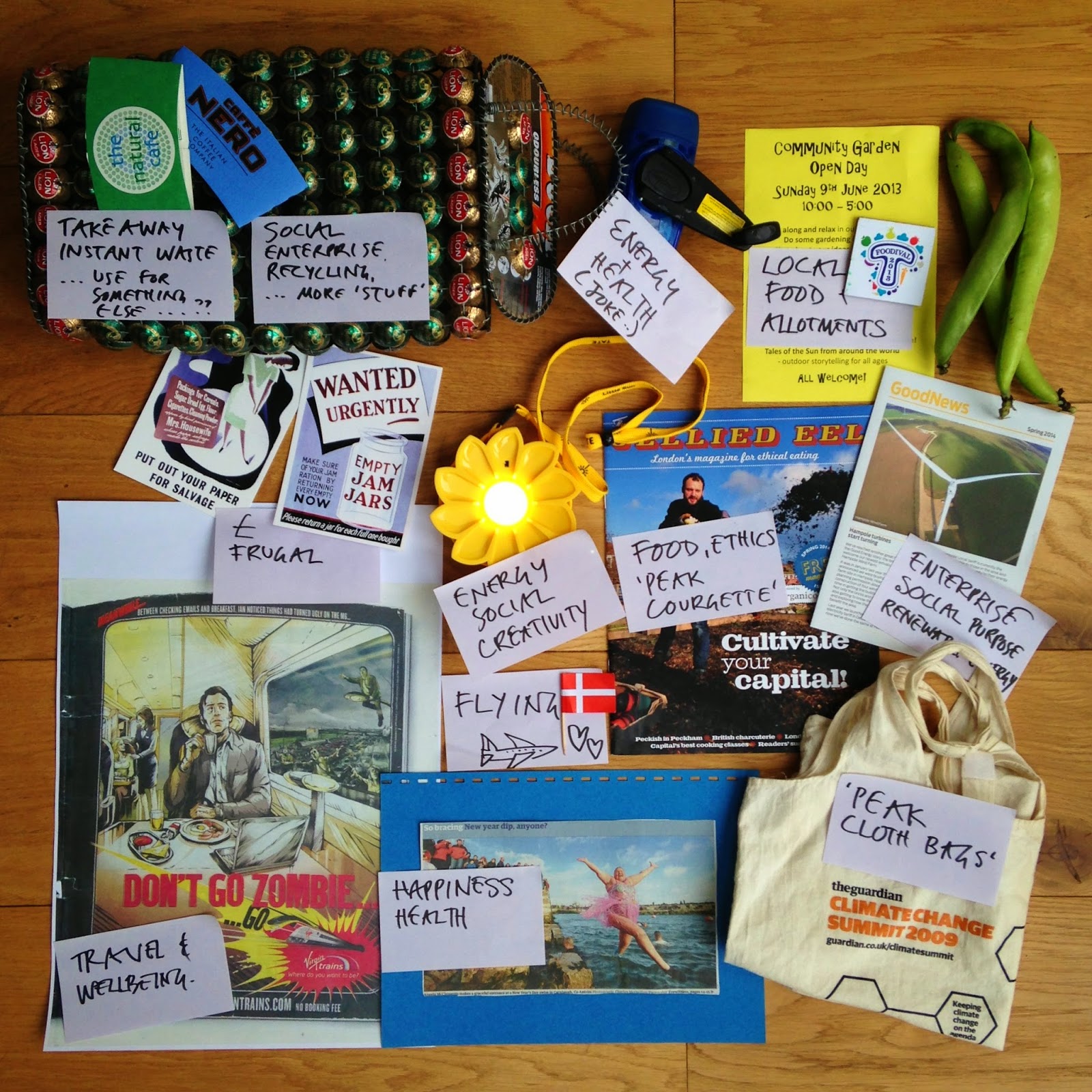
     
    Low-carbon living pops up everywhere
    “The final conversation gave us the opportunity to reflect on the things we had learned and decisions we had made along the way, and to think about where we go from here.
    It was also an opportunity to celebrate what we had done – and accordingly everyone brought along some delicious (low carbon!) food that we ate to round off the finale.
     

    The session began with everyone sharing a “carbon moment” that they had experienced during the week – these could be something positive, something negative or just a moment of realization. ‘Carbon moments’ included:
    • Swimming in the (unheated) Lido and feeling you’re on holiday (while in the heart of Tooting)
    • Cooking a home grown artichoke
    • Giving a rose from the garden to a girlfriend instead of one that was flown in from Kenya
    • Drinking local beer
    On the subject of beer, we discovered that Adnams do a great deal to reduce their carbon footprint  – this was just one of the many useful bits of knowledge I have learned over the course of the conversations – and one that suited me down to the ground as Broadside is one of my favourites!

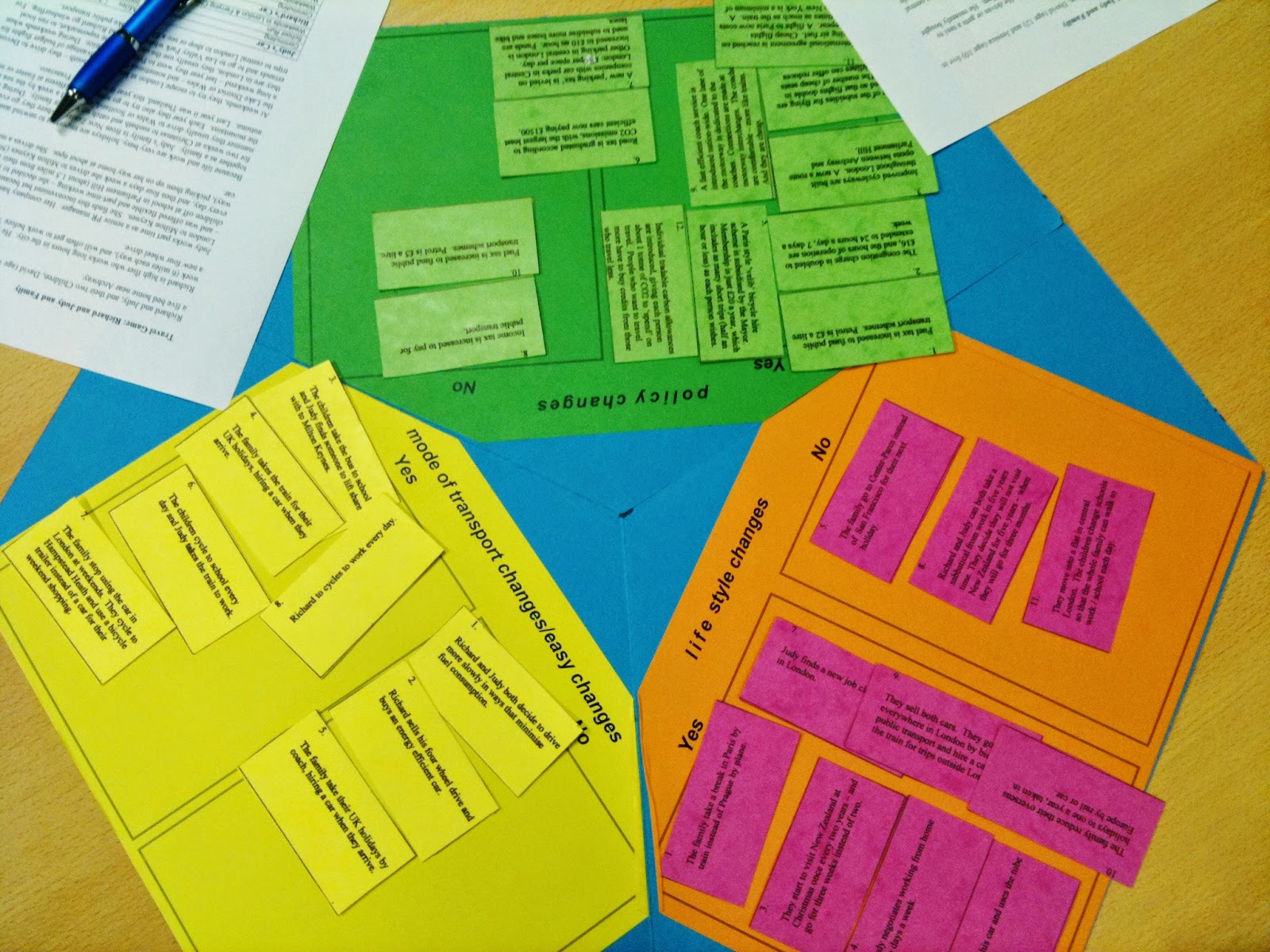
    Next, we played the Climate Walk game in two teams: we had to make a series of choices about things we would personally do and things that, if we were in government, we would legislate on. 
     
    The group’s ‘Climate Walk’  via choices, and chances, to 2100.
    Would we take steps to limit the global rise in temperature?
    At the conclusion of the game, we found out where (if everyone in the developed world made these choices) we would end up – in terms of the average temperature rise and the ensuing climate changes/wider impacts.
    It was interesting that the group found it harder to commit to the personal sacrifices (e.g giving up flying, giving up air freighted exotic fruit) than to the pieces of legislation.
     
    In discussion, we concluded that it felt easier to do things if everyone did them (as in the case of legislation). Reflecting on this on the way home, I also wondered whether part of what was off-putting was the absoluteness of giving something up permanently.
     
    I feel it is perhaps easier to think in terms of working towards a carbon budget of around 6 tonnes a year (as recommended in the Carbon Conversations workbook and in How Bad are Bananas) because then you can still choose to fly if you want to – but in order to do so you could “save up carbon” by cutting down on milk and dairy – or by changing your car commute to a bicycle one, and so on.

    To conclude we reflected on where we go from here.
    It was inspiring to hear what people were planning to do, including:

    Training as Carbon Conversations facilitators
    > Considering lifestyle changes, such as living or working differently to avoid a commute of 6,500 kilometres on the tube every year
     
    > Creating a game for the Tooting Foodival to help spread awareness of carbon choices
    > Setting up Carbon Collaborations – developing a community to bring people together, face-to-face and via a new website and Facebook page to spread these ideas widely in a very participative way


    Personally, I learned a great deal from the whole Carbon Conversations process and made a few fairly significant choices about my own lifestyle.

    I’m now busy reflecting on ways to communicate what I have learned to others in a way that avoids preaching and guilt trips.
    In the meantime, I’m loving seeing London from a bicycle rather than sweating on the tube.
    And I’m trying to convince myself that I prefer coffee without milk…”
     
    ..thank you for sharing your own experience of the meeting, Dan!
     All welcome to join in with the next Carbon Conversations series when we fix new dates. Meanwhile, everyone is welcome to enjoy taking part in Carbon Collaborations
     
    And of course there’s the Tooting Foodival on the weekend of Sept 13th and 14th – you can grow local vegetables, cook a dish and participate in many ways on the weekend.
     
    Dan will be at the Foodival with FanSHEN theatre company on Sunday Sept 14th.

  • Food: Carbon Conversations Meeting 5

    We’re continuing the glimpses into what we’re covering in our current series of informal Carbon Conversations. Here is the fifth…
    Participant Ben has written his own response to this week’s meeting, all about exploring carbon reduction in our Food.
    Ben’s comments:

    ” Monday evening in Tooting….cold, damp with a mid-summer mist clinging to the trees across the common.
    And here we are, huddled around Jane’s dining room table for our fifth Carbon Conversations session.
    This evening’s topic is food. As ever, the discussion is thought-provoking and far-reaching.

    We discuss our personal relationships with food. We feel that food can be the source of positive things (pleasure, socialising, creativity) as well as negative (neuroses, ethical dilemmas, health concerns).

    Then we play a board game where we assess the carbon footprint of different food items. I’d never thought about food production in such an atomised way (production, processing, packaging and transport are all very distinct parts of the production line from plough to plate).

    The game throws up some surprises.
    Frozen chicken nuggets flown to the UK from Thailand are bad all round – high carbon at every stage of the process.
    But because 48% of food’s carbon emissions are embedded in the production part of the process, a piece of Irish cheddar comes out pretty high in C02 emissions as well (the production of cheddar involves the rearing of cows, their feed, methane the cows produce, etc, which is all very carbon-intensive).

    It is also interesting to note that something that’s travelled from afar isn’t necessarily bad –slow, long distance transport of non-perishable items by ship can be quite low in carbon. So, a few surprises here!

     
    Very Local:
    British-grown, good for you!
    Very Very Local:
    Sown, grown and
    eaten in Tooting!


    What are the prospects of making lifestyle changes on the basis of all this?
     

    The prospects are good I’d say. Low-carbon food tends to be healthier and cheaper. Indeed, the best food of all is stuff you’ve grown yourself: low-carbon, super cheap, and super healthy. So, the moral of the story? Dust off your gardening gloves, grab a trowel, and get planting.
    The future of food consumption is local produce.
    It’s a no-brainer.”


    Thank you very much, Ben!
    Next week is our 6th meeting: the finale of our 8th Tooting Carbon Conversations. All welcome to join us next time we offer the series.
    STOP PRESS:

    A very relevant article titled: Planting potatoes into policy: why town planners must think about local food’ was in The Guardian on 14 May. Read it by clicking here.
    
  • Travel and Transport: Carbon Conversations Meeting 4

    Jenny has posted her response below to the most recent meeting in our ‘CC’ series. During the series we have been digging into understanding our own ‘carbon footprint’ and what it means to us in real life.

    The UK average carbon footprint per person per year now is c12 tonnes of C02 emissions. There’s a challenging and more sustainable goal of four tonnes of CO2 emissions per person per year (= emissions from home energy, travel, food purchasing and general consumption, at roughly a tonne each).

    “I offered to write a post on this, because when I did my carbon footprint, I realised that travel and transport form a significant portion of my annual carbon footprint, so it’s an area I want to improve on.
    In this session, we shared what was important to us – peaceful, safe streets, short journeys to work, lower speed limits and safer cycling. 
    We imagined what it would be like if people didn’t own cars anymore and there was a cycle super highway like the one Norman Foster has proposed. We didn’t all agree on these more extreme re-imaginings of how we travel, but we all agreed that shorter local journeys on peaceful streets would be a good thing.

    While looking at the pros and cons of different types of transport, there was a lot of debate and focus on cycling. Most people in the group own cycles and had cycled to the meeting. It’s a quick and easy way to get around Tooting, but all agreed cycling in the centre of London was not such a pleasant experience.

    Wouldn’t it be great if you didn’t have to be aggressive cycling in the city just to claim your piece of road? Would more people cycle if London was more like Amsterdam? What if the state gave you a free bike if you promised to use it more than three times a week, like in Sweden?

    We played a game, imagining we were a family of four making travel choices based on lifestyle, and on government policy.
    What soon became clear was that low carbon choices aren’t always made with the sole intention of doing good for the planet. More often, travel choices were made based on money or time saved – money and time that could then be spent as a family. Policy rarely influenced decisions in our game and sometimes, that was surprising.
    In the future, we may have to reduce to 1 tonne of CO2 per year per person for travel. Here’s my challenge: can I get to 1 tonne?

    I started my own travel diary and estimated my day trips & holidays.
    Here’s how my annual carbon footprint stacks up now in 2014:

    • Commuting and local travel around London: 6,396 miles per year = 0.9 tonnes of CO2
    • Day /weekend trips out of London, and holiday travel: 1640 miles = 0.3 tonnes of CO2
    • 2 return short-haul plane trips to Europe: 4 tonnes of CO2

    In total, that puts my travel emissions at just over 5 tonnes per year. 
    Is it time to cut the trips abroad or can I save enough by getting a job locally to afford me one flight a year?

    One tonne is certainly going to be a challenge!
    I’ll post a follow up on this, and from the other participants in the group”

    Thanks for these honest comments, Jenny!
    We’ll report back from the two remaining Carbon Conversations meetings in this series.
    If you would like to get into this fascinating and urgent topic, do join us in the future when we next offer ‘CC’ locally. All welcome: you do not need to be an expert, just interested in exploring your own choices, and in taking some action.
  • Re-used & Reclaimed: Carbon Conversations Meeting 3

    Our third meeting in the current Carbon Conversations series was all about exploring and reducing our carbon footprint in the things we purchase. That’s a big topic which ranged from ‘why do we buy stuff anyway?’ to re-use and ‘upcycling’.
    Richard is a participant and has been researching an apect of consumption: re-using building materials, He recommends a couple of interesting projects below:

    Hi all, I’m researching ways we can enable re-use of materials that come out of domestic scale renovation/extension work. This is something dear to my heart having been involved in making projects with Transition Town Tooting and at home using reclaimed timber – you guys will remember the water catchment project, (which was all reclaimed except for 5 lengths of timber that needed to be longer than the available) and the cold frame project that was 100% reclaimed materials.

    Re-upholstered chair with funky echeverias.
    Anyway, during my research I’ve found some really cool initiatives from around the world, and I thought I’d share them with you.
    Have a look at the vimeo clip from the Portland, Oregon based organisation called “The Rebuilding Center” and tell me if you give it an English chuckle or join in with the tears at the end!

    The Rebuilding Center also has done projects using bicycles to transport the materials they salvage form demolition jobs – hardcore! They also have lots of project ideas.

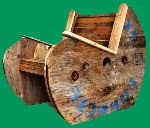
    Handmade cable drum chair

    Yooz is up in Scotland and integrates re-training in its business model.

    Ok, there’s two. Hope you like ’em and it inspires how we can better re-use the copious amounts of useful material going into skips up and down the land.
    Richard

    And thanks a lot, Richard! For more about this meeting series, click on CARBON CONVERSATIONS at the top of this blog page. All welcome to the next series we run.
    And maybe you have ideas for Made in Tooting re-use and reclamation?
    Do get in touch.

  • Carbon Conversations Meeting 2 – Hunting Energy Use In The Home

    Report on Carbon Conversations by Eleanor. 
    On 27th May we looked at our carbon footprints and then at home energy. I’ll try to explain without jargon while recognising that learning new ‘carbon literacy’ skills is useful.

    Carbon Footprint:
    Our carbon footprint is a measure of the amount of emissions in tonnes of C02 equivalent (called C02e for short) that we use to live our lives. The average personal footprint in the UK is twelve tonnes of C02e.

    So … where would you ‘hunt for carbon’ if you want to reduce your own footprint?
    Our individual carbon footprints are made up of 5 main areas:

    As a group everyone was well below the national average, but we are all still keen to do better. The next conversations will give us the tools to take practical steps to reduce our carbon footprints overall.

    C02 in our homes
    Just to get everyone thinking we started with an exercise to determine what home comforts mattered to the group. The conclusion we came to was that once we have basic shelter, it’s all personal. Everyone has different priorities and will approach this opportunity from a different perspective.

    Turning to home energy, there are two routes to a low carbon home
    1. Use less energy (gas and electricity)
    2. Switch to an energy provider who puts renewable energy into the national grid.

    The Low Carbon Home game was a bit of fun to see if we could reduce the carbon footprint of a family house by 6 tonnes over 6 years. Some actions are free and easy to do like monitoring energy use and turning down the thermostat. Others require some time and a small investment like changing the light bulbs and some like fitting double glazing or a new boiler require building work to be carried out.


    A real life example

    The best bit was that all the points raised were backed up with a real life example. The venue for the session was in a property that had been modified to be as sustainable as possible. Susan had done exactly what the game set out to show, but in her own home.
    The house (see this link to Susan’s project) is an inspiration and it was great to see that it was achievable. The main thing was how comfortable it was, no drafts, good lighting, and still low energy. Low energy living doesn’t have to mean going without, in fact quite the opposite with the house being cosy and warm over winter. Reducing the heat losses of the house through insulation really made a difference to living in it.
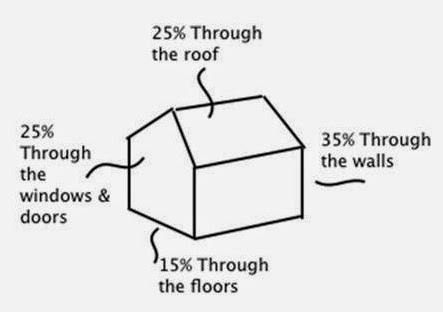
    So where does heat loss occur….?

    Worth bearing in mind if you are making any improvements to your home; it’s not all about double glazing.

    Susan’s main recommendations are:
    1.   Start reading meters and measuring, so you know if you are really reducing energy use
    2.   Explore the options,really get to know your house or flat
    3.   Plan to take steps over 2-5 years, and think about the sequencing so each step is valuable


    I can’t wait to get started on implementing some of the measures discussed here today. The next meeting on June 9th will focus on consumption and purchasing ‘stuff’, and the impact our decisions on what to buy can have.
    Thanks from all the group to Eleanor for this report. 

    Please email transitiontowntooting@gmail.com if you have any questions or would like to inquire about our next series of Carbon Conversations. Other TTT blog posts on Carbon Conversations can be found here.   The Energy Saving Trust – website here – is a practical resource for practical energy reduction tips.

  • Green sky thinking – here in Tooting

    On Tuesday evening 3rd June the Furzedown Low Carbon Zone is having its monthly planning meeting  at the Furzedown Pub, in the back room from 1900 to 2030.
    The group has carried out diverse local projects for the past three years with many partners. On Tuesday we’ll share updates on current plans and make new ones: our priority now is to develop a community renewable energy project locally.
    For more info, email us at furzedownlowcarbonzone@gmail.com
    All welcome – and we’d love to talk to you at the Furzedown Festival Big Day Out on 21st June http://furzedown.net/

    At Sprout Arts on Wednesday 4th June, from 1900 to 2100, there’s the first of a fascinating series of events with local architect Ayca Cutts.
    ‘Green Thinking: Designing to Survive’ is the title of Wednesday evening’s participative workshop. For more details on Ayca’s whole series at Sprout, click here.
    We are looking forward to this – and it’s a great fit with our Tooting Carbon Conversations series (click on this link for more info on our curent and past meetings)

  • Our 8th ‘Carbon Conversations’ series has begun

    We began last evening………..our small group’s exploration of understanding, choices and action on carbon reduction.
    The participants aren’t all starting from the same place on this journey. Some people in the group know a lot, some know less, and for all of us terms like a low-carbon future or carbon footprint may be simple words, but what do they mean?
    Yes, we’ve promised to be careful of jargon.
    However there is no getting away from the fact that it’s useful to become more ‘carbon literate’, and engage with some new terminology, and some measurement (‘where are all those tonnes of C02?’) –without becoming carbon bores or confusing people.

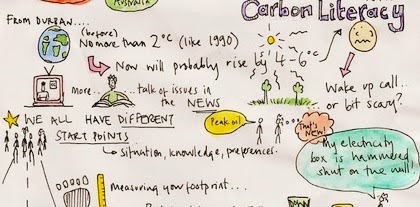
    Sketch of an earlier carbon conversation, by Alice Maggs
     

    We asked ourselves the question: why do we bother? to act on sustainability and carbon-reduction in our lives.
    Here are our responses, and no one needed to mention carbon at all in these personal and passionate comments:

    • I feel more powerful and in control, rather than helpless
    • It’s a crime not to
    • I wish to look after the world
    • I hate waste and with my ‘cheapskate tendencies’ I love to recycle
    • I care about the future, and my children’s lives
    • I believe doing positive things makes more positive things happen
    • We are all at risk – people, countries, nature
    • This is a global challenge, and I want to know what I can do

    These comments show a range – maybe some are from the head and are about understanding and facts; maybe some are gut feelings from the heart; some are about taking action that’s hands-on.
    We have a creative mix in the group for this series!

    This session was designed to frame the whole series, and the next meetings are focused on separate practical topics. The second meeting is Tuesday 27th May, and you can still join the rest of the series then.
    For more info, click here for the flyer.

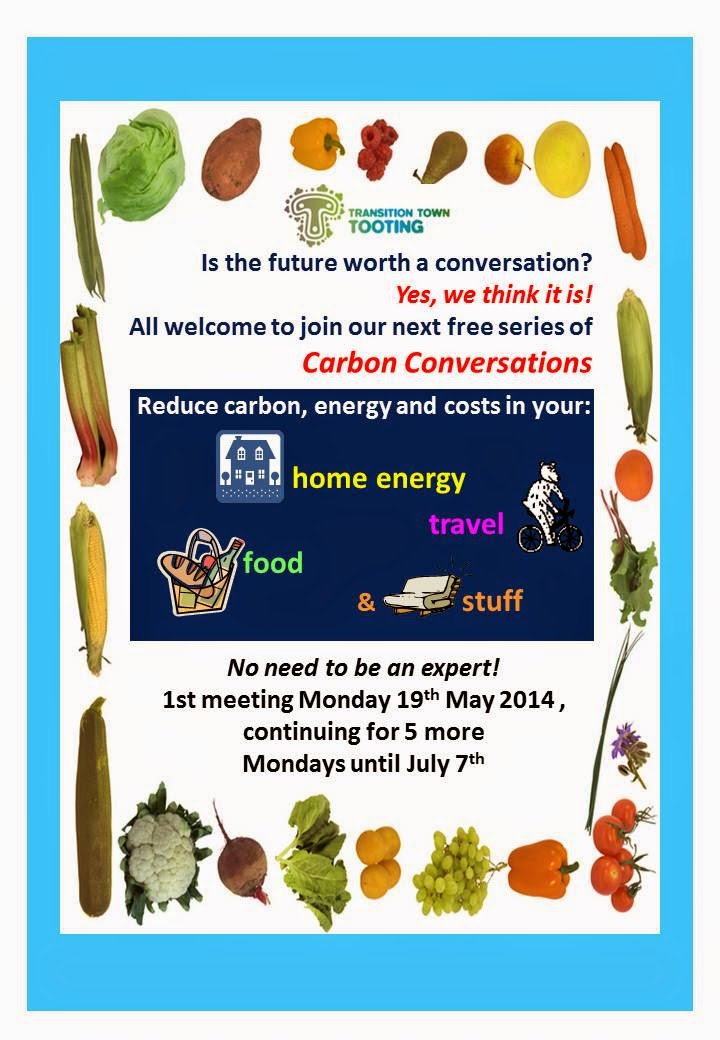
  • Join us for Carbon Conversations 19 May to 7 July

    All welcome to our eighth series of Tooting Carbon Conversations.
    We have a group formed now to start on 19th May, with a couple of places left – please do join in for a free, instructive, practical and non-judgemental tour around reducing your own carbon footprint.

    Click here for the flyer with all the details. And click on CARBON CONVERSATIONS at the top of this blog page to read past TTT posts.
    To sign up or chat, email Charles at transitiontowntooting@gmail.com – but don’t leave it too late!

    And we have a fascinating new offer:
    Our Transition Town Tooting colleague Jenny is developing the idea for Carbon Collaborations – an informal space, online and face to face in other meetings and workshops.
    Carbon Collaborations can encourage people to share their own successes and challenges in understanding and managing their own journey with carbon reduction in home energy, travel, food, consumption, and more.
    We’ll share What does that look and feel like?
    That could be expressed through wishlists, diaries, sharing equipment or time, confessions, pleas for help if stuck, photos of achievements… 
    We’ll get into this at the end of this next Carbon Conversations series.

  • Three practical local projects: do join us!

    Furzedown Low Carbon Zone
    We had a productive monthly planning meeting last week – please see the minutes and actions here
    In outline we’re at the stage of visiting local partners to explore sites where there is space and interest to be involved by ‘hosting’ renewable energy generation equipment – whatever technology is appropriate – and sharing in the benefits.
    A second stage will be to engage with local people who can become involved as co-owners of a community generation scheme. The Furzedown Festival in June is a target for that, certainly for informal sharing of the project.
    Next planning meetings are on 8th May and 3rd June in Furzedown…please come along if you would like to be involved at this stage. Details will be on the TTT Events Calendar on this blog. Contact us on this email link for any further information.

    Eighth series of our ‘Carbon Conversations’ meetings
    We are going to offer a free series of local Carbon Conversations from the 19th May to early July this year. Running on Monday evenings (with one Tuesday for luck), this will be a set of six participative meetings which enable individuals to discuss, understand and take control of their carbon footprint, and work out ways to reduce energy consumption and expenses.

    It’s a very engaging and practical set of meetings…..and even fun.
    We’ll cover home energy, food, travel and transport, and general consumption of ‘stuff’.
    All the details are in the flyer for this next series: please click here.
    Please contact Charles at transitiontowntooting@gmail.com with any questions.

    ‘Cleaner Air 4 Communities’ Project
    This project brings citizen science and local action to the challenge of measuring and advocating for clean air. The toolkit – click here to link to a pdf copy – describes some of the steps that can be taken by a community group.
    Graham Petersen recently took part in air quality measurement at Clapham Junction, with the Battersea Society (there’s a case study on this experience in the toolkit). There is some funding available to support this project, and Graham is investigating that, with a view to improving air quality in Tooting. Please use the Furzedown Low Carbon Zone contact email for more info.

    All welcome to join in with these three projects. Please get in touch!