Tag: Carbon Conversations

  • Carbon Conversations Week 2

    In the second session of Carbon conversations, we predominantly discussed domestic energy and how we could reduce our carbon footprint from energy usage.

    The discussion started with how much temperature rise could happen in the future and within what time and would we able to cope with it? People had thoughts from 2° C rise to 10 °C and some of them felt we are doomed, while a few who are still aware would not want to think of it negatively and see what action they could do.

    We did an exercise of what a comfortable home looks like. While most of us did prefer fresh light and air some preferred a garden. We touched upon minimalism, as to how it could contribute to a comfortable home. We discussed energy, EPCs and how we could reduce our carbon footprint as owners or tenants.

    The group was divided into two (role as owners and tenants) and played a game of reducing 6 tonnes of carbon footprint through energy savings. It included a combination of changes to the house along with behavioral changes.

    We spoke about challenges that we could face in reducing our carbon footprint through energy. The changes being expensive was a dominant factor, while for some being in a position of the tenant could hinder progress. Understanding of the technical aspects could be a challenge, while the efforts and time for research and taking informed decisions could prove to be a big task.

    At the end we all spoke about specific actions that we could take to reduce carbon footprint and any challenges that we could face. All in all, it was a fantastic session with a lot of learning on different aspects of energy as a facet of reducing our carbon footprint and how we could start off with even the simplest and free measures to reduce our carbon.

  • Carbon Conversations – First Session April 26

    In our first session we discussed some general issues around climate change such as responsibility for the problem and what a low-carbon future would look like.

    On the issue of responsibility we thought about individual vs structural change. We agreed that individuals do hold significant power through their consumer choices. However we also recognised that people can only take actions within certain frameworks of possibility (eg they can only use public transport if these services are provided; they can only use community-generated energy if the political system supports and encourages such endeavours). So of course there are limits to individual action.

    We also brainstormed what a low-carbon future might look like. We wondered what legal frameworks might be developed to ensure that our carbon footprints were lowered. In the absence of such frameworks, would people’s individual morals be enough to keep all of our footprints down? This is a thorny issue which governments are reluctant to touch, because it would involve imposing carbon quotas upon people, which could be unpopular.

    We also thought about whether we would have such a strong sense of seasonal change in the future, given our changing weather and how the availability of produce all-year round makes us more immune to the seasons. We also wondered whether, if people have smaller families, this would lead to more people living communally, in order to find a sense of community which they wouldn’t get from having a big family. Finally, we had a mind-bending discussion about self-drive vehicles, which felt like science fiction, but apparently is a fast-creeping reality!

  • TTT’s new series of practical & participative local ‘Carbon Conversations’ is running in April and May

    Carbon Conversations is back! Our new series of six free meetings in April & May in SW16 – organised by TTT’s Ben Cuddon. The six facilitated workshops enable individuals to explore how they can reduce their personal carbon footprints. The meetings bring together small groups of local people to discuss the areas of our lives where we can reduce our own carbon emissions: travel, food, domestic energy, consumption and waste.

    A quote from a past participant: “The beauty of Carbon Conversations is the optimism, creativity and shared ideas”

    During the six weekly sessions you’ll discuss in a supportive atmosphere all the practicalities of making your own ‘low-carbon lifestyle’ changes. Making these changes is never one size fits all. 

    Exploring your own situation, start point and preferences is so valuable and makes the series personal and practical. 
    The meetings are well structured with a mix of games, activities and exercises.


    Click here for the flyer and see below for summary details:
    Venue: in SW16 near Streatham Common Station 
    Timings: all meetings run from 7:00 pm to 9:00 pm 
    Dates: six Thursdays from April 19th to May 24th, one a week
    Free: there is no fee to take part. The only cost is currently £14 for the workbook and learning materials, which TTT charges at cost. Sessions are led for free by TTT’s trained Carbon Conversations facilitators. 

    TTT has run over 10 series of Carbon Conversations since 2011. 
    On average participants are able to identfy how to reduce their own carbon footprints by a third – by over 4 tonnes of carbon.
    Wait a minute! 
    What does ‘four tonnes of carbon’ mean? 
    You may already be worried about shorthand & jargon. The way we facilitate the meetings means that you do not need to be an expert
    Although it’s a complex subject, we guarantee that by the end of the sessions you will learn useful new language and concepts and understand the practical elements of household carbon reduction.

    This is a great place to start if you want to reduce your carbon footprint, meet some friendly and like-minded people and explore the topic as it affects you, rather than being lectured at!

    As a participant said: 

    “At the last session I don’t think anybody wanted to leave!”

     Join us to find out how to reduce heat loss from your home!  
  • Exploring Food and Travel in your carbon footprint – stories from May’s ‘Carbon Conversations’

    TTT’s 10th local Carbon Conversations series continues – the free weekly local facilitated meetings where participants can explore their own practical options for low-carbon living.

    The sessions are not only about ‘counting carbon’ and understanding our carbon footprint; they are also about exploring our own values and preferences in a safe and facilitated setting with a small group. Understanding the meaning of our choices…. the ‘why’ as well as the ‘what’…. means we are more likely to take steps which we can sustain over time.
    Quoting one of the participants in this series:

    “The beauty of Carbon Conversations is 
    the optimism, creativity and ideas
    that are shared and emerge”


    Each of the six meetings has a theme – for example home energy, or waste. We reported on the first two sessions in this blog – read it here, and below two more participants describe the discussion points and feelings raised by the third and fourth meetings: about food and travel.


    1 Food: probably the issue that goes to the core of our identities more than any other.
    We did an activity reflecting on all the aspects of food production that worry us most. One of the group shared a really heart-rending story of playing a game with a child where they had to mime different animals. They wagged their tail like a dog, pranced like a horse, but when asked to enact a chicken they curled up into a ball on the floor. This child only knew a chicken as a dead body wrapped in clingfilm on a supermarket shelf. It was a poignant moment…

    We also played a board game to figure out the carbon emissions embedded in all the different stages of the food production process: growing, processing, packaging, transport.
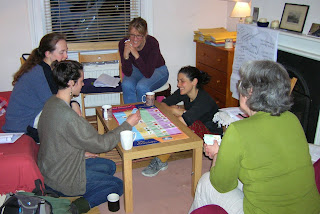
    It was illuminating, but it also made us realise the complications of solely judging things based on carbon emissions. What is something is ‘really low carbon’ but harmful in other ways? There are lots of factors to take into account.
    It also made us reflect on the foods we eat. As one group member said: ‘it does make you think….what ARE we eating?!’

    2 Travel: The slow and rewarding journey
    As I cycled to the little flat in Tooting where our intimate group meets every week to talk through the labyrinthine emotions and values of our relationships with carbon, I was reminded of my first year after graduating from university with a degree in Geography. I wanted to live overseas and make the world a better place. That year alone I took 18 flights. 
    “Take a couple of minutes to think of your favourite journey to date – and also your nightmare journey – to share with the group.” This is how Ben introduced the session of Carbon Conversations with the theme of travel. 

    There was a surprising and reassuring synchronicity to everyone’s answers about their favourite journeys. A cycle trip with friends across Europe, a train ride, a walking pilgrimage to a friend’s cottage, a botched ferry booking requiring troubleshooting cycle journeys to make it to Portsmouth on time. In nearly all the examples, the journey was more memorable than the destination. 

    And why are these journeys so memorable? It’s the slowing down, the views from the windows, the conversations with strangers, the human pace. But then one participants looks confused. “But you can’t do it to all the people all the time”.. she says, half asking, half hoping, about talking to strangers. True that. 

    So if the journeys are the most memorable, why do we all fly everywhere so quickly? Why do we insist on so many destinations?  One participant suggests that it’s ‘constructed desire’. “I don’t want to go to Vietnam”, she says, “but sometimes I feel like maybe I should.”
    And it is complex. Families are spread around the world, jobs require meetings in far flung corners of the globe, billboards promise escape on golden beaches, and that super amazing permaculture training course I’ve had my eye is in the South of Spain. So is it possible to live in the world today while maintaining sustainable modes of travel?


    Since moving back to the UK, I’ve decided to live as locally as I possibly can. I only cycle, I dumpster dive for much of my food, I grow veg in a community garden, I switch off my lights when I’m not in the room, oh and I’ve cut down on international travel, to the extent that I’ve missed a friend’s wedding for the sake of reducing my carbon footprint. 

    And here’s the moment of truth. Ben hands me my carbon footprint calculation. The USA average is 20 tonnes of carbon per person by year, followed by the UK at 15. The world average is 4.5 tonnes while the sustainable world average is 1.5 tonnes. Tanzania’s average is 0.1 tonnes. I’m feeling optimistic.   

    I look at the sheet.
    19.18 tonnes. 


    It’s the two flights I took this year. Both of them to destinations which meant a lot to me. 

    ‘Tonnes of carbon’ is shorthand used to refer to the tonnes of CO2 and other ‘greenhouse gases’ released into the atmosphere. The impact that air travel has on our carbon footprint is undeniably unsustainable! Yet our lives are so scattered around the world already that it’s near impossible to imagine reining them in.

    The beauty of the Carbon Conversations program is the optimism, creativity and ideas that are shared and emerge. The lengths that some participants go to to find solutions is admirable. So is the faith that every change each of us makes as individuals will slowly but surely contribute to a change in emissions and in the global carbon culture. 

    So if you’re looking for alternatives, then two easy things you can do are:
    Oh and one more thing.. if the journey is just as interesting and exciting as the destination, then I think we can make the journey towards a carbon neutral world also just as rewarding. It can be slow, full of surprises, and of course, include conversations with strangers – which is just what Carbon Conversations gets us to do!


    We’ll share the stories of the last two sessions in this series. And if you like the sound of the content and style of these meetings, keep in touch and look out for the next series of Tooting Carbon Conversations.  

     – Charles

  • Update from the first two meetings in TTT’s current series of local Carbon Conversations

    TTT’s tenth series of local Carbon Conversations began in April with a group of 8 local people. Thanks to all, the sessions have been lively and informative.
     
    The series facilitator Ben has shared a short report of the first two sessions:
     
    “For our first session we had several interesting and far-ranging discussions.
    One of them was about what a low-carbon future would look like
    Several people suggested that everything would be conducted at a much more local level. But this left us thinking: does this mean we will have to unravel everything that globalisation has delivered? Is it possible (and desirable) to dismantle globalisation, or should we aim to retain aspects of it and go local only in certain ways?  
     
    For our discussion about a low carbon future we spoke about the importance of having more regulation from government to control carbon emissions, fossil fuel extraction, etc. But the issue of regulating ourselves was also raised. How will we regulate our own behaviour? Several people suggested education and how important that would be in the process.

    Ben continues his report:
    “For session two we discussed carbon reduction in our home energy consumption.

    Everyone agreed that the whole process of overhauling your house can feel very complex and overwhelming. There are so many things one can do, and most people don’t have the technical expertise to understand all the options thoroughly.
    We discussed the problems of the current housing market and how the energy rating of a home is often not very important to the people purchasing it. This is especially true in a housing market like London where people are just desperate to get on the housing ladder and probably aren’t too concerned about the energy efficiency of a home.
    The issue of being a tenant came up – we noted how there is little incentive for landlords to renovate their homes if their tenants are paying the bills.
    We also talked about communicating these issues and how to point out someone is overfilling the kettle without appearing a nag! You can tip-toe, or you can just tell someone they’re being daft…. (we will return to the issue of how to communicate climate change in session 6).
    Finally, the question came up of how to make carbon reduction at home glamorous. Loft conversions are glamorous. But carbon reduction isn’t. Or at least, at the moment. That could change….
    There were some positive notes as well.
    One potentially fun way of tackling the issue is by engaging children. If engaged they could be enthusiastic supporters of carbon reduction, if it is made fun, and if they have the chance to receive education on the issue – linking with what we discussed in week one.”
    Heat loss in a simplified detached house travels in all directions…would you have guessed those percentages?
    We’ll continue the coverage of this series of meetings, and more information about Carbon Conversations can be found by clicking here.
    Get in touch with TTT if you would like notice of when we are offering the 11th series – or get the core of a group together yourself, and we’ll find more people and maybe run it in your home!
  • Our tenth series of Carbon Conversations postponed to start on 20th April

    TTT’s tenth series of local Carbon Conversations is going to start on Thursday April 20th
    We promise you will enjoy and also find a lot of practical value in this exploration of your own ‘low-carbon living’ choices and opportunities. 

    The outcome of the series is an action plan for reducing your own carbon footprint by understanding the impact of what’s in your own control – home energy, travel, food and purchases.

    An active game about the carbon footprint of food

    You’ll find it friendly, fun & surprising
    – and there’s just two places left!

    For all the details, please click here.
    And for our recent blog post (including the new dates)click here.
    Don’t hesitate to get in touch with Ben at bencuddon@gmail.com even if you can’t make every date over the series of 6 meetings. 
    We look forward to seeing you!

  • New series of free Carbon Conversations workshops starts April 20th

    All welcome to join our Tenth Series of free local Carbon Conversations!
    Do you want to make some changes to reduce your carbon footprint, save energy and save on your bills, but you’re not sure how or where to start?

    Join a group of local residents in a series of 6 meetings to explore how small changes can make a big difference.
    You’ll assess your own carbon footprint, then together we’ll look at home energy, transport and travel, food, consumption and waste to help you make changes that fit your situation. We’ll help you make an action plan of practical steps to take. The workshops are free.

    When?

    • Sessions will take place on Thursdays between 20th April – 25th May 2017
    • Specific dates are 20th April, 27th April, 4th May, 11 May, 18 May, 25th May
    • they will run from 7:00 – 9:00pm

    Where?

    • At 96 Besley St, SW16 6BD

    What do we do in the sessions?

    For a start, they are enjoyable!
    We discuss what’s important to us about ‘low carbon living’ – our values as well as technicalities. We’re meeting in the home of one of the facilitators, so it’s a friendly atmosphere and you can bring cake or samosas…!

    We play some creative and instructive games, which lead to more discussion and planning. This one is about making travel choices.

    We look at technical information, too. 
    In this example we’re exploring where heat loss occurs in a normal house.

    For all the info on the workshops, download the series flyer

    Please email Ben to join in, express an interest, or ask any questions. 

    We ask for a voluntary contribution of £16.00 per participant to cover the direct cost of “In Time for Tomorrow?” the excellent Carbon Conversations handbook published by The Surefoot Effect.

    To read personal blog posts by participants in an earlier series of meetings, click here and scroll down all six (they are in reverse order as we posted them live after each session).

    All welcome – you do not have to be an expert!
  • Carbon Conversations – the final session… for now!

    Over the last six weeks, we’ve run a series of workshops called Carbon Conversations, to help a small group of people learn about the steps they can take to reduce their carbon footprint, and investigate why some steps are harder than others.

    We’re looking to run another series in October, so if you’d like to find out more or even sign up, please do get in touch. You can find out more about the workshops here.

    Martin Cobley is one of the participants. He’s an active community gardener and a member of Transition Town Tooting, who has taken a lot of steps recently to live more sustainably. Here, he sums up the final session of Carbon Conversations.

    I’ve been reflecting on one of the topics of last week’s final session: where next in my journey to lower carbon living? After a short exercise reviewing the areas we’d covered in the series – energy, travel, food and recycling, consumption – and some interesting suggestions such as eating only food in season; insulating between floorboards to reduce home energy bills; using local takeaways to reduce unnecessary travel, I’m drawn to the idea of getting a bike. I’m fitter and healthier now that I walk as much as I can, and I’m impressed by the folding bikes a couple of the participants have used to get to the venue. Hmmm… but it’s decades since I’ve ridden one and then it was on quiet suburban roads, no busy London traffic.


    Next we played the Climate Walk game: mentally moving through the century thinking about the consequences for global warming of personal choices, such as giving up flying (a difficult one for some of the participants) and the things governments might do such as compulsory land purchase for growing food, or setting personal carbon quotas. Very thought-provoking: I can see that large-scale government action sooner than later could really make a significant difference. Although I happily sign online petitions from the likes of Avaaz, 38 degrees and Sum of Us for all sorts of climate-related issues, I’ve never been particularly interested in Politics (with a capital P). Logically it’s something I should be doing and I imagine joining in one of the many events which will no doubt be organised around the Paris 2015 talks later this autumn… But is this really my kind of thing? Can’t see myself enjoying it.

    The session ended with a delicious and very healthy supper: everyone brought a low carbon dish, whether home cooked, locally grown or foraged from a school kitchen (with permission in case you were wondering). The conversation picked up some of the threads we touched on earlier: how hard making lifestyle sacrifices can be and having friends think you’re weird; how difficult to talk to climate change deniers without evidence; how to get more Carbon Conversations going? (Could we get a pro-environment character into EastEnders?!). Then, way past the scheduled finish time (I don’t think anyone wanted to leave), farewells at the door and arrangements to meet up again soon.

    So a week later and where next? Neither the bike idea nor going on a demo fills me with enthusiasm. I’ve pushed my comfort zone quite hard recently with some of the lifestyle changes I’ve made – mainly on my own – and some still feel a bit fragile. I think I need something upbeat whilst they bed in. I remember the spirit of camaraderie at the supper; I’m enjoying physical activity… Got it! I shall try learning ballroom dancing! At a party recently I’d chatted to a very lively and energetic person who turned out to be a teacher at a local dance centre. I was immediately drawn to her. And it turned out that several friends-of-friends went to her beginners classes. Low cost, healthy, sociable and fun, plus it doesn’t matter if I’m a complete duffer. And there’s a perfect place to practise waltzing , a private corner of my local community garden!

  • Carbon Conversations – Energy at Home

    We’re into week 2 of Carbon Conversations and this week, workshop attendee, Robin Dru, gives his report on the session focused on Home Energy.

    This week’s session on Home Energy was fascinating, full of tips and new technologies. Over the course of the evening we:

    • discussed what is important to us in making a home comfortable, 
    • played a game based around reducing a family’s carbon emissions (oh yes we did!) 
    • and had the chance to learn from Susan, a green architect who has set out to reduce the carbon emissions of her home by 80%. 

    We all left excited, with some practical tips and new ideas to implement in our own homes.
    First off we thought about the important things to each of us in our own homes. This ranged from practical things like bike storage and south vs. north facing through to things like positive family/house dynamics.

    The discussion hovered over the issue of how to get other house members on board with making changes. Several ideas were thrown up, like making things easy e.g. clear signs for what can be recycled, making things fun e.g. smart meters to monitor energy consumption and making things comfortable e.g. draught-proofing your house.

    After this we moved into playing a game based around a family with a limited budget trying to reduce their carbon footprint. Whilst the game was perhaps a little one-dimensional, it helped to expose us to different ideas, divided into good housekeeping, weekend jobs, appliances and building jobs. A flavour of things mentioned: housekeeping changes like regularly defrosting your fridge and freezer and monitoring your monthly bills; weekend jobs like draught-stripping windows and doors and bigger changes like triple-glazing windows and various types of insulation.

    How much energy do areas of your house lose?

    Finally we had the pleasure of listening to Susan, an inspiring architect who has managed to reduce the carbon emissions of her family home by over 50% in 3 years for ~£25,000. Whilst obviously she has the advantage of construction being her bread and butter, she offered us some a couple of key tips: 1) the importance of awareness and monitoring and 2) the importance of comfort (and how the vast majority of times carbon reduction goes hand-in-hand with this).

    We left excited and energised from the session, equipped with knowledge and greater understanding of energy consumption in the home. Right, now to find a smart meter!

    For more comprehensive information on changes you can make, please visit the Energy Saving Trust.

    If you’d like to find out more about the Carbon Conversations series of workshops, please contact us. We hope to run another series in the autumn.

  • What would a low carbon future look like?

    The first session of six in our ninth Carbon Conversations series took place this week.
    We dug into motivations for reducing our carbon footprints, who is responsible for addressing climate change and what a low carbon future might look like.

    Each week, a different person taking part will report on the themes of each session, giving you a flavour of the series as a whole, while picking up some tips on how you might be able to reduce your own carbon footprint.

    Carbon Conversations facilitator, Ben Cuddon, gives us his impressions of the first session.

    We took some time this week to look at who is responsible for addressing climate change, and the question was raised of how far individuals can make a difference. There were certainly different opinions – some thought individuals could make a real difference; others weren’t convinced.

    We discussed how business and government can take meaningful action and whether legislation or ethical convictions will be the driving force for change.  The question of whether moral or legal change comes first is a fascinating one to think about!

    Group members shared thoughts over how the problem could be solved. Whether our entire economic model (free-market capitalism, endless economic growth) was the essential problem, or whether climate change could be solved within capitalism, through technological innovation.

    We thought about why we want to reduce our carbon footprints and why it’s important. A range of opinions emerged – from the importance of the equal distribution of resources around people to the importance of reducing the world’s overall consumption of resources. Most people seemed to agree that activism on climate change brought people together through a sense of shared purpose, and that this made it exciting and fun.

    Finally we tried to imagine what a low-carbon future world might look like. Some of our ideas were easy to imagine – less long-distance travel, more vegan and vegetarian food, less material consumption. Others were more surprising. I liked the idea of making insects and garden creatures a bigger part of our diet.

    Calculating your carbon footprint

    Each member of the group also calculated their carbon footprint, so they can start to explore areas where reductions are possible. If you’d like to calculate your footprint, head over to Carbon Collaborations, where you’ll find a range of calculators including some for children.