Tag: Carbon Conversations

  • Living with the climate crisis / carbon conversations

    Living with the climate crisis / carbon conversations

    Would you like to join local residents for a programme of facilitated workshops exploring our responses to the climate crisis -personally and collectively?

    Living with the climate crisis is a programme of workshops which offer a mix of psychologically-based groupwork and experiential learning which support people in managing their feelings, experiences and actions towards this complex issue. 

    Anxiety, distress, burnout and despair are common responses to struggling with climate change. The workshops provide a space for people to talk, to share, to express what they feel and to reflect, but they also offer tools, ideas and skills for action. They focus on:

    • support and understanding
    • communication
    • finding pathways to carbon reduction and community and political action

    The programme was designed by the same team who designed Carbon Conversations, which we ran in Tooting for several years – you can read more here.

    We will be running a programme of these workshops in the Tooting area during June and July 2023.

    If you are interested in taking part please email Ben Cuddon to learn more: bencuddon@gmail.com

  • Carbon Conversations

    Carbon Conversations

    Between 2011 – 2018 Transition Tooting led several rounds of Carbon Conversations – involving over 80 local residents.

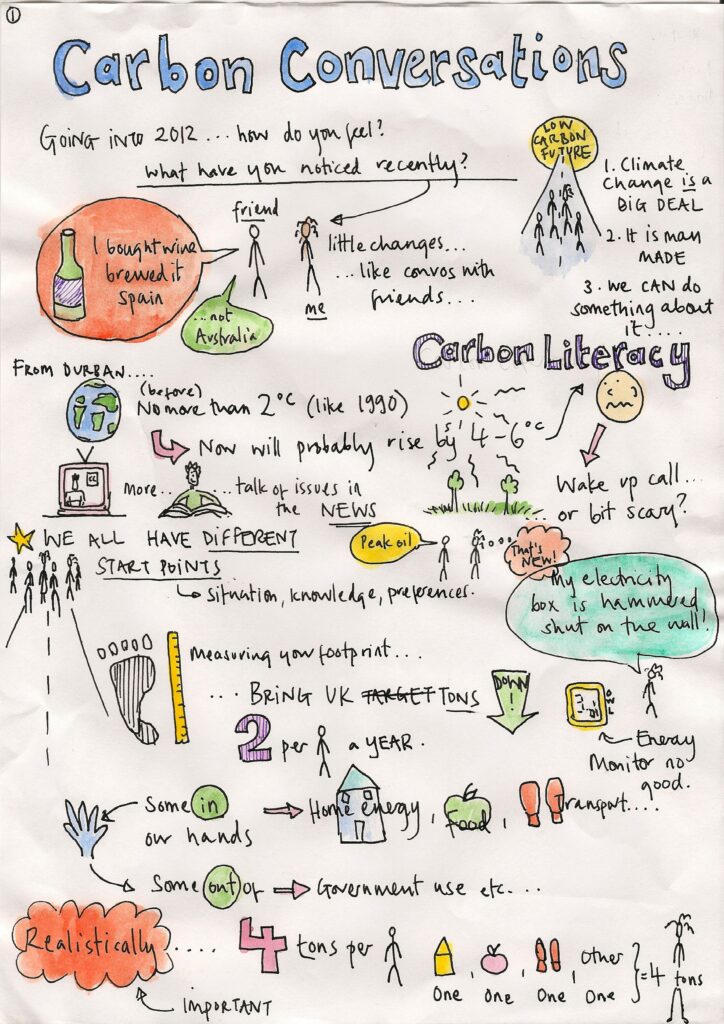
    The facilitated workshops enabled individuals to explore the areas of our lives where we can reduce our own carbon emissions: travel, food, domestic energy, consumption and waste.

    A quote from a participant: “The beauty of Carbon Conversations is the optimism, creativity and shared ideas”

    10 of those who attended went on to get trained and to co-facilitate ongoing groups.

  • TTT’s next series of Carbon Conversations is postponed until early 2019 – in time for New Year’s resolutions!

    We’re postponing our new series of Carbon Conversations until the New Year.
    Tonight’s first session is cancelled, as are the following 5 meetings. The series of meetings needs a critical mass of local people to join in so we have rich and diverse discussions – we are nearly there but not quite for the series due to start this evening. So we will find new dates early in 2019 with that existing participant group, and encourage more people to sign up and join them. Let us know if you are interested!
    Very early New Year’s resolutions, anyone?
    All the info on the six free meetings organised by TTT’s Ben Cuddon in a recent blog post here. Just ignore the dates.

    The facilitated workshops enable individuals to explore the areas of our lives where we can reduce our own carbon emissions: travel, food, domestic energy, consumption and waste.
    During the six weekly sessions you’ll discuss in a supportive atmosphere all the practicalities of making your own ‘low-carbon lifestyle’ changes. Making these changes is never one size fits all. 

    A quote from a past participant:  
    “The beauty of Carbon Conversations is the 
    optimism, creativity and shared ideas” 

  • Local Stories of Sustainability Success – four vivid can-do examples of reducing carbon footprints and increasing wellbeing

    We’re hosting a new free event: Local Stories of Sustainability Success in the afternoon of Saturday 20th October, from 2:00 to 4:00 at the Mushkil Aasaan Hall, 220 Upper Tooting Road SW17 7EW.

    The event will illustrate vivid can-do stories by local people who have reduced their carbon footprints and increased their wellbeing 

    Martin, Susan, Tanya & Dermot – clockwise from top left
    • Martin Cobley and several hundred worms will demonstrate why he is the borough guru for how worm composting
    • Susan Venner will share the steps to make a 19th century family house in Balham warm and cosy, emphasising how to tackle the high-impact things first. More detail on Susan’s experience on the Superhome Database at https://tinyurl.com/y94mqnsb
    • Dermot Jones will share his experience of switching to an electric vehicle. Dermot also tweets as @ElecticVanMan about the story of his first 4000 miles – and the myths and memes
    • Tanya de Afonseca will share her own experience of reducing (refusing?) household plastics. Tanya’s BYO Zero Waste Shop is in Tooting Market https://byo.london/
    We’ll discuss these inspiring examples of what can be done, share ideas, be energised, make some new resolutions & links.
    For the ‘Local Stories’ flyer, please click here.

    The session is designed for anyone who is interested in these lively local stories. You do not need to be an expert!
    Please share with friends and colleagues who you think would appreciate the event.
    Bring the family! We’ll have a crafts table alongside for some making.

    Thanks to the Zero Waste Shop for sharing this diagram of five core elements of zero waste.

    We’ll also introduce the next run of Carbon Conversations starting on Thursday November 1st. For details, click here. Please encourage friends to join in with this 13th series!

  • TTT’s new series of practical & participative local ‘Carbon Conversations’ is running in November & December – you’re invited to take part!

    Carbon Conversations is back! Our new series of six free meetings in November & December in SW16 – organised by TTT’s Ben Cuddon. 

    The facilitated workshops enable individuals to explore the areas of our lives where we can reduce our own carbon emissions: travel, food, domestic energy, consumption and waste.

    A quote from a past participant:  
    “The beauty of Carbon Conversations is the 
    optimism, creativity and shared ideas” 

    During the six weekly sessions you’ll discuss in a supportive atmosphere all the practicalities of making your own ‘low-carbon lifestyle’ changes. Making these changes is never one size fits all. 

    Exploring your own situation, start point and preferences is so valuable and makes the series personal and practical. 

    The meetings are well structured with a mix of games, conversation, debate, activities and exercises.

    Click here for the flyer and here are the summary details:
    Venue: in SW16 between Mitcham Lane & Streatham Common Station 
    Timings: all meetings run from 7:00 pm to 9:00 pm 
    Dates: six Thursdays from Nov 1st to Dec 6th, once a week
    Free: there is no fee to take part. The only cost is currently £14 for the workbook and learning materials, which TTT charges at cost. Sessions are led for free by TTT’s trained Carbon Conversations facilitators. 
    To join or ask any questions: contact Ben Cuddon by email here or TTT by mail here

    TTT has run over 12 series of Carbon Conversations since 2011. 
    On average participants are able to identfy how to reduce their own carbon footprints by a third – by over 4 tonnes of carbon.
    Wait a minute! 
    What does ‘four tonnes of carbon’ mean? 
    You may already be worried about shorthand & jargon. The way we facilitate the meetings means that you do not need to be an expert
    Although it’s a complex subject, we guarantee that by the end of the sessions you will learn useful new language and concepts and understand the practical elements of household carbon reduction.

    This series is a great place to start if you want to reduce your carbon footprint, meet some friendly and like-minded people and explore the topic as it affects you, rather than being lectured at!

    As a participant said: 

    “At the last session I don’t think anybody wanted to leave!”

     Join us to find out how to reduce heat loss from your home!
  • Inviting you to our series of free local events this autumn exploring sustainability in Tooting!

    We’re thrilled with the fun and buzz at the Tooting Foodival last Saturday! Thanks to all who contributed their time, equipment, skills and produce to make it a success (see the I Grew This 2018 blog post).  Over 600 people took part on a sunny Tooting afternoon!
    Much more to share about it soon on this blog.

    The Tooting Foodival was the first in a series of free local events this autumn, all about exploring, influencing and creating sustainability in Tooting, together.

    All invited to all of them!

    Click here for a copy of the flyer.

    The next event is a Tooting Debate on Weds 19th Sept:

    ‘Local Food is an Expensive Luxury’.

    Yes, we know…..that’s intended to be provocative after the success of the community Foodival based on locally-grown food, local cooking and local eating together. 
    Come along and share what you think! Details to come here on the blog.
    The debate is on Weds 19th Sept from 7:00 pm – 10:00 pm at The Selkirk Pub, SW17 0ES

    We’ll promote and share details of all the other events in good time.

  • Carbon Conversations – The Final Meeting

    The final session discussed how we communicate with others about Climate Change. We were asked to consider examples of bad and good conversations we had experienced. We considered some of the reasons that make it so difficult to engage in conversation: busy-ness, it’s all about the future rather than the here and now, it demands self-sacrifice with no benefit for me.

    We went on to consider our own initial reservations about approaching the topic: fears about upsetting those closest to us, our sense of ignorance, never knowing enough to present a persuasive argument. We then shared what gave us positive support. Some found that being part of a group provided a network of resources. Others talked of the cost-saving arguments for low carbon energy use. What is most helpful is to frame the problem in terms of things that can be done now.

    We followed up with a listening exercise in pairs where people were encouraged to listen to the other without interrupting them or listening selectively in order to ask questions. We recognised the importance of speaking from our own experience , “telling our story”,rather than using ideas alone as a means of engaging with people.

    Finally, we reflected on what we had found useful about our six weeks together. We shared how we had become empowered to make changes in our lives and how sharing our feelings about the process was so important. We celebrated with a meal that members brought to share and planned how we will keep in touch and meet up again in the future. Thanks, once again, to everyone for their contribution. Great to have your presence in the final session, Charles, as one of the founding figures. Thanks especially to Ben, for providing his home as an intimate space in which we could all share and reflect in an atmosphere of trust.

  • Carbon Conversations Week 5

    General consumption and waste

     In this session we focused on our consumption. We learned how it is a big proportion of our carbon footprint and how it tends to increase in line with our total household income (the more money we have the more we spend!). There is a relationship between what we buy, why we buy it and our identity.

     Our first exercise was to relate a purchase we were pleased with: Kew membership, solar PV, a battery to go with PV, second hand clothing, bikes, evening courses. And those we regretted: books, home improvements that go wrong, bad phone contract, speed dating nights, shoes and interestingly, bikes.

    Then we discussed why we buy using the exercise on p29. Thoughts that occurred to us included: purchases for comfort or enrichment, is being green denying ourselves pleasure?, purchases leading to hoarding, friends who buy to cope, purchases to celebrate traditions (Christmas, carnival), days out with children, substituting ‘experiences’ for actual gifts especially when celebrating children’s birthdays.

     Our next exercise was to design a poster exploring the differences between personal needs and wants. One group drew three concentric circles with basic needs in the centre (food, warmth, housing, ?Wifi), then a middle ring for things like special food, entertainment, enrichment, studying etc and an outer area for purchases that we felt were extravagant and not needed like weekend breaks by air (some said these were a necessity to some people), art collections, extravagant jewelry, watches etc, private heated swimming pools and so on. The other group’s poster was a collection of drawings: community giving companionship and friendship which didn’t require expenditure, a mastercard advert for a festival, choices and thoughts when making purchases, children’s expectations.

     Our penultimate exercise was to think about five ‘ways to well-being’ published by the New Economics Foundation which explored the ideas of give, connect, keep learning, be active and take notice. We all thought about whether we do these in our lives and could we make more time in our lives to do them. Generally we thought these were good principles but sometimes it can be hard to keep a balance. One particular example is how family responsibilities can take up the time we might spend on learning, being with our friends, volunteering and so on. Another is how education can give us a double bonus of spending time with others of different age groups and life experiences. And also our busy-ness can mean that we miss what is going on around us especially in the natural world. 

    Finally we thought about the things we didn’t get a chance to say during the evening – being too busy in our lives, remembering to be compassionate to ourselves, working towards the NEF Five ways, paying attention, new ideas for home improvements, the carbon significance of un-deleted emails (server space and carbon footprint!), unsubscribing to unread emails.

     Thank you to Ben for hosting our group and to Peter for the wonderful cake!
  • Carbon Conversations Week 4

    We had a lively and informed discussion about food. We started by discussing some memorable meals that we’d had and interestingly a lot of people described the context much more than the food itself. We then did an activity in pairs where we discussed the meaning of food, such as what and who influences our food choices. Topics ranged from how there’s more choice now than a few decades ago, veganism, organic vs. local, rituals and habits, noticing seasonality and availability to compassion for our own-grown vegetables. We then did an ‘anxiety spectrum’ where we got up and stood at one end of the room or the other according to how strongly we felt about certain issues, such as the treatment of small farmers in the UK and further afield, which some people in the group had not thought about much previously and took away as one of the main things they will consider after the session. In the break we enjoyed some lovely Brazilian snacks – cheese balls and corn cake and peanut sweets.

    For the majority of the session we played a food footprints game looking at the main sections of the chapter in the book: production, processing, packaging and transport. It was really useful as it’s difficult to differentiate between a lot of products which seem similar, such as the production of different fruits and vegetables, so it really gets you thinking. It seems easy to hold one piece of information in your head – say the worst or best thing about a product such as there being minimal packaging or it being flown over from New Zealand – but to think of all four factors with each product is more of a challenge. I generally find it easy to not buy a fresh product where it’s obvious that’s it’s been flown from far away, but more difficult to take into account where the ingredients of products with multiple ingredients have come from. So in some ways it’s easier to just avoid these products, or at least see them as a treat.

    We also discussed our food diaries briefly, which was interesting as even for people who already think about these things quite a lot, such as vegans, there is still often a gap between your own perception of what you eat and what you actually eat. I realised that I don’t think of myself as someone with a sweet tooth but I in fact eat more sweet things regularly than I had thought. And I also eat more dairy than I think of myself as doing.

    My main lesson was to eat less dairy (I’m already vegetarian and used to be vegan for five years), because in terms of carbon it’s actually worse than some meats. So I’m going to treat dairy as more of a treat than an everyday part of my diet. I was really encouraged by other people in the group who said they’d had loads of support to be vegan and it made me remember that my family and friends were really supportive when I was vegan a few years ago.

  • Carbon Conversations Week 3

    ‘Travel and Transport’ was the theme of the evening’s discussion this third week of Carbon Conversations.  Stories of favourite and nightmare journeys were shared – from wonderful night time cycling through Hyde Park to the extreme frustration of delays, queues and missed connections while under pressure to meet a deadline elsewhere.  We talked about what travel represents to each of us , especially within a culture where it has become so accessible and so enjoyed.  Aspirations to travel the world are encouraged almost as a rite of passage and, subsequently, many thousands of conversations coalesce around those experiences.  We looked at our reasons for making journeys and there was a recognition of the challenge that would be felt were the visiting of family and friends abroad to be restricted.
    We talked about the advantages and deficiencies of cycling and the current public transport system – who it works for, or not, – and some of the steps that could be taken to make it more accessible for all and why the obstacles to this happening are so significant.  There was a recognition that solutions in potentially wonderful technologies may be still in their infancy! This theme of taking difficult carbon-reducing decisions was continued in the group game we played: we experienced how lifestyle changing decisions could be made at the individual family level (good, though sometimes not to our liking, inconvenient and expensive) alongside having the opportunity to make strategic policy decisions at a government level (also good, potentially having a great impact but likely to incur huge resistance from many quarters).

    We spent some time reflecting on the dilemma of what feels acceptable behaviour and how we can take responsibility for our carbon footprint .  Our final activity was deciding on a manageable action that we want to take and then looking at the driving and restraining forces that we could see coming into play, and then focusing on reducing the effect of the restraining forces.  Plenty to think about during the week!