Tag: Uncategorised

  • Snippets from Ecobuild 2012

    Ecobuild was again a source of wonder this year.  I liked the re-use of materials such as the pallet arch, rubber band lampshade and some lovely tiles made from impressions in every day bowls and dishes.  And then there was water bottle man publicising the amount of water wasted in the home.

    It’s always amazing what you can overhear too …

    “Cities are shaped by the environment, economy and equality, and the environment must guide the others”.

    “We need ‘urban respiration’ across systems such as food, water, energy, jobs”

    At a stand promoting ready-made turf full of wild flowers: “the best way to start is to kill off everything with glyphosate weed killer!”

  • Making the local low-carbon future happen now!

    On Thursday 15th March there were two fascinating local meetings which illustrated some of the interrelated aspects of making the low-carbon future a reality.

    The first one was held in the afternoon at S Thames College in Wandsworth, and speakers examined ways that the community can anticipate, influence and make the most of initiatives such as the Green Deal.
    (TTT has been a partner in a 4 month project organised by the Greener Jobs Alliance). As well as the work experience with S Thames College students, and sharing the excellent activities in local schools, and encouraging the development of the Furzedown Low Carbon Zone, an outcome of the project will be a short video examining some of the challenges and practical responses. The video was premiered on the 15th. When the edit is complete, we’ll make it available on YouTube… Oscars look out!
    For more information on the project, please email TTT at transitiontowntooting@gmail.com

    The same evening saw a celebration party and an interim thank-you with the many volunteers, partners, advisors and investors who have helped establish the Brixton Energy share offer which is funding the rooftop renewable energy power station in the Loughborough Estate.

    They are keen to share experience and learning, and we’ll be talking in detail with them to help ‘Repowering South London’, and explore developing a local project like this that is suitable for Tooting.
    Congratulations! http://brixtonenergy.co.uk/

  • It’s Climate Week

    There are lots of different ways to support Climate Week: encouraging… taking action… challenging… celebrating… What’s yours?

    Looking forward to this week, three Transition Tooting colleagues – Susan, Alice and Charles – facilitated a workshop a fortnight ago with a dozen staff in a UK Government department, to contribute a stimulus for the senior director to write a personal blog during Climate Week. That blog has been posted yesterday on the department’s internal website: it touches on individual behaviours and choices as well as the department’s activities. 

    Why invest the time? For context, as in many organisations, there is a range of views and assumptions in this department about climate – and some sensitivity to change. It is easy to underestimate the  potential impact in an organisation of even a simple blog like this that demonstrates awareness, humanity and personal leadership. Clear communication is such an effective way to support change!

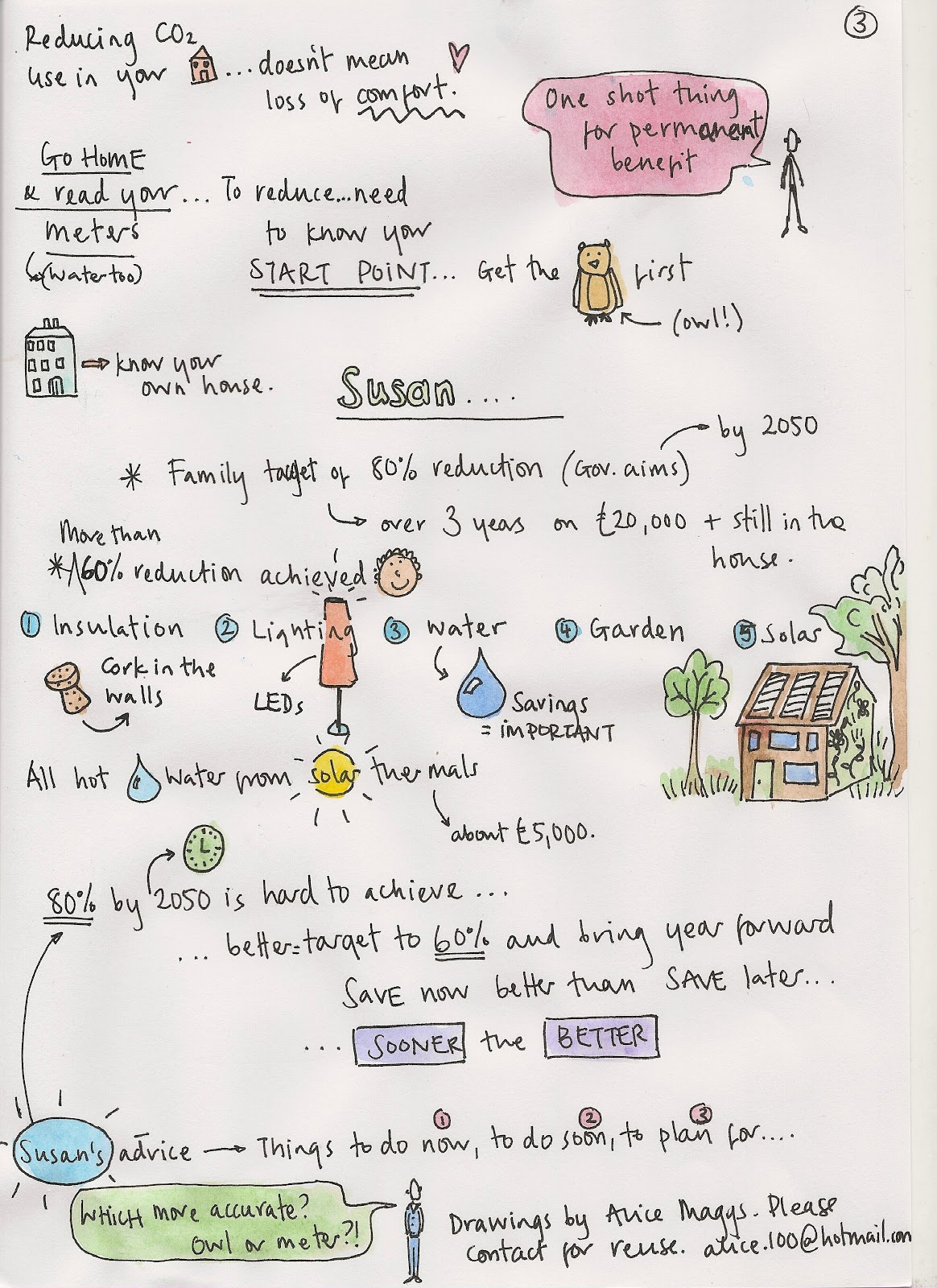
    What did we do in our workshop? Charles and Susan ran the ‘Home Energy’ section of Carbon Conversations (the five-part series of meetings TTT has offered locally over the past year), and discussed Susan’s own experience of carbon reduction in her own family’s house.
    Alice captured some of the interchange and questions from participants in a graphic record – also placed on the department’s internal web. Here’s one of her super drawings, reflecting discussion about Susan’s house:

    You’ll see the mention of the OWL electricity monitoring meter: that is where the senior director starts his blog. Please read on…….

    “Owls are currently big in our house….

    First, Helena (who is now 12) has been engaged in a theatrical presentation at school of a much loved children’s book, “Owl Babies”.  This required her (or more to the point, her granny and other adults in the household) to create a vast cardboard owl costume, ten or twenty times the size of an actual barn owl.  An unconscionable number of mostly adult person hours went in to this, and a rather smaller number of 12 year old ones.  Were she to be measured against the Senior Civil Service competencies, Helenawould score more highly on “setting direction” than on “engaging our people”.  So there was a certain frisson surrounding the owl construction project, especially in relation to those, like me, tasked with the clearing up stage of things.  Fortunately the performance itself went off really well.

    But the other prominent owl is our new electricity use monitoring device.  Many of you, I’m sure, will have them.  They tell you throughout the day exactly what your current electricity consumption is, and what it is costing you.  After an initial moment in which the younger members of the household competed with each other to see who could work out what combination of electrical appliances would send the device to the maximum dizzying level of expenditure, we have now got into quite a good routine.  The device sits on the kitchen table.  Mealtimes are preceded by a scurrying around process in which devices currently not being used have their plugs removed from sockets and switches turned off.  We are saving a small fortune.

    I have drawn two important insights from our electricity owl.  First, transparency is really powerful.  Simply seeing what we are consuming is leading us to consume less.  That is a real opportunity provided by Behavioural Insight work like that on transparency, nudge etc.  Second, thinking about our carbon footprint at home keeps climate change much more prominently in my mind when I arrive at work.

    The idea to get an Owl came from a ‘Carbon Conversation’ on energy in the home with a group of staff from across the department. We met a couple of weeks ago. The group discussed a range of ideas from solar panels and insulation down to energy efficient light bulbs and recycling.

    This week, as you know, is Climate Week….. ”

    (…the blog continues, exploring the department’s own work).

    What’s next? It was a very useful experience for us to facilitate together as a team. Personally, it showed me that one can achieve a lot in an hour, even from a ‘standing start’. And it was a creative way to work with a new kind of audience: I hope we can bring that experience back to Tooting, and to the way we run Carbon Conversations.

    To follow in the footsteps of TTT helping to influence exploration of climate change impact and personal behaviours….. do go and see Susan Venner’s house in Balham for yourself. It is open to the public on 24 March for guided tours. It’s a fascinating visit hosted by Susan, and places are limited, so please book on this link if you wish to join:
    http://www.superhomes.org.uk/events/london-balham-cornford-grove-24-03-2012/

    – Charles

  • SPRING STEPS

    I step down after four years as TTT’s Co-Chair – an energising and rewarding role. Daunting at times, (what are we doing??? how do we DO this?) and ultimately inspiring on a daily basis to see what incredible opportunities there are to bring about change,  using our imaginations and our wits to invent a more liveable future.  Thankyou thankyou thankyou to everyone collaborating to establish TTT since 2008.  I think we have opened up possibilities for re-imagining a more aware, creative and resilient Tooting.  A warm welcome to Tim Bage who joins Charles Whitehead as our inventive and resourceful Co-Chairs. 

    Our TTT AGM last week, gave us a chance to imagine ways in which the derelict chapel in Streatham Cemetery could be used as a community resource for quiet contemplation and re-skilling activities.  Some fantastic ideas came up, from a bio-diversity hub to cinema screenings to bee-keeping to a Passivhaus chapel.  We’ll be feeding them back to Lambeth Council who have expressed an interest in seeing the pretty Victorian chapel in use once more.  (Come on the Spring Wildflower walk there on March Sunday 25th 2.30pm with Roy Vickery. See http://www.friendsofstreathamcemetery.co.uk/)
    Transition and the Arts – As writer-artist in residence at Battersea Arts Centre join me for 3 (free) Playing For Time public sessions on March 16th, March 23rd and March 30th (all 5pm-6pm) to look at how the arts play a role in transitioning to a more ecological age. http://www.bac.org.uk/whats-on/playing-time-talks/
    AND HOW ABOUT THIS for bringing about change!  Lido bins, bought by the South London Swimming Club are now installed at Tooting Bec Lido! 
    Lucy
  • US sustainability students walk the Transition talk in Tooting

    24 college students from the USA doing a ‘Sustainability in Europe’ course based in Denmark came to spend half a day in Tooting on Monday 5th March to kick off a week in the UK.

    Their curriculum explores the role of local communities as agents of change towards greater wellbeing and a more sustainable future. This includes getting out into the real world and seeing what people are doing.
    Two of us from Transition Town Tooting took them on a talking and walking tour.
    Lucky it was sunny…even if there was a freezing wind.
    We started at the busy road junction by Tooting Broadway tube, then north to Streatham Cemetery, where we explored the opportunities that the Friends of the cemetery are developing. We went back through residential streets and past Gatton Primary to Tooting Market, where we had snacks by the Brick Box and soaked up the atmosphere. Then into the meeting room at Mushkil Aasaan (thank you!) for a fuller discussion, and on up to Tooting Bec tube via asian sweet shops, and a peek into the Wheatsheaf. Three hour tour complete!

    At each place we talked about the students’ own first impressions of opportunities for supporting sustainable living in Tooting, and we described diverse existing and future local projects.
    In the longer discussion, the students offered very useful observations based on what they had seen, and on their own experience. It was valuable for us, and both humbling and exciting to think that some insights into community and sustainability in Tooting will find their way back to two dozen locations across the USA.
    – Charles and Lucy

  • Furzedown Low Carbon Zone meeting 1st March

    All welcome to an update meeting on the Furzedown Low Carbon Zone, at the Furzedown Project, 91 Moyser Road, Tooting SW16 6SJ, on March 1st from 7:00-9:00.
    We will:

      • hear from Brixton Energy http://brixtonenergy.co.uk/, who are launching their exciting share offer right now for the UK’s first inner-city renewable energy project. That’s a scheme we would love to see in Furzedown in the future….!
      • share details of our current project with South Thames College, using video and work experience to engage local young people with low-carbon employment opportunities
      • and more! Please come along…
    • Two London meetings in December emphasising community resilience

      TTT members took part in two recent London meetings:
      London Transition Groups Gathering

      On Dec 1st, 100 participants from over 25 London Transition groups – and beyond – met at City Hall, by Tower Bridge on the Thames.
      As well as meeting new people and following up links and ideas, we heard quick updates from 4 speakers:  on the London Low Carbon Communities Network, from two of London’s funded Low Carbon Zones, and from the founder of Project Dirt. All these talks mixed humour, honesty about mistakes and celebration of successes with encouragement for the rest of us in our diverse community projects.

      The main part of the evening was led by Rob Hopkins, who founded the Transition Movement seven years ago. His new book ‘The Transition Companion’ has just been launched: developed over 2 years of listening to and collecting stories about many Transition groups. (Yes, there is a lot in the book about Transition Tooting…have a look!).
       

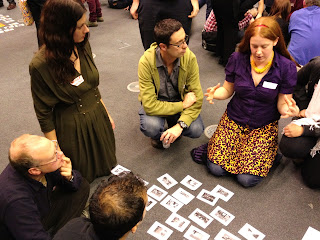
      Rob facilitated the ‘audience’ to participate by exploring a new

      Transition tool – a set of cards illustrating the 40-plus ‘Ingredients of Transition’ which groups are using to support their projects and communities – and which he describes in the new book.

      Photo: Rob looks on as TTT’s ingedients are mapped by many hands using the picture cards
      Different groups in the gathering used sets of these cards to look at their own activities, history and plans – laying them out on the floor as timelines, or as maps.

      It was fun, and easier to do than to explain. We had great ‘show and tell’ discussions as we went round the room, seeing what sense different groups have made of the ingredients.

       
      Photo: Jeni describes TTT’s journey 

      If you would like to know more about these ‘Ingredients of Transition’, have a look on line at http://www.transitionnetwork.org/ingredients

    • City University Food Symposium


      On December 13th, City University hosted its second Food Symposium, bringing together over 150 people from community and consumer groups, farmers and food producers, wholesalers and retail chains, unions, universities, the NHS, local authorities, and the government.
      The overall topic was the direction, roles and challenges facing UK food policy – influenced of course by change across the globe.
      The day was convened by Tim Lang, Professor of Food Policy at City University, who has supported several Transition Tooting events and lives locally.

      After a morning of talks from a wide range of experts, the group divided into three (‘Civil Society’; the ‘Food Supply Chain’; the ‘State’) and addressed these questions: “what are the current challenges facing the UK food system from your perspective?”, and “what can be done about those challenges, and who will do it?”


      Some of the practical points that came up which are very relevant to communities such as Tooting included:

      Ø  How can consumers have more direct involvement with food production?
      Ø  How can we find delicious and nutritious food in a time of austerity, when processed food that’s high in sugars and fats is the cheapest to buy, and available everywhere?
      Ø  How can we integrate the health benefits of good diet with other factors that promote wellbeing – exercise, keeping active, connecting with other people?
      Ø  How can we reduce waste in food (<50% of disposable income is spent on food, and <30% of food is wasted).
      Ø  How to use good food well, and also ‘cut carbon’ – in the home, and in procurement by large purchasers such as hospitals?
      Ø  How can we establish ‘Fair Trade’ locally in the UK?

      Practical advice & feedback from these sessions will be shared soon, and we will post a link on the TTT blog.

    • Footfall on our High Streets (plus some webbed feet too…..)

      It’s a fact: a local economy needs to take account of Peak Oil and Climate Change. We cannot ‘grow’ our economy without recognising we live on a finite planet. Our fiscal ‘crisis’ is tagged to these two reality-checked ‘barriers to growth.’  How exciting to see the new government Mary Portas report on bringing life back onto our High Streets talk of community well-being and sustainability  –  though she explains it in terms of building social and cultural capital to build economic capital – bringing human footfall back onto our High Streets to create vibrant centres.
      To join the dots between what Transition’s been exploring for 4 years and what Portas herself is saying,  do look at this recent Transition Culture blog by  Rob Hopkins. ‘Another world is not only possible..she’s opening a bakery around the corner’.

      ‘The national chains and large stores can increase our oil dependency rather than reduce it, and this is not a time when that is a smart thing to do.” A resilient, thriving, sustainable living local economy instead takes account of ‘plugging the leaks’ in our local Tooting economy and recognises how much MORE small and medium businesses contribute to local resilience than large brand companies who relocate at the drop of a hat.  Smaller businesses are the ones that actually build a community’s resilience.  We do hope Wandsworth Council are taking note..

      Portas’ idea of local people as ‘co-creators’ of town life rather than simply consumers came alive during the TTT/BATCA re-envisioned High Street excercise back in March 2010 Let’s Make Tooting Better . A vision was conjured with more people-friendly streets,  facilities for arts and learning and safe and easy places to meet,  a redeveloped Tooting Market and much more..As we all move brilliantly down the road together in that direction, let’s not forget to take account of the real barriers to growth – peak oil and climate change.  
      And doing just that, see Tooting’s own contribution to Transition in 10 Objects – spot 2 Trashcatching Carnival Ducks, Bertie and Gertie adding to the footfall on July 4th 2010 along with 5000 others…now that’s what we call footfall!

      Watch this space for work on Tooting’s community currency and more footfall action in 2012. A good season to all.
      TTT


    • Festive Making & Social II

      An interesting evening learning new craft ideas and chatting was had by all on Tuesday evening. Wreath making from Community Garden unwanted ivy (great idea Maddie) and wrapping paper printed from polystyrene sheets (thanks Gillian) were particular hits alongside Mal’s poms-poms! Is Hilary still knitting that pink thing? What will it be?