Tag: Uncategorised

  • Experiencing the camp at St Paul’s

    This past week, two TTT supporters have made separate visits to the ‘Occupy London’ camp outside St Paul’s Cathedral. We asked them both to blog on our site to share their responses, and we hope you find their personal comments interesting and thought-provoking:

    Jesse’s experience:
    On Saturday I decided to see what all the fuss was about and spend some time at the Occupy London Stock Exchange Camp outside St Paul’s. As has been commented on in the mainstream media it is difficult to simplify and describe; I thought it would be good to share my experience and let everyone know how they can get involved if they’re interested.
    Firstly, I feel the comments that have been made that the camp is ‘incoherent’ and ‘don’t know what they want’ are missing the point. Protests such as strikes and marches often have demands but the Occupy movement is different, it’s about participation and opening up space to have a conversation about the type of world and society we want to live in, talking to one another and working on solutions together. It made me think that Transition Towns are, in a way, also about ‘occupying’ our communities positively to help build resilience.

    If, like me, you don’t think we can solve our environmental problems without addressing issues of social justice then I think the coming together of environmental activism with calls for social justice is a very positive step. I have been back today to listen to a talk by Richard Wilkinson, co-author of The Spirit Level: why equality is better for everyone: essential reading on the effect of inequality on social cohesion and a huge number of other issues from levels of trust to crime rates.

    The other Transition-related part of the camp it is that I was very impressed by how they have created a low carbon community from scratch. Great public transport links, communal veggie cooking, low heating bills and an excellent waste management system. I heard a rumour that they have single-handedly increased the City of London’s recycling levels!

    If you want to get involved at the camp discussing how environmental and economic justice are linked, the environment working group meet at the info tent outside St Paul’s on Wednesday and Sunday at 5pm. There is also a working group dedicated to recycling and waste management at the camp. I’m not sure when they meet, but as I said it’s about participation – so go along and find out!
    I’d be interested in your thoughts about the Occupy movement – do add comments below.

    All the best, Jesse

  • Jane’s experience:

    I had been meaning to offer solidarity to the St Paul’s Camp for days and decided to spend last Wednesday there with the tenters. I arrived from the Tube fired up that someone is making a visible statement, to cry out against the extreme levels of inequality in our society. It has been too long.
    From the hedonistic values and consumer culture of the ‘there is no such thing as society’ eighties, is main stream society now getting the message of social justice? Has the financial crisis seen a phoenix begin to arise from the violent ashes of recession?

    I went down the alley close to the Cathedral via the cash point, reflecting on the fact I had ready cash, and saw the tops of tents around the side of the site. I was anxious in case there was an aggressive police presence; remembering three hours of kettling on the Student March last November.

    But it was fine! Relaxed, wet, a bit miserable…tents of children painting, tents for faith groups, tents for bags and supplies. Posters asking for volunteer first aiders and night guards for the kitchen. My favourite banner was ‘Compost Capitalism’, and a beautiful small embroidery saying ‘liberation’ hanging on the official wire fencing. A row of recycling bins…boy they are good!

    One tent was selling cakes and teas, like a church fete. I wanted to make a donation so asked a guy who to speak to – he guided me, and as he went repositioned tents on the way, ones which the rain and wind had blown over. There was nothing to stake the tents to …some had bags of rubble; others, a wing and a prayer.
    We all look after each other’ he said as he fiddled with the guy ropes …great, I thought, a tight group. I had read in the paper about their voting system and how hand signals were used for the group to indicate the need to talk, the need to shut up and to give someone else a go, and how to agree or disagree. Well organised.
    My guide, who I was worried about being cold, was handing out leaflets to passers-by. It was a bit of a cattle market with tourists taking pictures… but what a great location to spread the word!
     
    I went to the Info Tent (good organisation), with info on the day’s events: a discussion on the Tobin tax; faith tent mediation (shame I missed it). The tent had hand-sewn fabric pigeon holes for the different groups for messages; I clocked the ‘outreach group’ one.
    There were huddles of young people standing around, talking about issues. After donating I wandered freely …reading the posters and looking at the art and messages woven into the wire fencing by the wind and rain. There was also a donation spot for food.
    I took a bunch of ‘Occupy London’ flyers and started to hand them out, and wandered back to Evensong at Southwark Cathedral, distributing I went. Walking cross the Millennium Bridge I reflected on the camp and its Statement of Consensus reached on different issues, which were printed on the reverse of their flyer. I agreed strongly with each one. I felt exhilarated and wondered what would be useful support to keep those guys warm in the cold and wet over the coming days and hopefully months.

    What will happen next, who knows? But it is true that anything is possible, even in our ordered British society. You just don’t know!
    Jane

  • “Common Knowledge: Drawing Tooting”

    Sunny weather brought 15 local people, including several Transition Tooting friends, onto Tooting Common to join a Wandsworth Arts ‘Big Draw’ event on Saturday 15th Oct:

    “Explore the hidden ecology of Tooting Common
    with artist Jacques Nimki through drawing, talking and walking.”
    We practiced ‘measured drawing’, collected leaves and seeds in paper boxes which we made on the spot, and tried drawing in tiny sketchbooks – no excuses for not having materials with us!


    We looked at the Common through our own varied and personal experience of the space – including searching for stories in the apparently random paths we followed (Jacques calls them ‘desire lines’). We felt this drawing and observing both plants and social meaning should be continued – all part of valuing what makes Tooting special.

  • A weekend spent getting ecologically deep

    I thought I’d take a few minutes to write a bit about a recent ecological/environmental conference I attended, which I found completely inspiring, energizing and life affirming.  If you’ve not come across Green & Away, it’s Europe’s only tented conference centre, with everything in the open air or under canvas.  Set in rolling fields outside Worcester, by the river Teme, I’d highly recommend it.  I took part in the Resurgence summer camp, and as well as several great speakers and workshops, found the experience of living outdoors for 4 days (including taking open air showers!) really lovely.  Satish Kumar, peace activist and ecological campaigner, ‘headlined’ and spoke of a trinity of ‘soil, soul and society’, which in essence I took to mean thinking of ecology as three inter-connected spheres which we must nurture as a whole if we’re to find sustainable solutions to the challenges of climate change, inequality and the many other ills facing the world.  I was particularly interested in the ‘soul’ aspect, and the importance of connecting with our inner landscapes whilst moving away from a constant outer focus, for example on material possessions.

    Related to this I attended a workshop on creativity and deep ecology, which drew on Joanna Macy’s work (see Joannamacy.net).  This involved making connections with fellow ‘work-shoppers’ in a way you might not normally do, writing, telling stories and drawing.  I’ve not come across this approach before, but am keen to find out more (hopefully with TTT) – Joanna’s website sets out a goal: ‘to help people uncover and experience their innate connections with each other and with the systemic, self-healing powers in the web of life, so that they may be enlivened and motivated to play their part in creating a sustainable civilization’

    Kirsty Schneeberger also inspired the conference with her talk on climate change and intergenerational equity. An amazingly self-assured and natural speaker, she spoke about how she came to attend the UN climate negotiations in Bonn as part of a youth delegation, where she presented her ‘how old will you be in 2050?’ campaign.  I’d really recommend looking out for her at other events

    Finally, I’d love to get a (small) tented structure like one of these up at the community garden – let’s see what might be possible!

    Charlotte


  • Tooting Trashcatchers Carnival Shortlisted for Award

    The Trashcatchers Carnival which took place last summer in Tooting is one of four finalists shortlisted for Climate Week’s Best Event.
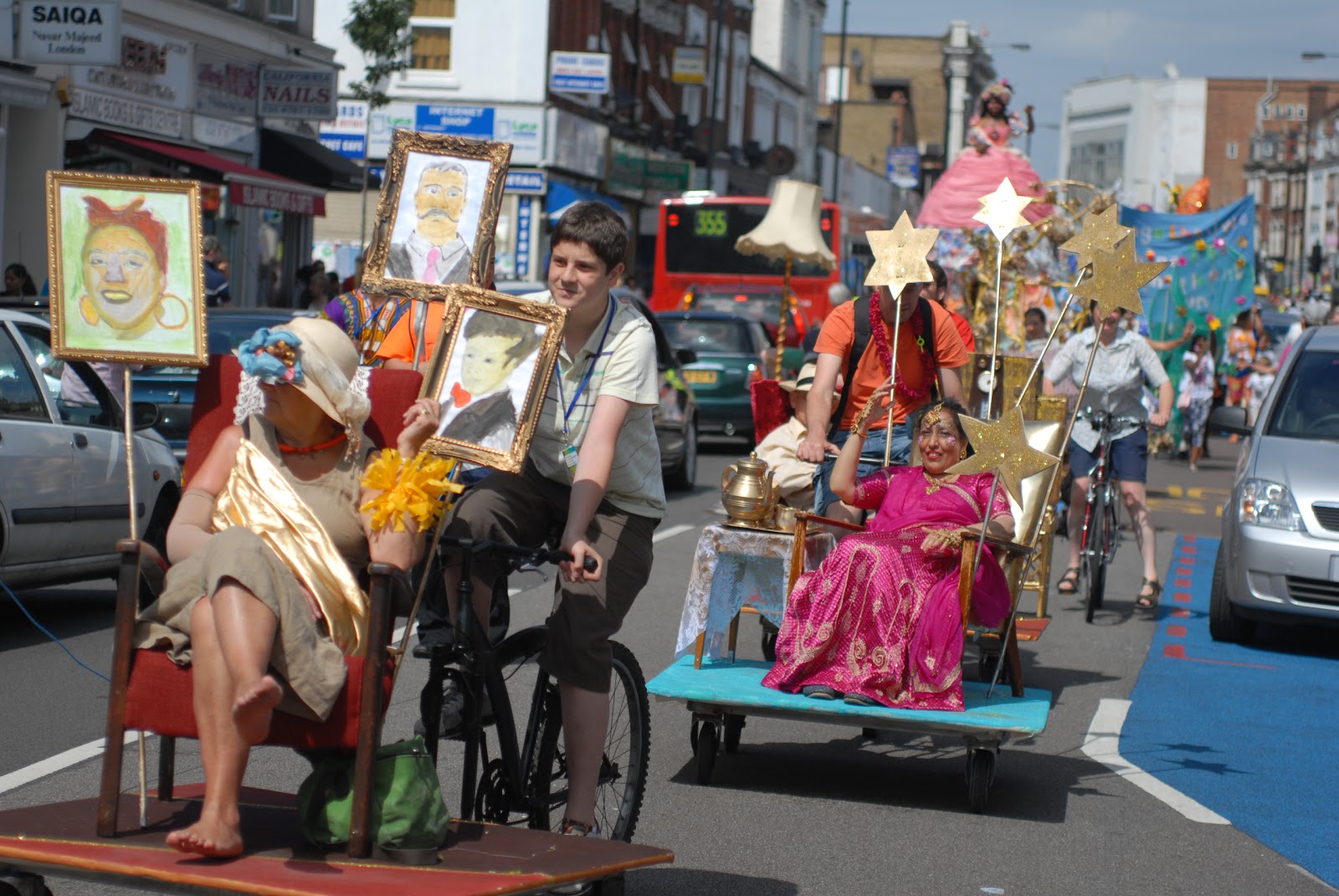
    The Carnival was a vibrant and colourful event that used recycling as a metaphor to build a vision of a low-energy future for Tooting. It aimed to create beauty from rubbish, using story, art, science and celebration to tap into the collective ingenuity of local residents. Characters, sculptures, musical instruments, dance, performance, costumes and floats were all created using discarded materials such as plastic bags, bottles and boxes.

    Produced by Transition Town Tooting in partnership with Phakama and Emergency Exit Arts, the Carnival was one of the most significant community events to take place in the Borough of Wandsworth in 2010 and had the support and participation of numerous schools, community groups and local organisations.
    The community of Port Adelaide in Australia have been so inspired by this event that Transition Town Tooting and Phakama will be working with their local transition, waste, education, arts and environmental groups (by skype, facebook and social media) to connect up the two communities through the ‘Trashcatching’  concept of public celebration. 

    Climate Week is a national occasion that offers an annual renewal of our ambition and confidence to combat climate change. It is supported by every part of society – from the Prime Minister to Paul  McCartney, Vivienne Westwood to Manchester United, the CBI to Girlguiding UK. Its commercial partners are Tesco, Aviva, EDF  Energy, Kellogg’s and RBS.
       
    “We are delighted to have been shortlisted for the Climate Week Best Event Award. The Trashcatchers Carnival was an inspirational project that enabled us to reimagine our relationship with our earth. We want to dedicate this to every single Trashcatchers Carnavalista and to the whole community of Tooting”.
    Fabio Santos. Director of Phakama
    and Lucy Neal. Co-Chair of Transition Town Tooting  
       
    The winner will be selected by a judging panel which includes Lord Nicholas Stern,  Met Office Chief Scientist Julia Slingo, environmentalist Tony Juniper, author Ian McEwan and Arnold Schwarzenegger’s climate  advisor, Terry Tamminen. It will be announced on 21st March at the official Climate Week launch  event at Lancaster House in Central London where the keynote speaker is Chris Huhne MP,  Secretary of State for Energy and Climate Change. 
  • Reducing Greenhouse Gas Emissions

    Have a go at your creating your own plan for the UK to reduce greenhouse gas emissions by 80% by 2050.
    Transition Town Tooting – along with lots of other local groups, businesses and NGOs – were invited to a consultation event last Friday run by DECC where they unveiled The 2050 Pathways Analysis.  Described as ‘an online framework through which to consider some of the choices and trade-offs we will have to make over the next forty years. It is system-wide, covering all parts of the economy and all greenhouse gases emissions released in the UK. It is rooted in scientific and engineering realities, looking at what is thought to be physically and technically possible in each sector.’
    Giles and Hilary shared some interesting, and heated, discussions as we joined groups thrashing out various options for our future.  The tool allows you to test out scenarios relating to energy usage and production whilst seeing the immediate outcome of your actions on a graph of predicted CO2 emissions.  There is also a huge amount of background information provided to all your ‘decisions’ if you take the time to investigate. 
    It’s a very good way of demonstrating how hard it is to balance the books between supply and demand under current modes of exponential growth.  A startling example is that the most ambitious target you can select for future UK flights involves a doubling of current usage.
    It also gives an insight into the areas the government is looking at and into current thinking around possibilities – looking at the parameters used is extraordinarily insightful and gives us clues for where we need to inform the government and policy better
    It was also interesting in exploring areas people are willing to sacrifice to balance the power sheet – every one we saw was completely different.  Some people favoured nuclear over biofuels and others who hated nuclear were willing to sacrifice food growing land in other countries to continue our Western gravy train.
    You can create your own ideal pathway and can debate and compare with scenarios produced by a number of others including organisations as diverse as Friends of the Earth and the National Grid.   The online tool is fascinating to experiment with – if occasionally frustrating – as there are limits on the range of options available to you.  In addition to the assumption of growth we spotted the following, you may find others: 
    • There is no account taken of the carbon footprint of any UK imports as these are not currently included within government targets. 
    • Cost involved in the various options isn’t currently taken into account – some people questioned the bias this gave nuclear despite the infrastructure and decommissioning costs of reactors with only limited active life.
    Perhaps unsurprisingly no account was taken of the long term availability of key raw materials such as oil, gas, coal or those used for generation of nuclear power.  Maybe the recent Announcement by the UK Government of Emergency Plans to wean the UK off Oil will see them factored into a future version!
  • TTT’s Giles star of Sunday Times article

    …. you can spot him up the ladder in the photo…
  • Confronting Change – London Transition at the South Bank Centre

    News from the Confronting Change event at the South Bank Centre last week organised by Transition Finsbury Park.  

    The event was a sell-out, and proved to be an inspirational coming together of London Transition initiatives, under the title “Confronting Change”.  Polly Higgins, a barrister and author of ‘Eradicating Ecocide’ was the host – she recently returned from the COP16 negotiations at Cancun and talked about what had happened there- followed by presentations from Rob Hopkins and Michael Meacher MP.  Read a great write up by Rob Hopkins on his blog here

    There was a fantastic outcome to the evening – Polly Higgins and a team of lawyers already working on a Transition Enabling Act!  Find out more and have your input on the Transition Network site here.
  • Photos from the winter making and social

    We had a fantastic time at the winter making and social – we learnt make pomanders from oranges, juggling balls from socks, wallets from fruit juice cartons, decorations from discarded plastic and cards from scrap paper.  We made a HUGE bowl of mincemeat which found its way into mince pies across Tooting.  Some of us even learnt how to knit.  Here are some lovely pics of the event…

  • Plastic – from Oil Well to Ocean – via Tooting

    This event, organised by Hilary, Sally and Nicola, looked at our relationship with the ubiquitous plastic.  Starting with a look at the multitude of plastic items that one person touches in a single day (from the lining of a swimming pool to a humble biro), we looked at where plastic comes from, how we use (and misuse it!), what happens after we drop it into our Wandsworth bin or recycling bag, and how it ends up in our oceans.
                                                                                                                                       
    We found out that most plastics are sourced from fossil fuels – oil and natural gas and how that cheap source of raw material will be threatened by the onset of peak oil.  We considered how many everyday items are made from oil-based plastic.
    We looked in particular at plastic packaging – our intrepid researcher headed out to take some pictures of particularly bad examples of packaging.  Some items were wrapped in four layers of plastic on their arrival at the store.   She also took a low packaging approach to her takeaway kebab by bringing her own reusable container and cutlery.
    Nicola from Wastewatch – which raises awareness about recycling in local schools – explained the limits of plastic recycling in Wandsworth – being limited to plastic bottles.  She explained the reasons for these limits and told us that the UK lagged behind many other countries in its levels of recycling. 
    We considered where much plastic ends up – with a short TED talk by Captain Charles Moore about plastic in the ocean which you can watch online here.  Another good talk by Diana Cohen of the Plastic Pollution Consortium is here.
    All kinds of initiatives are springing up across the world to address the issue of our overconsumption of plastic.  Following the lead of Modbury which a plastic bag free town in 2007 traders in 80 mainly small towns round Britain have either introduced a voluntary ban or are considering one as a way to reduce landfill.   Ireland banned free plastic bags in 2000 levying a 20p charge per bag.  By 2007 this had raised £109 million in tax and plans were in place to double the levy to 40p per bag.   Governor Arnold Schwartzenegger recently announced a plastic bag ban in the state of California.
    In 2009 a poll of Londoners showed there was 90% support for a levy or ban across the city – although subsequent discussions between CEOs of 33 London councils failed to agree on a ban or tax.
    We found out that 8 billion plastic bags are used in the UK each year – and the lucky winners of our ‘most wasteful packaging’ prize went away with a lovely reuseable silk sack.  One entry was literally a package holding nothing.
    Finally we talked about how we might reduce our wasteage of plastic in Tooting and came up with lots of ideas! 
    •          Refuse, reduce, reuse and recycle – especially the first three!
    •          Make a film about plastic – how its used locally and the global issues – to raise awareness in Tooting
    •          Lobby local businesses and residents for a plastic bag fee Tooting
    •          Research low-cost sustainable take-away packaging which local businesses could use.
    •          Co-ordinate a regular ‘protest’ return of excess packaging to local supermarkets

    If you’d like to get involved in making any of these happen- or have other ideas – get in touch at transitiontowntooting@gmail.com.
    Finally unfortunately we didn’t have time to watch this Futurestates film entitled Plastic Bag – struggling with its immortality, a discarded plastic bag (voiced by Werner Herzog) ventures through the environmentally barren remains of America as it searches for its maker.  Well worth a look!