Author: Transition Town Tooting

  • Local Stories of Sustainability Success – four vivid can-do examples of reducing carbon footprints and increasing wellbeing

    We’re hosting a new free event: Local Stories of Sustainability Success in the afternoon of Saturday 20th October, from 2:00 to 4:00 at the Mushkil Aasaan Hall, 220 Upper Tooting Road SW17 7EW.

    The event will illustrate vivid can-do stories by local people who have reduced their carbon footprints and increased their wellbeing 

    Martin, Susan, Tanya & Dermot – clockwise from top left
    • Martin Cobley and several hundred worms will demonstrate why he is the borough guru for how worm composting
    • Susan Venner will share the steps to make a 19th century family house in Balham warm and cosy, emphasising how to tackle the high-impact things first. More detail on Susan’s experience on the Superhome Database at https://tinyurl.com/y94mqnsb
    • Dermot Jones will share his experience of switching to an electric vehicle. Dermot also tweets as @ElecticVanMan about the story of his first 4000 miles – and the myths and memes
    • Tanya de Afonseca will share her own experience of reducing (refusing?) household plastics. Tanya’s BYO Zero Waste Shop is in Tooting Market https://byo.london/
    We’ll discuss these inspiring examples of what can be done, share ideas, be energised, make some new resolutions & links.
    For the ‘Local Stories’ flyer, please click here.

    The session is designed for anyone who is interested in these lively local stories. You do not need to be an expert!
    Please share with friends and colleagues who you think would appreciate the event.
    Bring the family! We’ll have a crafts table alongside for some making.

    Thanks to the Zero Waste Shop for sharing this diagram of five core elements of zero waste.

    We’ll also introduce the next run of Carbon Conversations starting on Thursday November 1st. For details, click here. Please encourage friends to join in with this 13th series!

  • TTT’s new series of practical & participative local ‘Carbon Conversations’ is running in November & December – you’re invited to take part!

    Carbon Conversations is back! Our new series of six free meetings in November & December in SW16 – organised by TTT’s Ben Cuddon. 

    The facilitated workshops enable individuals to explore the areas of our lives where we can reduce our own carbon emissions: travel, food, domestic energy, consumption and waste.

    A quote from a past participant:  
    “The beauty of Carbon Conversations is the 
    optimism, creativity and shared ideas” 

    During the six weekly sessions you’ll discuss in a supportive atmosphere all the practicalities of making your own ‘low-carbon lifestyle’ changes. Making these changes is never one size fits all. 

    Exploring your own situation, start point and preferences is so valuable and makes the series personal and practical. 

    The meetings are well structured with a mix of games, conversation, debate, activities and exercises.

    Click here for the flyer and here are the summary details:
    Venue: in SW16 between Mitcham Lane & Streatham Common Station 
    Timings: all meetings run from 7:00 pm to 9:00 pm 
    Dates: six Thursdays from Nov 1st to Dec 6th, once a week
    Free: there is no fee to take part. The only cost is currently £14 for the workbook and learning materials, which TTT charges at cost. Sessions are led for free by TTT’s trained Carbon Conversations facilitators. 
    To join or ask any questions: contact Ben Cuddon by email here or TTT by mail here

    TTT has run over 12 series of Carbon Conversations since 2011. 
    On average participants are able to identfy how to reduce their own carbon footprints by a third – by over 4 tonnes of carbon.
    Wait a minute! 
    What does ‘four tonnes of carbon’ mean? 
    You may already be worried about shorthand & jargon. The way we facilitate the meetings means that you do not need to be an expert
    Although it’s a complex subject, we guarantee that by the end of the sessions you will learn useful new language and concepts and understand the practical elements of household carbon reduction.

    This series is a great place to start if you want to reduce your carbon footprint, meet some friendly and like-minded people and explore the topic as it affects you, rather than being lectured at!

    As a participant said: 

    “At the last session I don’t think anybody wanted to leave!”

     Join us to find out how to reduce heat loss from your home!
  • Reduce Waste in Tooting at our fixing and mending workshop!

    There’s been lots of interest in reducing waste packaging in Tooting in recent months, whether its the new Plastic Free Tooting group on Facebook or BYO the new zero waste shop in Tooting Market. So we’re delighted to be welcoming back our fixing and mending workshop which focuses on reducing electrical and electronic waste, and helping us mend and alter our clothes and household fabrics to extend their life.

    So whether it’s electrical or electronic items that you don’t want to throw away or a sewing machine that is broken or you’re not sure how to us or maybe you have have a favourite piece of clothing that needs mending or altering and you’d like to learn how?

    You might even fancy learning how to upholster a chair in an afternoon?  Or are you simply good at fixing and mending stuff (we’re looking for people to join our growing team of volunteers!)

    Maybe you fancy a cup of tea, a piece of cake and a chance to find out more about Transition Tooting and what we get up to?

    If so come along on to Mushkil Aasaan, 220 – 222 Upper Tooting Road, SW17 7EW (next to Nando’s) on either …

    13th October 12.00 – 15.00 or 
    8th December 13.30 – 16.30


    Restart Parties are a community self-repair space where you take responsibility for your own gadgets and data, so please don’t forget to take any back-ups beforehand, if relevant – and if possible arrive during the first two hours to allow time for fixing!   More info about Restart including details of regular skillshares at www.therestartproject.org

  • Tooting Speaks! The big dilemmas of local food

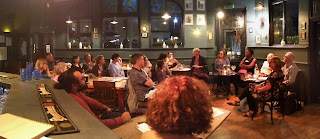
    30 passionate Tooting folk came to The Selkirk (thanks so much Ben and the team!) on Wednesday night to join our 4 fantastic speakers, Kemi Akinola, Robert Biel, Robyn Knight and Sue Sheehan, in wrestling with the big dilemmas of sustainable food systems and what we can do locally. Our title was “Local Food is an Expensive Luxury” and the discussion was hosted by TTT’s co-founder Lucy Neal. If you’re interested in these gatherings, they’re part of our monthly Green Drinks at The Selkirk on the third Wednesday of every month, details HERE.
    Local Food is an Expensive Luxury

    But what was it that contextualised food as “local”? Our first speaker, Sue Sheehan (Incredible Edible Lambeth) opened the account with the hyper local – food grown by you as being an active form of protest – claiming the land and building personal resilience for healthy, home grown, cheap veg and against the power of advertising and convenience, after all, gardening is the most “therapeutic and defiant act as you can do” according to the ultimate Guerrilla Gardener, Ron Finley, watch THIS and “plant some shit”. Switch to our second speaker, Dr Robert Biel, Senior lecturer at University College London and author of Sustainable Food Systems – the role of the city and we learn as recently as 1985, with population at 56 million, the UK produced 95% of its food from within its shores… a poignant and powerful statistic, particularly given the risk of a no deal Brexit and the threat that presents of us not being able to feed ourselves, which you can read more about in a recent article by Jay Rayner HERE.

    Read on for LOADS more…

    Zooming up a level, local food systems were championed as methods for plugging the leaky bucket of global finance – keep money circulating more locally through fresh fruit and veg and prepare food, cooked with love and shared in local eateries. Our third speaker, Robyn Knight joined us from Sutton Community Farm who supply 250 vegboxes to customers spread from Kingston to Greenwich. The Farm emphasises the social and environmental benefits of growing by engaging 1500 volunteers who benefit from exercise and socialising for increased wellbeing.

    which brings us to our first major dilemma… MEASUREMENT AND  NARRATIVE.
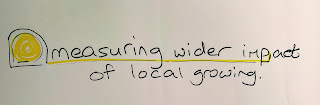

    Measuring impact in terms of monetary value alone compromises our ability to paint a more accurate picture of the role food plays in the beautiful complexity of life. And yet we’re required to do that to “make ends meet”, to be a “sustainable” business, to apply for and report back on funds. But how do we report back on the surrounding benefits, the positive impact on the wider community or even relieving pressure on the NHS through healthier, more active communities? Thinking beyond money, the language and metaphors become important, they can either “deliver us hope or foreclose possibility“, according to Robert Macfarlane, I’d much rather be opening the doors of possibility when ti comes to the future of food. The expense we talk about in the title of the debate could refer to the perceived prohibitively expensive farmers market produce, or could be juxtaposed next to the abundance of a well run allotment, garden, community garden or balcony, all requiring very little financial input, but a huge amount of time and love.
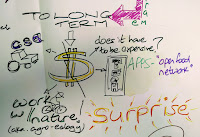
    Back to the debate and Robert Biel went on to talk about luxury as short, sweet, quick hits designed to make us want more. Can luxury be re-framed as being long term and slow, with richer, deeper rewards going beyond $£$money as the only factor in our food choices? Can Community Supported Agriculture schemes and online services such as  Open Food Network transform our food growing systems (maybe a truly long and slow project)? Can we learn to embrace “surprise” gardening – working with natural systems, in all their mess and chaos (from a human point of view) to produce abundance? Agro-forestry, permaculture and agro-ecology come to mind. Plenty to connect with in terms of your practice of growing food and which systems you may want to invest in for the weekly shop.

    This is all very well, but I was hugely grateful for the grounded view given by our fourth Speaker Kemi Akinola, founder of Be-Enriched and local Councillor (although she made clear the views she expressed were for the benefit of debate, the Devil’s Advocate had entered the room) and Co-Chair of both Lambeth food Partnership and Wandsworth food Partnership… Kemi gave a massive high five to Supermarkets, the way perhaps most of us shop for our food, for supplying consistently cheap, accessible food of huge variety and, in terms of the pressure on space in the urban landscape, super efficient. One shop does the lot. You can read more about the global food system HERE.

    Which brought us to our second major dilemma – LAND.


    For more on Land, check out Shared Assets


    In London particularly, land is seen as a driver for the housing crisis, and housing dominates conversation about land use in Town Halls across the Capital. Compare the use of land for food production against the use of land for a high density housing and you can see how challenging it is to fight for community gardens or inner city farms, in the context of the current capitalist regime. You only need to look across the Atlantic to see the effect of plummeting land value on opening up the possibilities for space use, let alone addressing urban food deserts which affect 26.5 million Americans, a staggering stat. Places like Chicago and Detroit, Michigan being recent examples of urban community farms re-valuing space for community benefit, addressing urban inequality and giving access to healthy food, community connection and exercise.

    Back to London and the definition of local that ran throughout the conversation. Scale became important, thinking about the productivity of local growing and the value of peri-urban agriculture. Imagine if it was the norm that we knew exactly where the food we bought was grown and that place was just down the road? However, its not just about local food being grown close to us. Knowing more about the food we eat is key in our decision making as food consumers. Ethical and sustainable choices are hard to make and often are a challengeable viewpoint at best. Would you support small local businesses over a globalised meat-free diet? How would you decide between packaging free and high provenance food choices? The Supermarkets may work to a globalised, season-less standard, but at least most food products are fully labelled as to where the food originates, empowering the consumer to make an informed choice. Audience member Jenny Teasdale even cited that lamb from New Zealand had a smaller carbon footprint than lamb raised in the UK, there’s an interesting article HERE outlining some of the research supporting this argument, I’d heard the same about apples (ah yes, the year round crop… fresh breaburns in January anyone?).

    Back to Tooting…  and we have just organised our 11th Annual Foodival, a celebration of what we can grow, cook and eat locally. David Thorne, one of the team of 5 who co-organise the event this year, reflected that this fundamental message behind Foodival was difficult to make stick with many of the 600 folks who attend. That’s not to belittle this fantastic event that brings all the communities of Tooting together in a spirit of celebration and food. Maybe some are just after a cheap plate of nosh.

    Which brings us to our third dilemma… CHEAP AND ACCESSIBLE VS “LOCAL” AND “SUSTAINABLE”

    This maybe a red herring and certainly harks back to Kemi’s point about Supermarkets. It wasn’t that long ago that Lidl and Aldi came over, offering substantially cheaper brands that we didn’t recognise and wonderfully random offers down at Lidl-de-Aldi-Lidl-Aldi-Lidl-de-Aldi dee. The reality of a lot of people’s lives right now is that the shopping needs to be quick, accessible, cheap. There are bellies to feed, demanding jobs to work and, some might say, equality to reach.

    But does local and sustainable need to be expensive and inaccessible?

    Our biggest dilemma of the night had entered the room… HOW DO YOU (S)MASH THE SYSTEM?

    We’d talked a lot about being active, one of NEF’s 5 ways of wellbeing, and most of the room had in

    some way taught or shared the joy of growing food with others. We’d talked about the multitude of benefits community gardening and local growing gives and the idea of communicating that, when measurement is challenging. And we’d shared another Foodival story of family food culture being expressed in a Top Tooting Cook entry using locally grown ingredients to make an award winning Indian dish – a true Tooting cultural mash-up. You could feel this sense of wanting to smash the silos and create a systemic shift towards true value beyond monetary cost, critically based in reality and meaningful for all.

    Finally, lets unpack that word “value”. Perhaps this word pushes against the “luxury” of our title, encouraging us to think more in the longer term using regenerative, circular practices rather than linear, wasteful ones. Value as regenerative refers to the social, economic and environmental – we heard about the value of social interaction at Sutton Community Farm, mirrored at Community Farms and gardens across the Capital and beyond. We heard about the value of exercise and connection to nature, so powerful some Doctors prescribe it for to aid Patient recovery. We heard about the value of organic food practices for the Earth, re-building soil layers so depleted by intensive, industrial scale agriculture (we are literally running out of soil, some would argue). Finally, we heard about the value of local food and the systems that support it – farms, shops and customers – meaning that money becomes a bit more sticky to neighbourhoods, providing more opportunity to stabilise local economies.
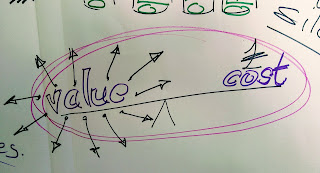
    And perhaps that’s the challenge at the heart of the debate, for us all to enact change based on the wider value of food for us, our Communities, and our future food systems. Kemi, Sue, Robyn and Robert were asked for their call to action and here’s what they said…

    Take responsibility in your choices, be informed and be active.
    Simply eat more vegetables than you do now.
    How are you spending your money? Spend it a bit more on food and bit less on stuff.
    Where are the growing spaces? Get involved in creating and supporting more.
    Work on the beautiful complexity by linking up social and environmental practice through projects.
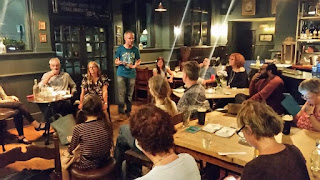
    Thanks for coming, folks!

    And finally… here’s some additional resources passed on from Robyn and Kemi:

    The Landworkers Alliance
    Community Food Growers Network
    Capital Growth
    Greenwich Community Development Agency

    Kemi can be found on Twitter here @BeeKemiA
    Sue can be found on Twitter here @GreenCChampion

    “I’d never seen a ready meal until I came from Austria to live in England in 2000”

  • Thank You Everyone at Foodival 2018!

    It takes many people to make Tooting Foodival happen.  

    Here’s a short thank-you to (hopefully) most of you!

    GROWERS

    Without your generous contributions of locally grown producewe would not have been feasting!
    • Charles & Lesley, Foulser Rd – tarragon & bay leaves 
    • Elisabetta, Dahomey Rd – Tuscan kale, cima di rapa, marrow, leeks, chard, pumpkin
    • Jane, Furzedown – rhubarb, squash
    • Tamworth Farm Allotment growers – marrows, squashes, cucumbers, peppers
    • David & Mal, Ramsden Rd – radishes, grapes, tomatoes, runner beans, kohl rabi
    • Kath, Khartoum Rd – beetroot, carrots, courgette
    • Susan, Cornford Grove – grapes
    • Michael, Ullathorne Rd – grapes, courgettes
    • Hilary, Tooting – plums
    • Tooting Community Garden, North Drive – blackberries, greengages, garlic, Picasso & Maris Piper potatoes, pumpkins
    • Rachel, Tooting Bec Rd – courgettes, cucumbers, tomatoes, mini aubergines, chillis, peppers
    • Richard, Upper Tooting Park – mint, rosemary, beetroot, courgettes, tomatoes, curly kale
    • Chuck, Cornford Grove – sprouting microgreens
    • Debbie, Furzedown – pumpkin, runner beans, cucamelons, squash, courgettes, apples
    • Egle, Derinton Rd – pea shoots, mustard greens
    • Susie, Earlsfield – carrots, yellow courgette, potatoes, tomatoes, runner beans, rosemary, sage
    • Belinda, Beechcroft Rd – flowers, marrows
    • Poppy & Teo, Streatham – patty pan & butternut squash
    • Al, Tamworth Farm – snake gourds, squashes & marrows
    • Sue, Furzedown – butternut squash, pumpkin, courgette, green leaves 
    • Ollie, Clapham Junction – squash
    • plus…Abel & Cole donated several boxes of organic vegetables when we were concerned that the summer’s drought would limit the amount that community growers could spare us. Thank you so much!

    CHEFS
    Volker Nissen of Essential Ingredient for co-ordinating the cooking on Saturday with three notable local chefs: Manisha from Pooja Sweets, Rick Gibbs of Rick’s Tooting & Elisabetta Costantini from Minestra Supper Club.

    COMMUNITY PARTNERS 
    Mushkil Aasaan – A special thank you to Project Director Naseem Aboobaker who has been a rock-solid friend and partner to us throughout the last 10 years. Letting us use their space and land for free has allowed us to run projects such as the Tooting Community Garden, eleven Foodivals and countless meetings at Mushkil Aasaan Hall over many years. 

    Thanks to Sarah and Deborah at Share Nurseries who have supplied plants to for our pop-up raised beds and to Beata and family who ran the Think Outside stall showcasing their outdoor learning workshops in schools. 

    PHOTOGRAPHY
    Thank you so much to photographers Bryony Williams – findmeintooting, Franco Ruarte and Riccardo Sai.  Click the links to see their amazing work.

    LOGISTICS

    • Brian Joseph for his generous gift of electricity, water and lending us his forecourt. 
    • St Anselm’s Primary School for gazebos
    • Gatton Primary School for tables. 
    • Work & Play Scrapstore for various making materials
    • Volker Nissen for all the catering equipment 
    • Miss U Stationers for giving us top rates on all our printing
    • Al-Mirage Restaurant for letting us use their ovens 
    • The Phantom Knitter of Old Tooting Town for knitting the Foodival banner

    MUSIC
    Dermot Jones for curating a splendid “Meltdown” ably helped by Mark on the mixing desk.  All our brilliant artists:
    Vincent Burke, Tai Li Ling, Babar Luck, Slim Estrada & Ingrid, The Troubadours de l’Avenue Verte, Emma And The Hot Tub Men and the Unconfirmed. & Ranjit for the dhol!

    MEDIA
    Rachel Husband for taking Foodival onto Instagram and Tooting PRSS for giving us publicity throughout the year.  Everyone who have tweeted/liked and mentioned us in various posts.

    TOP TOOTING COOK
    TTC local Prize donors: Abel & Cole, Al- Mirage, Deelicious Nazish’s Kitchen,Meat & Shake, Nando’s, Unwined, Walker Wyatt Cafe, Bring Your Own Zero Waste Shop.
    TTC Judges: Brian Albuquerque, Lillie Langford, Nazish Omar and Rick Gibbs.
    All cooks taking part in the TTC

    STALLHOLDERS
    Field and Flower,  Richard Glassborow and 15,000 honey bees, Debbie Morey – Good sorts, Jane Haskings, LSx – Abshir Weli and Charlotte Hawthorne 

    VOLUNTEERS

    • Ben and Sharon – sustainability games and fun 
    • Eleanor and Richard – waste management 
    • Barbara and Emily – choppers (and furniture-moving, Emily) 
    • Esther and Hilary – manning tables 
    • Jenny and Caty for taking your money! 
    • Christine for wool-spinning 
    • Rosalind & Resina for hard work at the welcome table, and selling plants 
    • Leon for fetching and carrying at the clear up 
    • Eleanor for looking after cash donation buckets 
    • Millie & Lewis for helping out with the food.
    • Ranjit & Mita for helping clear up. 

    All the Foodival visitors who helped create an enjoyable atmosphere on the day and many of you who helped us tidy up after and take rubbish away. Everyone who very kindly put money into the donation buckets – we need this to make the next Foodival happen so thank you to you all. 
    The residents of Hereward Road – thank you for putting up with us again. 
    Tim and the Metropolitan Police team who joined us.

    With big love from the Organisers:
    Chuck, Volker, Belinda, David and Mal 

    With your help, see you at Foodival 2019!
  • Tooting Foodival 2018: Congratulations to this year’s Top Tooting Cook competition winners!

    Thank you so much to the competition entrants, the judges and to the local enterprises who donated prizes for each class in the ‘Top Tooting Cook’ competition.
    We had fabulous entries made with love and delicious fresh local ingredients…all adding up to good tasting and decision-making challenges for our panel of judges. The panel judged several classes as well as the overall ‘Top Tooting Cook’.
    Thanks loads to Bryony Williams for her beautiful photos in this post.

    Overall ‘Top Tooting Cook’ Winner: 
    Norah Jane Brasington – not only for taste and look of all her entries to three categories, but also for her exceptional use of locally sourced fruit and veg, eggs and honey. 
    Her choices symbolised the fundamental reasons of this festival which are encouraging the community to consider sustainable living by Growing Local and reducing the air miles our food travels –  thereby reducing carbon emissions.
    A fabulous example of a community action response to addressing climate change!
    Winner in the Savoury Class:

    Farhana Wahab who made delicious Spinach and potato burgers from locally grown vegetables. The judges commented that ‘they are amazing and have great texture’.

    Winner in the Dessert Class:
    Rachel Crosby who made a blackberry and mint cake using locally grown fruit and mint. The judges were impressed especially by her beautiful presentation.

    Winner in the Apples and Pears Class:
    Norah Jane Brasington for her “beautifully moist” gluten-free apple and honey cake from locally sourced apples, eggs and honey! 

    Winner in the Jams and Pickles Class:

    Debbie Morey of Good Sorts won with her “delicious” Damson Jam with fruit sourced from a local allotment.

    Special Commendation to ‘Baked Bean Boy’ for his hot kale and tomato salsa with “great heat”, all ingredients sourced from donations to Foodival 2018. 
    The judges cogitate!
    The audience enjoying a taste of the entries
    Why not enter ‘TTC’ next year in Foodival 2019!
    Yum!
  • Inviting you to our series of free local events this autumn exploring sustainability in Tooting!

    We’re thrilled with the fun and buzz at the Tooting Foodival last Saturday! Thanks to all who contributed their time, equipment, skills and produce to make it a success (see the I Grew This 2018 blog post).  Over 600 people took part on a sunny Tooting afternoon!
    Much more to share about it soon on this blog.

    The Tooting Foodival was the first in a series of free local events this autumn, all about exploring, influencing and creating sustainability in Tooting, together.

    All invited to all of them!

    Click here for a copy of the flyer.

    The next event is a Tooting Debate on Weds 19th Sept:

    ‘Local Food is an Expensive Luxury’.

    Yes, we know…..that’s intended to be provocative after the success of the community Foodival based on locally-grown food, local cooking and local eating together. 
    Come along and share what you think! Details to come here on the blog.
    The debate is on Weds 19th Sept from 7:00 pm – 10:00 pm at The Selkirk Pub, SW17 0ES

    We’ll promote and share details of all the other events in good time.

  • I Grew This 2018

    Yesterday was another memorable one in the Tooting Foodival annals.  Full reports with myriad pictures will be posted on our blogas in the coming days but firstly thank you to our fabulous growers who donated home grown fruit and vegetables.  Without you the event is not possible.
    We give you I Grew This 2018!

  • Whats on at Foodival 2018!

    https://drive.google.com/open?id=1rDwZIXGjTY85FMQpz0PlmM3iu6FxTAU2
    Running Order 2018

    Foodival 2018 started this evening with the produce drop-off at Mushkil Aasaan. Left is the running order for the event including all the food, Top Tooting Cook and music timings.  Click through for the pdf.


    You can also drop off produce  between 10:00 & 11:00 on Saturday, in time to have what you have grown included in the chefs’ cooking.

    We look forward to seeing you for the main event tomorrow from 11am until 5pm in Hereward Rd and Mushkil Aasaan HERE

    Meanwhile … anything left in the garden, window box or allotment?  Here are five crops I harvested just now!

  • Who’s Playing Music at This Year’s Foodival?

    The Dermot Jones Meltdown showcases a variety of local musical talent at this year’s Foodival, including Dermot himself and some artists so secret we cannot yet name them here!  Here is a taster of some of this year’s acts.
     

    Dermot Jones

    Armed with six steel strings, a larynx, and a love of music stretching back to the 1930’s – a little before he was born – Dermot will entertain you with his own original songs mixed in with off-the-wall covers and instrumentals from the worlds of Soul, Pop, Blues, Country, Folk, Jazz, Rock – but not JazzRock, sorry – Spanish, and Ragtime @DermotTJones

    The Troubadours de l’Avenue Verte

    The Troubadours de l’Avenue Verte, Jawadi Darabuka, Bain Stringy Thing, Longpela Pick and Blow are Lido regulars going out to play with a mix of of Irish, Disco, Rhythm and Blues. Just back from their European tour, where they eschewed a tour bus for three bicycles. 

    Tai Li Ling

    Tai Li Ling is a ukulele/guitar-playing Scouser specialising in Folk and Blues songs about her experiences living in the Big Smoke – when not in her day job at St George’s University.www.taililing.com Soundcloud


    Slim Estrada

    Slim Estrada, deep south bluesman and Foodival veteran will be making his way out of the alligator-infested swamps (of Ealing) to join us again this year. We don’t know if Pablo X and Washboard Bob will be joining him! www.slim-estrada.com

    Emma and the Hot Tub Men play an eclectic mixture of original blues and traditional folk songs, with the odd French cover thrown in. Emma has a beautiful, original voice with a wide range and a soulful, yet ethereal tone. https://soundcloud.com/emma-and-the-hot-tub-menhttps://www.facebook.com/emmaandthehottubmen 

    Vincent Burke

    Vincent Burke recently discovered the fresh air and long walks of Summer Festivals playing Latitude Festival; some of the set went out on BBC6 Music and BBC Radio 3. He is well behaved, pet-friendly and occasionally entertaining. His music is melodic and not stupid, and now contains the added ingredients of double-bass and percussion.  http://www.vincentburke.co.uk

    There will also be acoustic songs and edutainment from a mystery special guest. 100% British culture from a world citizen… expect everything from kawalee to punk via country ballad and beatbox. 

    More information will be added to this post as we receive it … The Meltdown has secrets you know!